
The first time I took my phone and truck keys out on Herrington Lake in a zipper bag, I learned a quick lesson about kayak water. It does not take a wave over the bow. A little splash off the paddle, a wet hand, and a bag sitting in the low spot of a sit-on-top kayak will do it. I have been paddling a 10-foot sit-on-top fishing kayak for about six years now, mostly on Herrington Lake and a few slow creeks and farm ponds around Danville, and I have tried the grocery sack, the hard box, and the little zipper pouch. What finally made sense for me was an Earth Pak roll-top dry bag, the 20 liter size, with the phone case that comes with it. It is simple, it closes with a roll and a snap, and it does not ask me to trust a zipper with my truck keys.
Here is the problem with most kayak storage. A hard dry box is fine if you have a flat spot and do not mind the weight, but it takes up room between your legs and the lid gasket wants a clean surface every time. A zipper bag works until the zipper gets grit in it. A grocery sack is not a plan. The Earth Pak bag is a sack you roll closed at the top, so there is no zipper track to fail, and the 500D PVC shell takes a scrape against the kayak without turning into a torn mess. The bag is not a submarine. It is a dry bag for splash, rain, and the occasional dunk at the launch, which is exactly the water I paddle.
Pack the 20L Earth Pak bag once and stop worrying about the splash
The roll-top seal and the included IPX8 phone case cover the two things I most want dry: my phone and my truck keys. The 20 liter size fits a day on calm water without turning into a suitcase.
Amazon Check Today's Price on Amazon →The Five Steps I Use at the Truck and on the Water
Step 1: Pack for the wet, not for the maybe
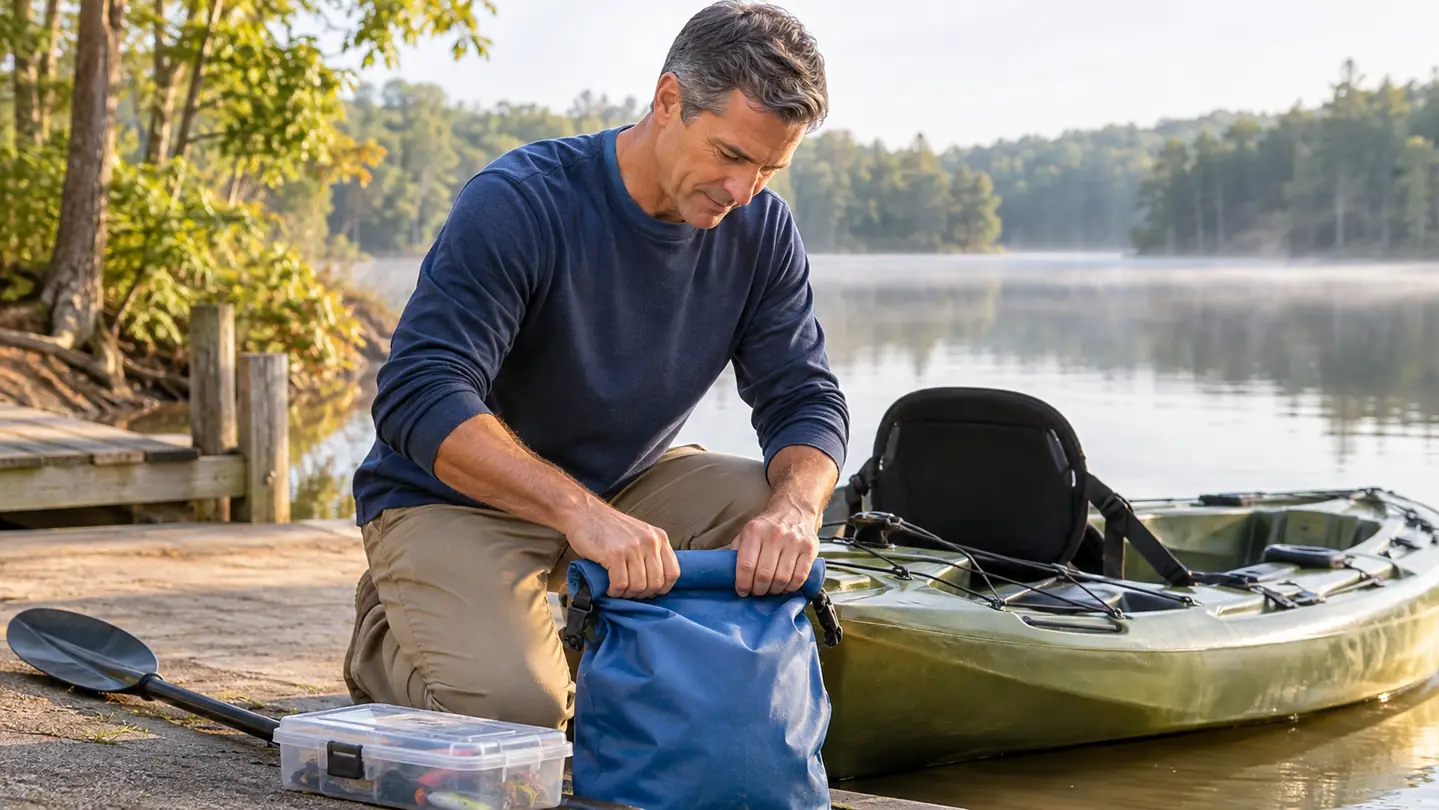
I pack at the tailgate of my silver pickup, with the kayak already in the bed and the bed extender holding the back end. The 20 liter Earth Pak bag is about 17 inches tall and 9.5 inches wide, and it weighs 13.6 ounces empty. That size fits a day of calm-water paddling for me. In goes the phone, already inside the included IPX8 waterproof case. In goes the truck key, a small towel, a light long-sleeve shirt, a cap, a water bottle, and a sandwich wrapped in paper. The outside utility pocket holds my lip balm and a little bottle of sunscreen. I do not pack for a what-if trip to the ocean. I pack for Herrington Lake in July.
One thing I learned the hard way: do not fill the bag to the top and then try to roll it. A roll-top bag needs some empty space at the neck. If the bag is stuffed like a feed sack, the top will not fold over cleanly, and you will be tempted to leave it half sealed. I leave about four inches of room below the top. That is not a measurement I read in a manual. It is what works when I am kneeling in the truck bed with Biscuit sniffing at my tackle box.
The first July I owned the bag I ignored my own rule. I had a rain jacket, two water bottles, a full lunch, and a sweatshirt in there, because the morning started at 58 degrees and I figured I might want the sweatshirt later. The bag stood up in the kayak like a barrel. I got one roll and a snap that would not hold, told myself it was close enough, and pushed off anyway. By ten o'clock the sweatshirt had wicked water up off the bottom of the bag and my sandwich paper was limp. Nothing electronic got wet that day, but I spent six hours irritated at myself. Now the sweatshirt stays in the truck. If the air warms up, I never needed it. If it does not warm up, I cut the paddle short and go home.
Step 2: Separate the wet from the dry inside the bag
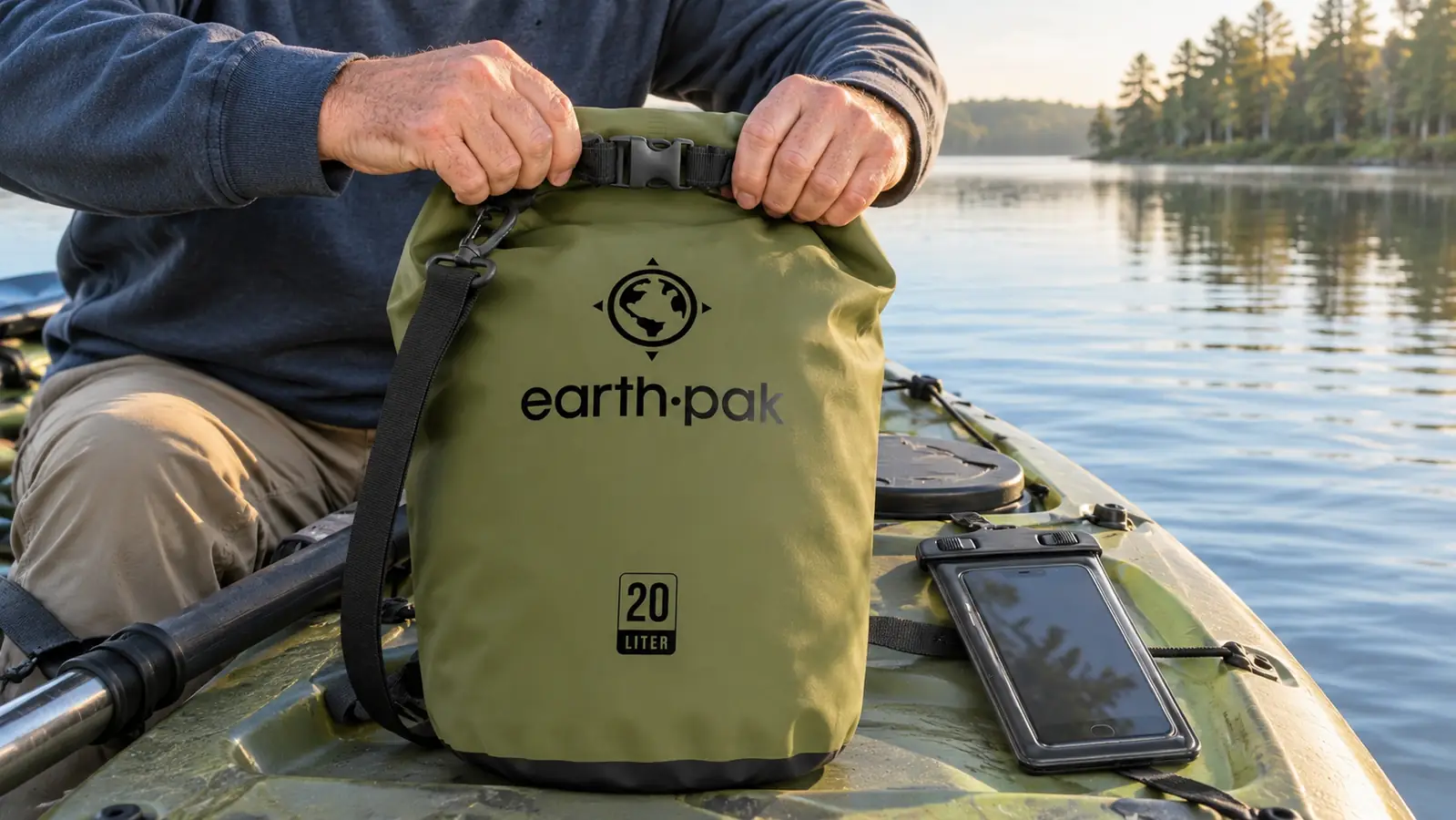
Dry bags do not organize themselves. I put the phone case and the truck key in first, down at the bottom, because those are the two items I cannot replace on the water. The towel goes in a small mesh bag. The sandwich goes in a paper sack. If my paddle leash or a wet anchor line has to come aboard, it stays outside the bag or in the utility pocket, never in the main compartment with the phone. That one habit has saved me more grief than any piece of gear.
On a calm day I sometimes carry the bag by the adjustable shoulder strap, which on the 20 liter size adjusts from 24 to 42 inches. At the truck I set the strap short and carry it by the web handle. On the water the strap goes around the seat frame so the bag cannot slide into the footwell when I shift my weight. I have a stiff lower back and sore shoulders after a long paddle, so I do not want to twist around and fish for a bag behind me. I want it where my hand falls.
Step 3: Roll the top like you mean it
This is the step people rush. I lay the bag on the truck tailgate or across my lap, press the air out with the flat of my hand, and fold the top over in three tight rolls. Then I snap the closure. The snap is the check. If the top does not want to stay rolled, I open it back up, take something out, and try again. A roll-top bag that is rolled once and snapped is not sealed. It is just folded.
For two seasons I thought two rolls was plenty. Then one afternoon on a slow creek south of Danville I came around a bend and a low branch knocked my paddle blade into the water, which threw a sheet of water across the deck and over the bag. When I opened it at the ramp, the bottom inch of the main compartment was damp. Not flooded. Damp. The towel had soaked it up and the phone case had done its job, so nothing was ruined, but I could see the water had worked in through a fold that was not tight. Three rolls and a snap that actually holds have kept that from happening again.
I also check the phone case before it goes in. I look at the closure, wipe off any grit, and close it in the light where I can see what I am doing. Then it goes into the bag. That sounds fussy. It takes about twenty seconds. A wet phone at the launch ramp takes a lot longer to sort out.
Step 4: Strap it down where it will not slide
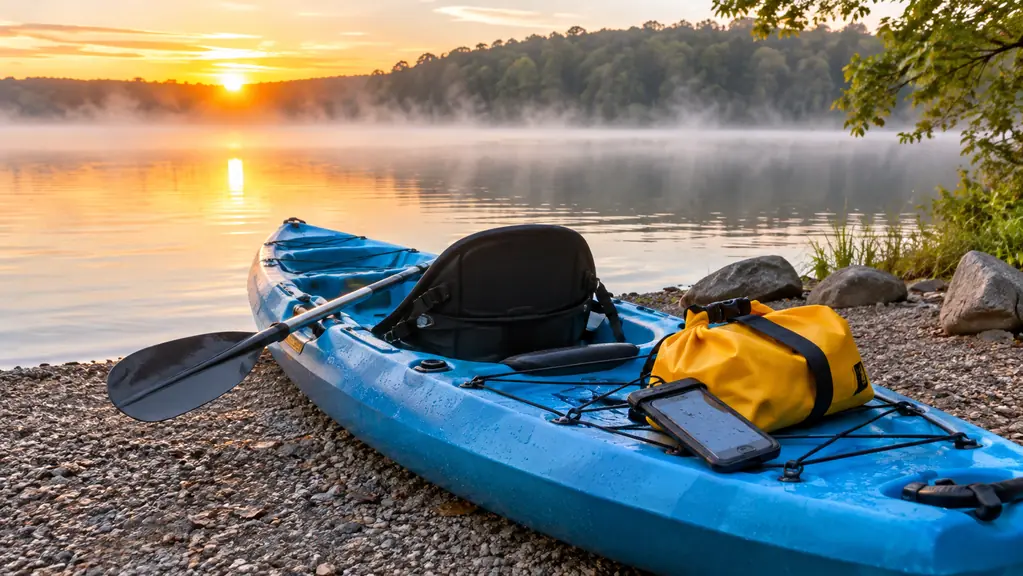
On my sit-on-top kayak there is a low spot between my legs and the seat. That is where a dry bag wants to sit, and that is exactly where it will slide when I lean to net a fish. I run the shoulder strap around the seat frame and pull it snug. I do not tie it so tight that I cannot get it loose with wet hands. The web handle gives me a second grab point when I lift the bag out at the ramp.
If Earl comes along in the borrowed kayak, he packs his own bag and straps it the same way. He is 64 and does not like a lot of fuss. His rule is one bag, one strap, nothing loose in the cockpit. I have adopted it. A dry bag that is rolling around under your knees is not keeping anything dry. It is just a thing to trip over when you stand up.
I learned the strap lesson on a windy afternoon in October, the kind where the lake goes from glass to chop in about an hour. I had the bag sitting loose in the footwell. Every time the kayak rocked, the bag rocked with it, and by the time I turned into the wind my lunch had slid forward under my knees and the phone case was pinned underneath it. Nothing broke. But I spent ten minutes in a chop with one hand on the paddle and one hand trying to free a bag, which is not a smart way to spend any afternoon. Now the strap goes around the seat frame before I leave the ramp, every single trip, calm water or not.
At the launch I set the bag behind the seat while I push off. Once I am clear of the gravel, I pull it forward and snug the strap. That keeps me from fighting it in ankle-deep water with the kayak trying to turn.
Step 5: Repack the same way at every stop
The temptations come at the stops. You pull into a creek bank for lunch, you open the bag, you set the phone on a log, and then you pack it back in a hurry. I go through the same order every time. Phone in the case first. Case in the bag. Bag rolled three times and snapped. Strap around the seat frame. It is not exciting, but it is the reason my phone still works.
Rain is the other test. A roll-top bag sheds rain well, but the outside utility pocket is not where I put anything that cannot take a little water. The pocket is for lip balm, a snack, or a fishing license in a zip pouch. The main compartment is for the dry stuff. I also keep the bag off the floor of the kayak when I can. Standing water in the low spot will find a seam before a splash will.
At the end of the day I empty the bag, wipe the inside with a dry cloth, and leave it open in the garage to air out. The 500D PVC does not need a lot of care, but it does not need to sit rolled up wet, either. I hang it by the web handle from a nail in the garage and forget about it until the next Saturday.
What Else Helps
A dry bag is one part of a dry day. I keep a paddle leash on my paddle so it does not swim away while I am messing with the bag. I wear a PFD every time, even on a farm pond. I put a small float on my kayak keys. I leave the hard dry box at home unless I am carrying something that needs a rigid shell, because the bag does more for less room. And I check the weather before I leave Danville. A calm morning on Herrington Lake can turn into a windy afternoon, and wind pushes water over the bow of a sit-on-top.
I also keep a dry towel in the truck, not in the bag. That is the towel I use on my hands and face at the ramp. The towel in the bag is for the phone and the lunch. Keeping those two jobs separate means I am not opening the dry bag with wet hands just to dry my hands. Small thing. It works.
There is also the matter of what not to bring. I stopped carrying a second dry bag full of maybes. One bag, packed for the day, is lighter in the boat and easier to keep track of. When I am fishing, the tackle goes in a small box that stays back in the tank well, never in the dry bag, because a wet lure and a bare hook have no business next to a phone. Biscuit rides along on the calm days and he does not get in the bag either, no matter how convincing he looks at me from the front of the kayak.
The Earth Pak bag has been in my truck bed, on the kayak, and in the garage for a few seasons now. It has a few scuffs on the PVC and the strap is still doing its job. I am not going to tell you it is indestructible. A sharp fish hook or a hot ember will get through any bag. I am telling you that for splash, rain, and a dunk at the launch, it has done what I bought it to do.
My phone came out dry after a wave slapped over the bow, and that is the only test I care about.
Put the dry bag in the boat before the next calm-water trip
The 20 liter Earth Pak dry bag, the included IPX8 phone case, and a roll and a snap are my whole system. Pack it at the truck, strap it to the seat, and leave it alone.
Amazon Check Today's Price on Amazon →