

The rain came up on Herrington Lake that sideways way it does in June, and I sat there in it for twenty minutes watching the water run off the bag strapped to the front of my kayak. My lunch was inside that bag. My phone was inside that bag. My truck keys were inside that bag. I had a stiff lower back and a long paddle home ahead of me, and the only thought in my head was, please let that roll top hold.
It held. That was month three with the Earth Pak dry bag, the 20 liter size, and it has held ever since. A full paddling season. Two real rainstorms. One tip-over in my neighbor's farm pond that was entirely my own fault. A whole lot of me being careless about where I set it down. I am 61, I retired from driving a school bus, and I paddle a 10 foot sit-on-top kayak on calm water around Danville, Kentucky. I am not gentle with gear and I am not interested in paying for things I will never use. Here is what a season actually taught me.
The Quick Verdict
A plain, thick, roll-top bag that kept every single thing dry through a tip-over, two storms and a season of splashes. One compartment and a stingy outside pocket are the tradeoffs.
Amazon Check Today's Price →The bag that kept my keys dry in a sideways June rain
20 liters, a roll top with a snap closure, and an IPX8 waterproof phone case in the box. It has been on every trip since April.
Amazon Check Today's Price on Amazon →How I've Used It
I started kayaking about six years ago, in my mid fifties, and I have been through a fair amount of gear that promised more than it delivered. This bag went into service in April and has been on every trip since. Herrington Lake mostly, plus three or four slow creeks and the farm pond where the bass are small but the quiet is good. Earl comes along now and then in a borrowed kayak, and he will tell you I am the one who overpacks.
A typical Saturday is four to six hours on the water. The bag rides in the truck bed on the way to the ramp, out in the open on a 25 minute drive with the bed extender holding my kayak, so it takes sun and road grit before it ever gets wet. Then it sits in the front of the kayak where every stroke that catches wrong throws water on it. By ten in the morning it is sitting in whatever is sloshing around my feet. Then it comes home in the truck bed again, in the sun, and gets hung on a hook in the garage.
The first trip out was the first Saturday in April, 48 degrees with a wind out of the northwest, and I had it loaded with a fleece, a thermos and a sandwich wrapped in foil. Before this bag I was carrying a plastic tote bin that slid around the front of the kayak and dumped over at the gravel ramp, and a ziplock bag for the phone that got a pinhole in it from the corner of my tackle box. The tote lives in the garage holding extension cords now.
By the end of the season the outside looks like it has been used, because it has. Scuffed at the corners. A little dull where it rubs the deck rigging. The roll top still snaps, the seams have not started to go, and I have never opened it to find water inside. That is most of the review right there, but there is more worth saying, including the parts that annoyed me.
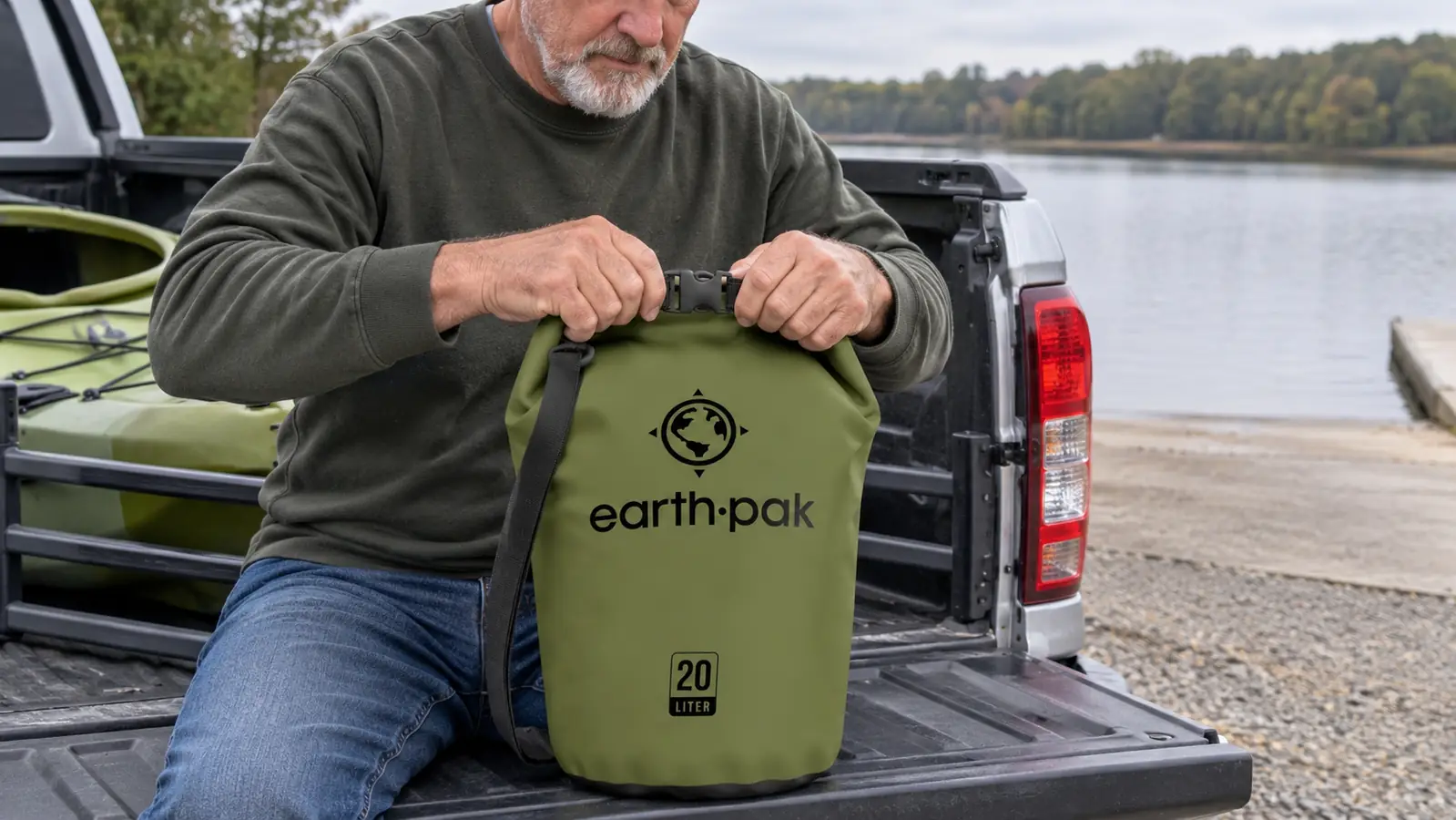
The Roll Top Seal Is the Whole Ballgame
A dry bag lives or dies on the closure. This one rolls down and closes with a snap, and the listing describes the material as abrasion resistant 500D PVC with a roll top seal. What that means in practice is a thick, stiff material that does not want to fold the way a cotton sack would. That is a good thing. A bag that folds too easily is a bag that folds itself open when a wave hits the deck.
The catch is that you have to roll it down properly. My first two trips I was lazy about it, folded it over twice and snapped it, and it still kept the water out, but I did not trust it and I did not enjoy the paddle. Now I press the air out, fold it down four or five times, and snap it. That takes maybe eight seconds. Eight seconds is nothing, and it is the difference between a dry lunch and a soggy one.
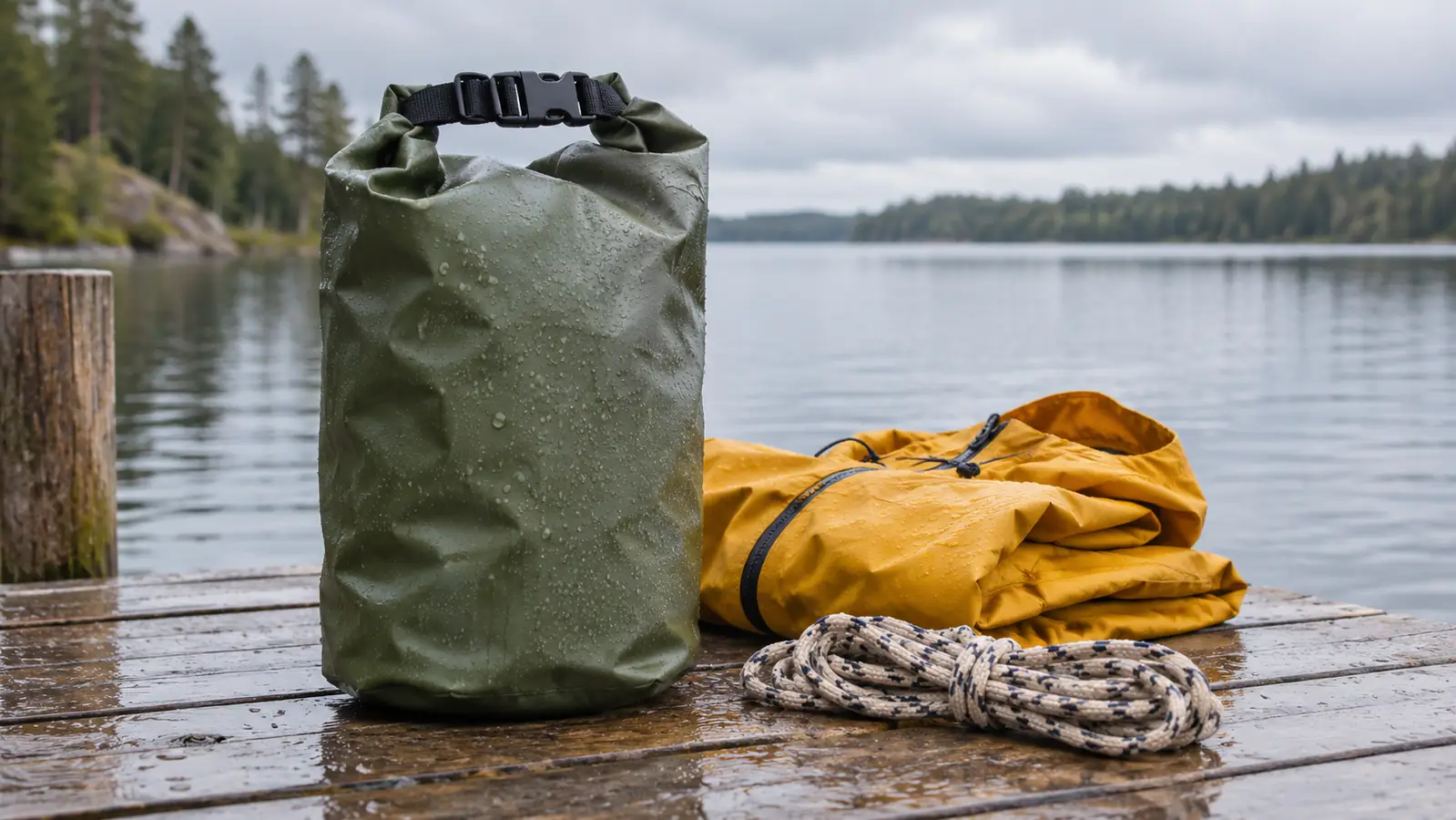
In August I got caught out when a storm came up faster than the forecast said it would. I paddled a half mile back to the ramp with the rain coming in sheets and the bag sitting in two inches of water in the bottom of the kayak. I opened it right there in the parking lot, mostly because I could not stand to wait, and the towel I had packed was dry enough to wipe my face with. The snap closure has not loosened on me all season. There is a utility pocket on the outside, which I use for a small tube of sunscreen and a folded bandana, and a web handle at the top that I grab when I am hauling the bag out of the kayak one handed with a paddle in the other. That handle has taken the full weight of a loaded bag more times than I can count and it has not pulled loose.
The Phone Case Is Not a Throw-In
The bag comes with an IPX8 certified waterproof phone case, and I want to be honest that I did not expect much from it. Free accessories are usually free accessories. This one has lived in the bag all season and has been underwater twice.
The first time was my own doing. I had the phone in the case on a lanyard around my neck while I climbed back into the kayak after a swim off the sand bar, and I went under to my shoulders. That was in July, water warm as a bath, and I came up sputtering with the case banging against my chest and the phone inside it taking pictures of the inside of my shirt the whole time. The second time was the tip-over in the pond. Both times the phone came out dry, and both times the screen still responded through the front of the case. I have taken pictures of Earl holding up a largemouth with the phone still sealed inside it.
IPX8 is the rating and I am not going to pretend I can explain what the number means beyond it being the one you want for something that goes under. What I can tell you is that it went under, twice, and the phone still works and the case did not leak or fog up.
What 20 Liters Actually Holds
The bag measures 9.5 inches by 9.5 inches by 17 inches and weighs 13.6 ounces empty. Twenty liters turned out to be exactly right for a day trip. Here is what goes in mine on a Saturday: a rain jacket, a towel, lunch in a small soft cooler bag, two bottles of water, a first aid kit, a spare pair of socks, a hat, and a paperback. Plus the phone case on its lanyard.
It all fits with room left over, which matters more than people realize. A roll top needs material to fold down, so if you stuff one to the brim you cannot close it properly. A little empty space is part of how the thing works. The 20 liter gives me that spare room without becoming a boulder in the front of a 10 foot kayak. I learned that the hard way in July, when I tried to add a folding camp chair and a second gallon jug of water to the same load and could not get the top rolled past two folds. I snapped it anyway and told myself it would be fine. It did stay dry, but I spent the whole paddle watching it instead of watching the water. Now I pack it, roll it, and if it will not roll four times I take something back out. On a normal Saturday the loaded bag weighs somewhere around 12 or 13 pounds, light enough that I can lift it out one handed by the web handle without setting my paddle down.
The listing comes in 5, 10, 20, 30, 40 and 55 liters, so if you are packing for two people or a multi day float you would want one of the bigger ones. Straps vary by size, which the listing says plainly, and the 10 and 20 liter sizes come with a 24 to 42 inch adjustable shoulder strap. That strap is what I sling over my shoulder walking from the truck to the water, and it adjusts long enough that I can wear it across my body while I carry the kayak by the side handle. Earl borrowed the bag once and said the strap cut into his shoulder with the bag full. He is not wrong. One strap carrying a full day of gear is one strap.
Where It Falls Short
It is one big compartment. There are no dividers, no inner pockets, nothing to stop your keys from ending up at the bottom underneath the towel. Every time I wanted my keys I had to unroll the whole bag and dig. I fixed that with a small stuff sack for keys, wallet and phone, but I fixed it. The bag did not. The worst of it was a Tuesday in September at the gravel ramp off the creek road. I had loaded the bag in a hurry that morning and dropped the truck keys in loose, and when I got back at four in the afternoon I stood ankle deep in the water unrolling the whole thing and pulling out a rain jacket, a wet towel, two bottles and a paperback before I found them at the very bottom.
The utility pocket is small. It holds sunscreen and a bandana and not much else. Do not plan on it swallowing a phone unless the phone is already in the slim case that came with the bag.
And here is the thing nobody tells you about dry bags in general. Once your hands are wet and sandy, everything you touch inside gets wet and sandy too. A wet hand reaching for the sandwiches means a wet sandwich bag. That is not Earth Pak's fault, it is the nature of the object, but it is worth knowing before you dump a bag of loose trail mix in there and expect to eat it cleanly at noon.
What I Liked
- Kept everything dry through a tip-over, two storms and a full season of splashes.
- Roll top with a snap closure seals in about eight seconds once you build the habit.
- IPX8 waterproof phone case included, and the phone stayed dry both times it went under.
- 20 liters holds a full day of gear with room left to fold the top closed properly.
- Web handle and adjustable shoulder strap make it easy to carry one handed from truck to water.
- 13.6 ounces empty, so it does not weigh down the front of a small kayak.
Where It Falls Short
- One compartment with no dividers, so small items sink to the bottom.
- The outside utility pocket is small and limited.
- A single shoulder strap digs in when the bag is full and heavy.
- The roll top has to be folded down properly every single time or you are gambling.
I have opened that bag after a tip-over, after two storms and after a hundred splashes, and I have never once found water inside it.
Who This Is For
This is for the paddler who wants one bag that takes a full day of gear and does not need to be babied. Sit-on-top kayakers, canoe folks, anyone loading a truck bed and heading to calm water. If you want to know that your phone, your lunch and your keys are dry at the end of the day without thinking about it again, the Earth Pak 20 liter does that job and does it without fuss. I would buy it again for the phone case alone, and I mean that.
It also suits people who are hard on gear without meaning to be. I have dropped this bag on gravel, set it in ankle deep water while I climbed back in, and left it in the sun for hours. In October I hosed the lake smell off the outside in the driveway, hung it over the fence to dry, and it came back inside looking no different than it did in May, just duller at the corners where it rubs the deck. It is still doing its job the same way it did in April.
Who Should Skip It
Skip it if you like compartments and order. If you want a place for the keys, a place for the phone and a place for the snacks, this bag will frustrate you by Wednesday. A hard dry box with dividers would serve you better, and there is nothing wrong with admitting that.
Skip it too if you are carrying heavy gear for more than a short walk. The shoulder strap is fine for the 40 yards from the truck to the ramp. It is not fine for a mile long portage with a full load. And if you are paddling big open water or anywhere the bag could go overboard and disappear, sort out a tether before you go, because a bag that stays closed is not the same as a bag that stays with you.
One season, zero leaks, and a phone case that earned its place
20 liters, 500D PVC with a roll top seal, a web handle and an IPX8 waterproof phone case in the box. Mine has been wet since April and everything inside is still dry.
Amazon Check Today's Price on Amazon →