

Six years ago I dumped my kayak in a farm pond four miles from my house and watched my phone slide out of the open compartment and go down in eight feet of muddy water. Earl still brings that up at family dinners. What I learned that afternoon was not that I needed a fancier boat. It was that a ten-foot sit-on-top has no dry storage worth the name, and anything I care about has to ride in one bag or it rides wet. That bag, for me, is the Earth Pak dry bag in the 20 liter size. I have carried it on Herrington Lake and up a handful of slow creeks every weekend from April to October, and I have quit babying it.
I am 61, my lower back is stiff by nature and my shoulders complain after a long paddle, so I am not interested in gear that needs a manual. This does not. It is a roll top sack with a shoulder strap, a utility pocket and a web handle, made of 500D PVC, and it weighs 13.6 ounces empty. That is the whole list. What follows are ten reasons it has earned the spot behind my seat, written for people who paddle calm water and would like their truck to still start at the end of the day.
The bag that ended my wet-phone problem for good
The 20 liter Earth Pak dry bag comes with an IPX8 certified waterproof phone case, a 24 to 42 inch adjustable shoulder strap and a roll top seal. It weighs 13.6 ounces and holds a full day of fishing.
Amazon Check Today's Price on Amazon →Your phone rides in a case rated for water, not just splash proof
The bag ships with an IPX8 certified waterproof phone case, which is the part I did not expect to matter as much as it does. IPX8 is the rating that covers being submerged, not a little rain on the deck. I keep my phone in that case inside the bag, and I have answered a text standing in six inches of lake without a second thought. If you have ever watched a phone go down in brown water, you already know what this one is worth.
20 liters holds a full day of fishing without a second bag
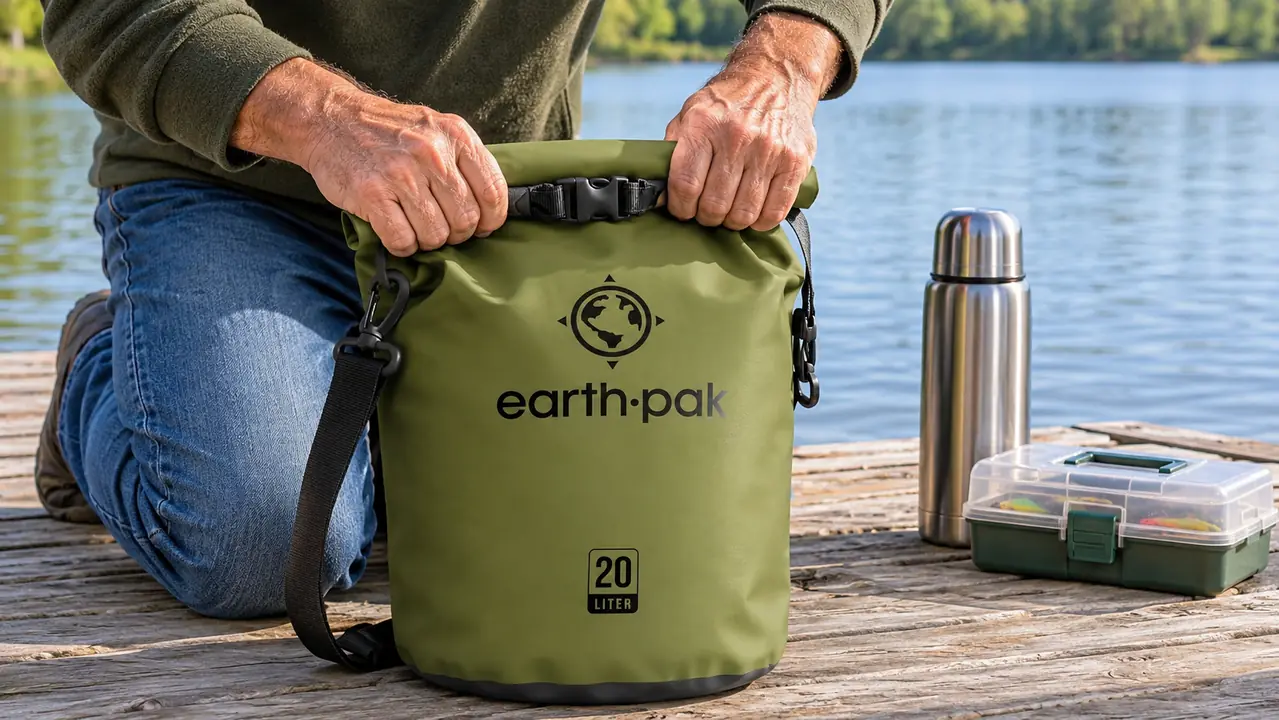
Twenty liters is the size that made sense for me. It swallows a rain shell, a sandwich, two bottles of water, a small tackle box, my wallet, my keys, sunscreen and the phone case, and it still rolls shut with room to spare. I tried a smaller sack once and spent the whole morning with a rain jacket crammed under my seat. Extra room matters because on Kentucky water the weather turns whether you planned for it or not.
The roll top gives you a seal you can feel with cold hands
A roll top is not complicated. You push the air out, fold the top down three times, and bring the ends together until the snap catches. What I like is that the snap tells you when it is done. There is no zipper to gum up with lake grit and no flap to get wrong in a hurry. I have closed mine in the dark, in the rain, and once with a wet hound standing on my foot. It seals every time, and after a few trips your hands know the motion without looking.
It goes from the truck bed to the launch on one shoulder
The 20 liter size comes with a 24 to 42 inch adjustable shoulder strap. That sounds like a small thing until you are the person hauling a tackle box, a paddle and a life vest down a gravel ramp and you would rather do it in one walk than three. I put the strap over one shoulder, hook the paddle under that arm, and I am at the water. Earl has started asking to borrow the strap, which is how I know it works.
500D PVC takes a beating from gravel, dock cleats and rod tips
The bag is 500D PVC with a roll top seal, and that material is the reason mine still looks the way it did the first season. It has been dropped on gravel, dragged across a wooden dock, sat on by a wet dog and poked by treble hooks I should have put away sooner. No punctures, nothing scuffed through the coating. If you fish around rocks and boat ramps, that toughness matters more than any feature on this list.
The utility pocket keeps the small things findable
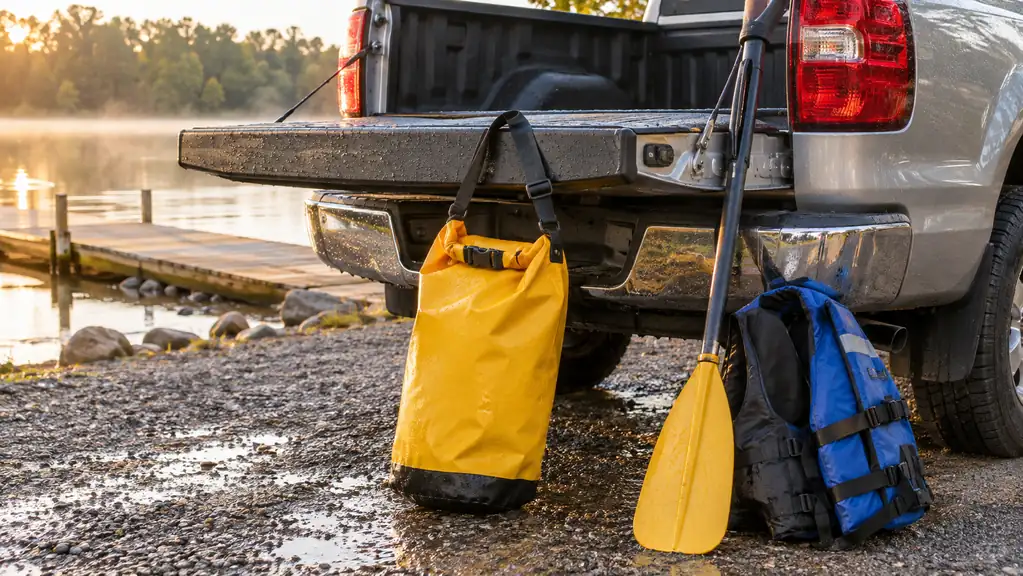
There is a utility pocket on the outside, and I use it for the things I want without unpacking the whole bag: the truck key, a couple of bandages, and a folded paper copy of my license. It is a small feature. But I have watched people dump an entire dry bag onto a dock hunting for a key while the wind pushed their paperwork toward the water, and it is not a pretty sight.
13.6 ounces means it costs you nothing in paddle effort
The bag weighs 13.6 ounces empty. My shoulders are already fussing by the second mile, and I am not adding gear that fights me across the lake. The weight of this thing disappears the moment I set it behind the seat. What you feel on a long paddle is what is inside the sack, not the sack itself, and that is exactly how it should be.
It fits behind the seat of a 10-foot sit-on-top without stealing legroom
At 9.5 inches by 9.5 inches by 17 inches, it drops into the space behind my seat and stays put. It does not roll around when a boat wake catches me, and it does not press into the back of my legs the way a hard cooler does. On a ten-foot boat there is not much room to give away, so a bag that fits the room you actually have beats one with features you never use.
The web handle lets you haul it out one-handed
When I come back to the ramp, I grab the web handle and lift the whole bag out of the kayak in one motion, wet and heavier than it started. No fishing around under the seat, no dragging it out by the strap and hoping the snap holds. For anybody with a bad back, that handle is the difference between stepping out of the boat clean and making a scene in front of the whole boat launch.
It keeps working after you get off the water
The shoulder strap turns it into a carry sack for the rest of the day. Wet swim trunks, a towel, a change of clothes for the ride home, all of it goes in the bag and stays in the bag. I have set it in the truck bed in the rain and unpacked dry clothes at the other end of the trip. A dry bag that only works while you are floating is only half a bag, and this one earns its keep in the parking lot too.
What I'd Skip
Two things I would not bother with. First, do not buy a bigger size than your boat will hold. The 20 liter size is right for a ten-foot sit-on-top and a day trip. A 40 or 55 liter sack in that same space turns into a wet duffel that shoves your seat forward and eats your legroom. Second, skip anything that closes with a zipper as the main seal on a kayak. Zippers and lake grit do not get along, and a roll top with a snap has nothing in it to fail. I would also skip the habit of leaving the bag unrolled at the launch while you mess with the kayak and the straps and the cooler. Roll it, snap it, then do everything else. I learned that one the hard way, and so did a phone.
I have carried the same 20 liter Earth Pak bag every weekend from April to October, and the roll top has not let water in once.
Roll it, snap it, and stop worrying about what is in your pockets
The 20 liter Earth Pak dry bag comes with an IPX8 certified waterproof phone case, a 24 to 42 inch adjustable shoulder strap, a utility pocket and a web handle. It weighs 13.6 ounces and measures 9.5 by 9.5 by 17 inches.
Amazon Check Today's Price on Amazon →