
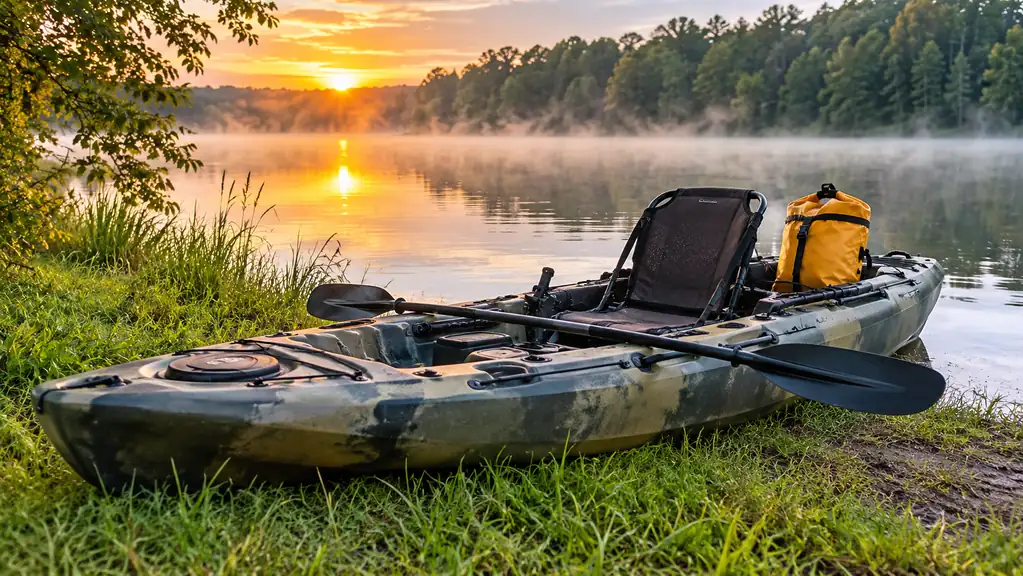
I have carried a dry bag and a hard dry box in the same 10-foot sit-on-top for six seasons, and I have quit arguing with myself about which one is better. They are not the same tool. The Earth Pak dry bag is a soft sack that goes wherever the kayak lets it go. The hard box is a rigid little suitcase that only fits where you can set it down flat.
Here is the short answer I would give you at the boat ramp. For a sit-on-top fishing kayak on calm water, the Earth Pak dry bag does more work for the space it takes up. It squashes into the tank well behind the seat, it weighs 13.6 ounces empty, and the 20 liter size I use holds a rain shell, a lunch, a dry towel, my keys, and a water bottle. A hard dry box wins on exactly one thing, and it is not a small thing: keeping small tackle sorted. Hooks, pliers, and a spare spool want compartments. A bag has one utility pocket and a big open cavity.
How I Compared Them on Herrington Lake
I am 61 and retired from driving a school bus, and I paddle Herrington Lake and a few slow creeks and farm ponds most weekends from April through October. My kayak is a green 10-foot sit-on-top that weighs about 60 pounds and rides in the bed of a silver pickup with a bed extender. There is no sealed hatch on it. Everything I bring goes in the tank well behind the seat or gets lashed to the deck, so I have spent six years learning what actually fits and what just rides to the lake and back.
The test was not scientific and I will not pretend it was. I loaded both containers with the same gear list on the same morning, paddled to the same rocky point, fished four hours, ate lunch on the water, and paddled back. I did it once in July heat and once in an October drizzle when the air never got above 55. The July morning started at 71 degrees and hit 88 by the time I quit, and by noon the inside of the hard box was warm enough that I would not have put a candy bar in it. The October morning was the opposite problem. My hands were stiff, and the latch on the box fought me every time I opened it while the roll top on the bag took both hands and a knee. I also tried keeping the box behind the seat first, which lasted about twenty minutes. It sat on a molded ridge, rocked every time I turned my shoulders to cast, and I moved it forward between my knees before I made it to the second point. I dropped a wet anchor rope across both of them. I opened both while sitting down, which is the part people forget to think about when they are standing in a store.
What I learned is that water is not the hard part. Both of these keep splash and rain out when they are closed right. The hard part is getting to your gear while you are bobbing with a rod in one hand and a lower back that does not want to twist.
The Side by Side
| Earth Pak Dry Bag | Hard Dry Box | |
|---|---|---|
| Sealing | Roll top seal, fold it down and snap it, 500D PVC body | Hinged lid with a gasket and a latch |
| Getting in while floating | Unroll the top and dig; one open cavity | Pop the latch and the lid holds itself open |
| Fitting a small sit-on-top | 9.5 by 9.5 by 17 inches, soft sides squash into the well | Fixed footprint, needs a flat spot |
| Weight empty | 13.6 ounces | Rigid shell and gasket, heavier before you pack it |
| Phone protection | IPX8 certified waterproof phone case included | Nothing included, phone rides loose in the box |
| Small tackle | One utility pocket, otherwise one cavity | Trays, dividers, and lid compartments |
| Carrying to the water | Adjustable 24 to 42 inch shoulder strap on the 10L and 20L | Molded handle, one hand, stays rigid |
| Size options | 5L, 10L, 20L, 30L, 40L, and 55L | Usually one size or two |
| Riding in a truck bed | Soft sided, shrugs off a bounce off the bed extender | A hard knock to a rigid shell is a hard knock |
| Draining a splash | Roll top keeps splash and rain on the outside | Gasket seal does the same job with a rigid lid |
Notice the pattern in those rows, because it does not change much. The bag wins on space, weight, and choices of size. The box wins on getting in and staying organized. Neither one takes every row, and anybody who tells you otherwise has not carried both of them down a gravel ramp.
Where Earth Pak Wins
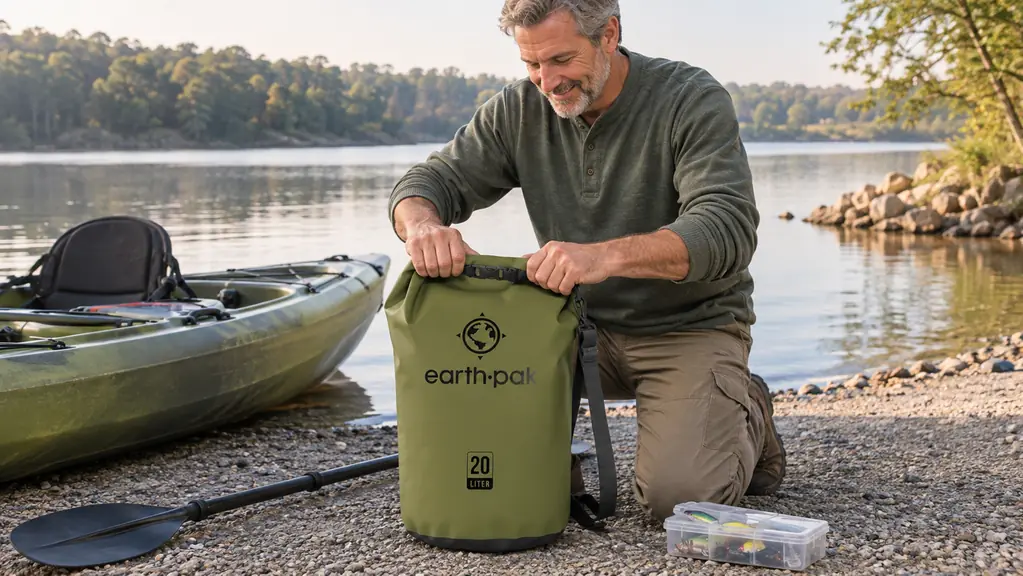
Space is the whole argument. The tank well on a 10-foot sit-on-top is lumpy and irregular, with scupper holes and molded ridges that do not care about right angles. The Earth Pak bag measures 9.5 inches by 9.5 inches by 17 inches in the 20 liter size, and because it is soft it leans, folds, and wedges into that well. A hard box has to sit flat or it does not sit at all. I have watched Earl fight a rigid box into a borrowed kayak for ten minutes and then carry it back to the truck. I measured my own well with a tape one Saturday just to settle the question. It runs about 21 inches long at the widest point and narrows to 14 at the back where the scuppers sit. The bag at 17 inches tall stands up in it and still leaves room for a rod bag alongside. A box 14 inches wide will not go into that back section at all unless you turn it crossways, and then it sits right under your casting elbow.
Weight is the second argument, and it matters more as the years add up. 13.6 ounces empty does not sound like much until you are making one trip from the truck to the ramp with everything on your shoulder. The adjustable strap runs 24 to 42 inches on the 10L and 20L sizes, so it hangs where I want it instead of where a box designer wanted it. The bag also takes abuse without complaint. The body is 500D PVC with a roll top seal, and mine has a scuff on one corner from the bed extender and has not leaked a drop.
The third thing is the phone case, which I did not expect to care about. The bag comes with an IPX8 certified waterproof phone case, so my phone does not go in the bag at all. It hangs on a lanyard around my neck and I can check the radar or take a picture of a fish without opening anything or drying my hands first.
The bag wins on space and weight. The box wins on getting in and staying sorted. Anybody who says one takes every row has not carried both to the water.
Where a Hard Dry Box Wins
Access, and I will not soften it. When I am drifting and want a different lure, I pop the latch on a hard box and the lid stays up on its hinge. My left hand is free and I can see everything at once. With the bag I unroll the top one handed, hold it open with my knee, and dig. Everything lives in one cavity, so the thing I want is always at the bottom, under the towel.
Sorting is the second win, and it is the one that makes some anglers give up on bags entirely. Treble hooks, split ring pliers, a spare spool, and a handful of weights should not share a sack. A box with trays and dividers keeps a hook away from the soft plastics. A rigid box also does not fold around a hook point the way fabric will, so I worry less about a stray treble in a tray than in a bag. If you carry more than a couple of lures, the box earns its space and I will say so out loud.
The One That Fits Where My Kayak Actually Has Room
The 20L Earth Pak dry bag, with the IPX8 phone case in the box, is what lives in my tank well from April to October.
Amazon Check Today's Price on Amazon →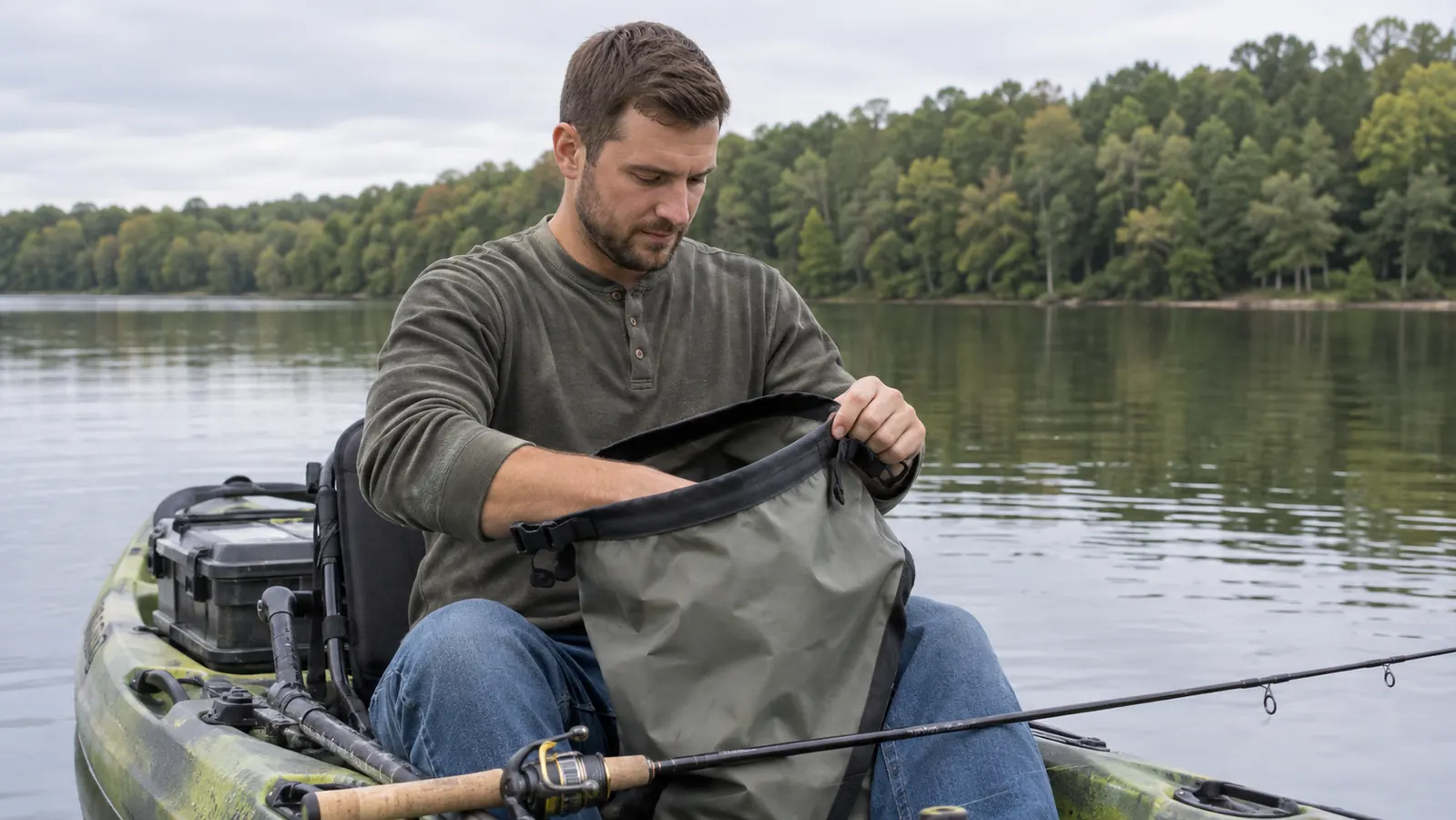
What Fits in 20 Liters
People ask me this more than anything else. In the 20 liter bag I carry a folded rain shell, a sandwich and a bag of trail mix, a small dry towel, my wallet and keys in a zip pouch, a headlamp, a bottle of water, and a light fleece for the ride home in October. It closes with room to spare. I tested that on a Saturday in June when the forecast turned on me. The radar on my phone showed a line of storms an hour out, so I unrolled the bag, pulled the rain shell out of the top, and had it on before the first drops hit the deck. That is the one job where the bag beat the hard box clean, because the shell was the last thing I put in and the first thing I needed, and it sat right at the mouth of the bag instead of at the bottom of a tray. If I am packing for two people I take the 30 liter. If I am only carrying a phone, keys, and a snack, the 10 liter is plenty and it takes up less of the well.
The sizes run 5L, 10L, 20L, 30L, 40L, and 55L, which is more choice than most people need but handy if you already know your load. My advice is to go one size bigger than you think. A dry bag that is stuffed full is hard to roll down three times, and a bag that will not roll properly is not keeping water out, it is just a sack with a folded top.
The Day I Brought Both
The longer trips are the ones where I bring both, and that setup has become my favorite. The hard box sits forward between my knees with tackle in it. The Earth Pak bag rides in the tank well with everything soft. The box stays closed unless I am changing lures. The bag stays closed unless I am eating or the weather turns. Each one has one job and neither gets in the way of the other.
The catch is that bringing both means both get carried to the water. The bag is the easy half. The box is the heavy half. On a morning when my back is already complaining, I leave the box in the truck and take a smaller selection of lures in the utility pocket on the bag, which is fine for a couple of hours of paddling and a whole lot of sitting.
Two Things I Would Change
The first is that a dry bag does not stay put by itself. In an empty tank well mine slides toward the scupper holes. I fixed it in about thirty seconds with a crate behind it and a bungee over the shoulder strap, and now it stays where I set it. What I settled on was a milk crate in the well with the bag standing in front of it and the strap clipped to a bungee, so the whole thing lifts out in one hand at the ramp. It has not shifted since, including one windy afternoon when I bumped a dock piling and everything loose on the deck went sideways. That is a rigging problem, not a product problem, but nobody tells you about it before your first trip.
The second is the roll top itself, which takes about a week to learn. You roll down at least three times, you press the air out as you go, and then you snap the closure. Roll it once and snap it and you have made a wet sack with a decorative top. The closure is a snap, not a buckle, so it takes a little hand strength. If your hands get stiff in the cold, do it before you push off, not while you are drifting.
Who Should Buy Which
Buy the Earth Pak dry bag if you paddle a sit-on-top or a recreational kayak, you carry clothes, food, a towel, a phone, and a few lures, and you want all of it in one bundle that fits whatever space the kayak gives you. That is most people reading this, and it is me. Start with the 20 liter for a day trip. Go to the 30 if you camp off the boat or pack for a partner.
Buy a hard dry box if your day is really about tackle. If you carry a dozen crankbaits, a hook file, pliers, and a scale, and you want them in the same order every trip, the box is the right tool and a bag will frustrate you every time you reach for a lure. Plenty of anglers carry both, box for tackle and bag for everything else, and that is not a compromise. That is just how much gear you brought.
Roll It Three Times and Stop Thinking About It
If you are tired of rearranging a rigid box in a kayak that has no flat spots, the Earth Pak 20L dry bag is the simpler answer.
Amazon Check Today's Price on Amazon →