

The first hour in my kayak is always easy. It is hour three that used to get me. By then my lower back has decided it has opinions, and the molded plastic seat that came with my ten foot sit on top has nothing left to give. I am 61, I drove a school bus for a living, and I fish out of that boat most weekends from April through October on Herrington Lake and a couple of slow creeks near Danville. So last spring I bought the GCI Outdoor SitBacker, strapped it into the boat, and left it there. Not for a weekend. For the whole season.
What follows is what I found after roughly thirty trips, not what the box says. I am not going to tell you it turned my kayak into a recliner, because it did not. What it did was change which days I could paddle and how long I stayed out before I quit and loaded up. For a woman with a stiff back, that is worth more than any feature list, and it is the only reason the thing stayed in the boat instead of going on the shelf in the garage next to the other gear I bought with good intentions.
The Quick Verdict
Firm, light, and it holds your lower back up for a full morning. The seat pan is thin enough that long days want a pad under you, and the back stops around your shoulder blades. My trips got two hours longer and my back stopped deciding when I went home.
Amazon Check Today's Price →The seat that stopped deciding when my trip ended
It straps on with one 17 inch strap, folds flat, and weighs 2.9 pounds. I set the back angle at the ramp in April and did not touch it again until fall.
Amazon Check Today's Price on Amazon →How I've Used It
The SitBacker went into the boat in early April and came out in late October. In between it saw Herrington Lake maybe twenty times, two small creeks I will not name because I like them quiet, and a farm pond belonging to a neighbor who lets me fish it if I bring him tomatoes. Earl, my husband, came along now and then in a borrowed kayak. Biscuit, my hound, rides in the back on the calmest days and mostly sleeps on a towel. The seat has been rained on, sat on in wet jeans, and dropped once on a gravel ramp, and it still folds and still locks.
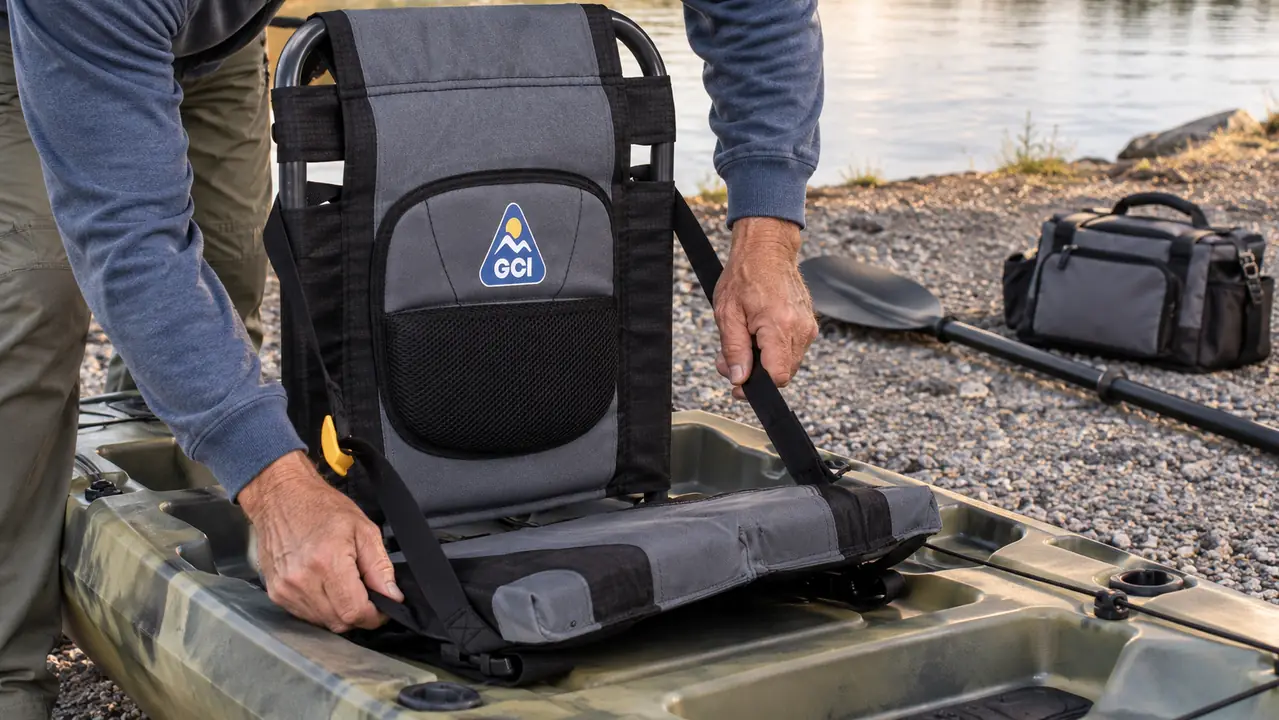
Installation is one strap and no assembly. It comes out of the box ready to use, and the 17 inch seat strap runs around whatever the boat already has back there. On my sit on top, the molded seat has grooves where the factory back used to sit. I ran the strap around the whole pan, snugged it down, and that was the job. It has not shifted in a season and I have not had to re-tighten it once. On a wide canoe bench, measure before you assume, because 17 inches is 17 inches and a strap that is too short is a bad afternoon.
One thing I want to be straight about. This is sold as a canoe seat, and it is one. I use it in a kayak because my seat pan is flat enough that the base sits down on it properly. If your sit on top has a deep molded bucket that holds you like a cup, this will sit up on top of that instead, and you will be a little higher in a boat that is already narrow. I started with a plain foam cushion the spring before, and it helped my backside and did nothing for my back. That is the difference I paid attention to when I decided to try the GCI Outdoor seat.
The Back Support Is the Whole Point
The factory back on a sit on top is a plastic shell with a thin pad. It hits you around the middle of your back and stops, so after a couple of hours your shoulders curl forward and your lower back takes the load. The GCI Outdoor SitBacker has a solid back panel that comes up higher and stays firm. It is not a soft cushion that folds away when you lean on it. It holds you up, and a stiff back wants holding up more than it wants padding.
I noticed it most in wind. Paddling into a chop, you brace with your whole torso, and that is when I used to start cheating, leaning back and letting the boat do the work. That cheating is what made my lower back sore. With a firm panel behind me I could sit up and paddle properly for longer. By midsummer I was doing five hours on the lake instead of three, and my back was not the reason I quit. Heat was. That is a problem I will take.
My shoulders used to be the other half of the trouble. When your back gives out, you brace with your arms, and then your shoulders ache the next day and you blame the paddle. I still get tired shoulders after a long morning, but it is ordinary tired now, the kind that goes away with a sandwich, not the kind that keeps me up that night. The seat did not fix my shoulders. It stopped my back from making them worse, which is most of the battle for me.
The Recline Adjustment, and What It Will Not Do
The back adjusts. GCI Outdoor calls it patented Back Comfort Technology for customized reclining, and what that means at the ramp is simple enough. You can set the back angle where you want it instead of taking the one angle the boat handed you. I set mine sitting in the boat on dry ground before pushing off, a notch back from straight up for sitting still and casting, and more upright for the paddle across the lake. It held all morning.
It is not a lever you flip with a rod in one hand and a crankbait swinging off the other. You set it and live with it until you come in. That suited me fine. I set mine in April and touched it twice all season, both times on the bank. If you pictured yourself reclining out there like a lawn chair, adjust your picture, because this is for choosing a posture, not for changing one every twenty minutes.
There is a middle position that is neither upright nor laid back, and I never found a use for it. I mention it because two useful positions out of the range is still two more than the boat gave me, and I would rather tell you that than pretend every notch is a gift.
Folding, Weight, and the Trip to the Water
The seat weighs 2.9 pounds and folds flat to about 3.7 by 16.5 by 16.5 inches. That matters at my age and with my boat. My kayak is about 60 pounds, and I already do a two part lift to get it into the truck bed with the bed extender. Anything that adds a third trip from the truck to the water is a thing I will leave in the garage. This folds, the portage lock holds it folded, and the shoulder strap lets me carry it on one shoulder with the paddle under the other arm.
The shoulder strap sounds like a small feature and it is not. Walking from the truck to the ramp I have a paddle, a tackle bag, and a seat, and the strap means the seat rides on my shoulder instead of in my teeth. The portage lock is the other small thing. A folded seat that pops open under your arm on a gravel ramp is a nuisance you tolerate exactly once.
Open, it measures 12.3 by 16.5 by 17.9 inches and it is rated to 250 pounds. I am nowhere near that number and neither is Earl, so I cannot tell you how it behaves at the limit. What I can tell you is that the frame is powder coated and has not rusted or flaked, and the folding joints still move freely after a season of grit and lake water. Between trips I fold it into the space behind the cab of the truck, and it does not take up room I need for tackle.
After a Full Season: What Held Up and What I Would Change
Nothing broke, which sounds like a low bar until you remember the camp chairs you have thrown away. The strap still holds, the back still locks where I put it, and the fabric on the seat pan has no tears after gravel ramps and wet jeans. The thing I would change is the seat pan itself. It is firm and thin, and on a five hour day my backside knows it. I solved that with a cheap foam pad from the hardware store, cut to fit, and now I do not think about it.
The second thing is height. The back comes up well, but the top edge lands around the middle of my shoulder blades rather than above them. If you carry your tension up between your shoulders, this will help your lower back and not your neck. Earl is an inch taller than me and noticed the same thing when he borrowed it on the pond. It is not a flaw exactly. It is a decision about what the seat is for, and it is for your back.
It lives in the garage from November to March, folded, hanging on a nail beside the life jackets. That is the whole winter routine. Wipe it down, make sure it is dry, forget about it. In April I unfolded it and the joints moved as freely as they had in October, which is more than I can say for me.
What I Liked
- Holds your lower back up for hours instead of letting your shoulders curl forward
- Folds flat to 3.7 by 16.5 by 16.5 inches and weighs 2.9 pounds
- One strap install, no assembly, and it did not shift all season
- The back angle adjusts and stays where you set it
- Rated to 250 pounds, powder coated, and grit and lake water have not hurt it
Where It Falls Short
- The seat pan is firm and thin, so a long day wants a foam pad under you
- The back panel stops around the shoulder blades, which does little for your neck
- The recline is not something you change on the water with a rod in your hand
- The 17 inch strap is snug on wide benches, so measure your boat first
- On a deep molded bucket seat it sits on top and raises you in a narrow boat
By midsummer I was doing five hours on the lake instead of three, and my back was not the reason I quit. Heat was.
Who This Is For
This is for the paddler whose back is what ends the trip. If you come in after two or three hours because your lower back is complaining and not because you are finished, the SitBacker is aimed at you. It suits a sit on top or a canoe with a bench style seat, a paddler who sets a position and leaves it alone, and anybody who hauls their own boat and does not want one more heavy item to lift. It also suits anyone who, like me, is not getting younger and would like to keep fishing past the point where their back used to call it a day.
If you fish with a partner and take turns in each other's boats, this is easy to move. Earl used it twice on the pond and I heard no complaints, which from him is a rave review. It is also the sort of thing you buy once and forget about, which is what I wanted out of it.
Who Should Skip It
Skip it if your trouble is in your neck and shoulders rather than your lower back. This supports your back, not your head, and this is not that product. Skip it if your kayak has a deep molded bucket that cups you, because this sits on top and raises you, and a narrow boat feels different when you do. Skip it if you want a soft plush seat, because this one is firm and it stays firm. And skip it if you want to change positions a dozen times a morning, because that is not what the adjustment is built for. Earl went back to the factory seat in his borrowed boat without a word of complaint, which tells you how much of this comes down to one person's back and one person's morning.
If your back is what ends your fishing trips, start here
Folds flat behind the truck seat, straps onto the boat in a minute, and holds your lower back up for the whole morning. A full season in, mine is still in the kayak.
Amazon Check Today's Price on Amazon →