

I am Wanda Collier, 61, a retired school bus driver from outside Danville, Kentucky. I started kayaking about six years ago, and I paddle a 10-foot sit-on-top fishing kayak on Herrington Lake and a few slow creeks and farm ponds from April through October. About forty minutes into a paddle, my lower back used to start talking. Not a sharp pain, just a dull, stiff ache that made me sit up straighter and paddle worse. I tried a foam cushion, a rolled-up towel, and a cheap stadium seat. None of them gave me a real back support. What finally helped was the GCI Outdoor SitBacker Adjustable Canoe Seat with Back Support, plus a five-step routine I now do every trip.
I am not a doctor and this is not medical advice. If your back pain is sharp, numb, or runs down a leg, get it checked before you paddle. This is simply what worked for me on calm water. The SitBacker is sold as a canoe seat, not a kayak seat, and I use it in my sit-on-top as a back support. It is rated to 250 pounds, weighs 2.9 pounds, and folds flat enough to carry with one hand. The rest of this article is the routine: setup, placement, recline, paddle technique, and the halfway reset that keeps me on the water longer.
Put a real back support behind you before the next paddle
The GCI Outdoor SitBacker gives you an adjustable back, a 250-pound rating, and a shoulder strap for the walk to the water. No assembly required.
Amazon See the SitBacker on Amazon →The Five-Step Routine That Keeps Me Paddling
Step 1: Set the back angle before you leave the truck
The worst place to adjust a seat back is in a kayak that is already moving. I open the SitBacker on the tailgate of my silver pickup, set it to the upright position, and then change the recline one notch at a time until it feels right. The patented Back Comfort Technology is the adjustable part, and it is the reason this seat works for me. I want the back to meet my lower back, not push my shoulders forward.
Open, the seat measures 12.3 by 16.5 by 17.9 inches. Folded, it is 3.7 by 16.5 by 16.5 inches. That is small enough to ride behind the truck seat when I am not using it. The portage lock keeps it closed while I carry it, and the shoulder strap with Auto-Fold Technology means I can open it with one hand at the ramp. There is no assembly. I take it out of the truck, unfold it, and set the back.
I also check the arm pads before I load. They are included, and I like them for two reasons. They give my forearms a place to rest when I stop to fish, and they remind me not to hunch my shoulders. If the pads are loose or twisted, fix that on land. Everything is easier on land.
Step 2: Place the seat so your hips are level with or higher than your knees
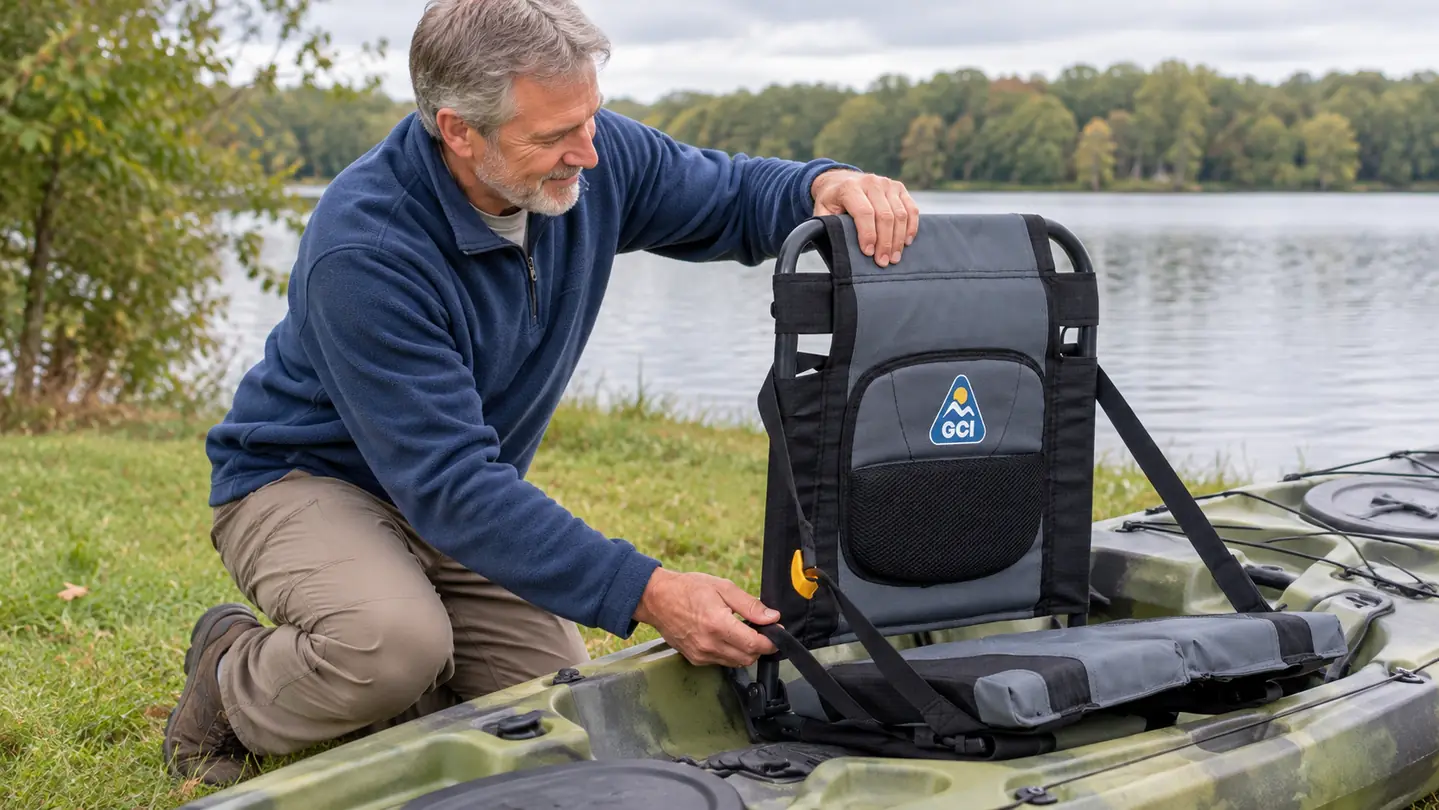
In my sit-on-top, the molded seat pan is low. If I drop the SitBacker flat on that pan and leave it, my knees come up and my lower back rounds. So I set the seat back against the molded seat back area and use the 17 inch seat strap to hold it where I want it. I do not rely on the strap to carry my weight. I rely on it to keep the seat from sliding.
The seat is 16.5 inches wide and 16.5 inches deep. That fits my kayak's seating area without hanging over the sides. I center it, then sit down and check my knees. If my knees are above my hips, I add a thin closed-cell pad under the seat, not a thick cushion. A thick cushion raises me up and makes the back support sit too low. A thin pad changes the angle just enough.
This is the step most people skip. They strap a back support to a low seat and wonder why their back still hurts. The back support can only help if your hips are not curled under you. On my kayak, moving the seat forward about an inch and keeping the back upright made more difference than any cushion I tried.
Step 3: Set the recline for the first twenty minutes, then change it
I start more upright than I want. Upright keeps my chest open and my paddle strokes clean. After about twenty minutes, when my lower back starts to stiffen, I change the recline one notch. The SitBacker is adjustable, so I can do this without taking the seat out. I reach behind me, make the change, and sit back down. Then I paddle a few strokes and see how it feels.
The mistake I made at first was setting the back too far back. It felt good for five minutes, then my chin dropped and my strokes got short. A reclined seat is not a lounge chair. I want enough back angle to take pressure off my lower back, but not so much that I am rowing with my arms only. My rule is simple: if I cannot keep my chest up, the back is too far back.
The arm pads help here too. When I stop to fish or eat a sandwich, I rest my forearms on them and let my shoulders drop. I do not lean my full weight on the pads while paddling. That would put my shoulders in a bad position. I use them at rest, and I use the back support while paddling.
The seat back did not fix my lower back. It stopped me from folding like a pocketknife every twenty minutes, which is most of the battle.
Step 4: Paddle from your ribs, not from your lower back
A back support is not a license to sit still and pull with your arms. The best thing I did for my lower back was learn to rotate from my ribs. I sit tall, plant my feet on the foot braces, and let my torso turn with each stroke. My arms finish the stroke, but my bigger muscles do the work. When I forget this, my lower back tells me within ten minutes.
I also shorten my stroke. A long stroke feels powerful, but it twists my lower back more than I need. A shorter, quicker stroke keeps the kayak moving and keeps my back straighter. I count ten strokes on one side, then ten on the other. Counting keeps me from getting sloppy when I am tired.
The SitBacker helps most when I am already sitting well. It gives me a surface to sit against, so I do not collapse backward. It does not paddle for me. If I slump, the seat back cannot save me. If I sit tall and use my ribs, the seat back takes the edge off the stiffness.
Step 5: Take a five-minute reset at the halfway point
I pick a calm cove or a shady bank at the halfway point, stop, and reset. I take my feet off the braces, let my legs hang, and stretch my lower back by leaning forward with my hands on my knees. Then I sit back against the SitBacker and check the recline. Sometimes I change it. Sometimes I leave it alone. The point is to stop before my back gets angry, not after.
If the water is shallow and the bank is safe, I get out and stand up straight. That is the best stretch for my lower back. If I cannot get out, I stand up in the kayak only if the water is flat and I have something solid to hold. I do not do that on a windy day. I am 61, not 21, and I do not need to prove anything to a farm pond.
Biscuit, my 7-year-old mixed-breed hound, sometimes rides along on calm days. He is 45 pounds, and he is not help with my back. But he is a good reason to stop and stretch. I give him water, I drink water, and I sit back for five minutes. Then I paddle home with a back that feels like it belongs to me.
A Short Fit Check Before You Buy
The SitBacker is 16.5 inches wide and 16.5 inches deep. Measure your kayak's seating area before you order. In my 10-foot sit-on-top, it fits with room to spare. In a narrow cockpit kayak, it may not. This is a canoe seat, and the back is solid. It is not a molded kayak seat with a thin back. If your kayak already has a tall molded seat back, you may not need it. If your kayak has a low pan and no back support, that is where it earns its keep.
The 250-pound rating is a real limit, not a suggestion. I am well under it, and I still check the strap and the frame before every trip. The seat weighs 2.9 pounds and folds to 3.7 by 16.5 by 16.5 inches. That is easy to store, but it is not a tiny cushion. Plan for the space. The shoulder strap and portage lock make the carry easy. The no-assembly part is true. I have never had to put it together.

What Else Helps
The SitBacker is the main piece of gear, but it is not the only thing. I keep my paddle length suited to my kayak width, I use the foot braces, and I carry water in a bottle I can reach without twisting. I also wear a good life jacket. A life jacket that rides up makes me hunch, and hunching is the enemy. I adjust the straps before I launch, not after.
I also watch the wind. A headwind makes me paddle harder and slouch lower. On windy days, I pick a shorter loop and take more breaks. I would rather paddle a mile with good posture than three miles with a bad back. The GCI Outdoor SitBacker has held up for me across a few seasons of weekend paddles, and the shoulder strap makes it easy to carry even when my hands are full. That matters when you are unloading a 60-pound kayak by yourself.
If you want more detail on the seat itself, there is a longer honest review on this site. I also compared it with a foam seat cushion in another article, because a lot of people ask me whether the cushion is enough. My short answer is that a cushion changes the surface, and a back support changes the position. You may want both, but the back support is the part that helped my lower back.
Your back is going to vote on every paddle
The GCI Outdoor SitBacker folds flat, carries with a shoulder strap, and gives you an adjustable back for the long stretches between coves. Set it up on land, strap it in, and see if it keeps you on the water longer.
Amazon See the SitBacker on Amazon →