

Three hours into a paddle on Herrington Lake, my lower back starts sending me messages. It is not the paddling that does it. It is the sitting there, hour after hour, with nothing behind me but air and a molded plastic pan underneath me. I am 61, I have been kayaking about six years now, and for the first few of those I figured a sore back was just the price of a good Saturday.
It is not. The fix for me was a GCI Outdoor SitBacker, an adjustable canoe seat with back support that straps down over the molded seat of my 10-foot sit-on-top. It weighs 2.9 pounds, folds flat to 3.7 by 16.5 by 16.5 inches, and takes up less room in the truck bed than my tackle bag. I have run it on farm ponds, on slow creeks, and on long mornings at Herrington, and it changed how far I am willing to paddle before I turn around. Here are ten reasons why, roughly in the order they mattered to me.
The seat that got me past my two-hour wall
Same boat, same lake, same stiff lower back. One strap and a back panel and I quit cutting my mornings short. Take a look at the current price and the size chart before you order.
Amazon Check Today's Price on Amazon →Your lower back stops bracing itself all day
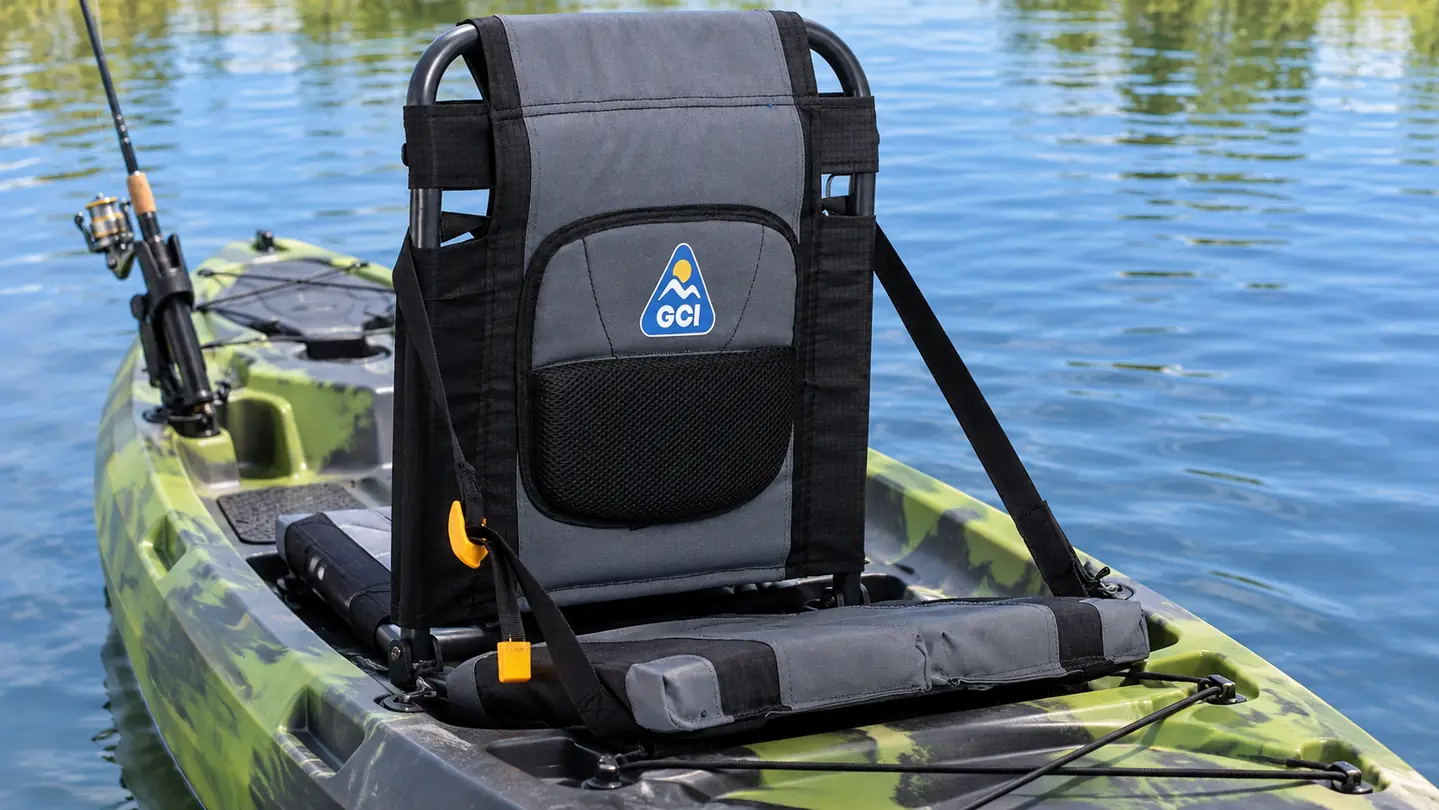
A molded sit-on-top seat has nothing behind it. So your lower back muscles spend the whole morning holding your spine steady against every wobble the boat makes, and by noon they are tired in a way that has nothing to do with paddling. The SitBacker has a solid back panel, which means the seat does that job instead of your muscles. The first thing I noticed was not comfort. It was how much less worn out I felt walking back up the ramp.
The back reclines to what your back wants that day
Some days I want to sit up straight and work a bank. Some days I want to lean back and eat a sandwich while the boat drifts. The back on this seat reclines to a position I choose and holds where I set it. GCI Outdoor calls it patented Back Comfort Technology, which sounds like catalog language until you are the one with a cranky lower back at hour four. Then it just sounds like somebody thought it through.
I quit turning around at the two-hour mark
Two hours used to be my wall. That is when my back got loud enough that I headed for the ramp whether the fish were biting or not. With a back on the seat I am good for four hours, and my last paddle of the season ran close to five with one stop on a bank to stretch my legs. Paddle time is the entire reason I own a kayak. Everything else is just getting to it.
It gets you up off the bare hull
I do not care how thick the plastic is on a sit-on-top. It is still plastic, and your hips know it. This seat gives you a 16.5 by 16.5 inch platform to sit on instead of the molded pan, which spreads the pressure out and takes it off the two spots that go numb first. My legs quit falling asleep somewhere around the second hour after I switched. That alone was worth the change.
The shoulder strap means one trip from the truck
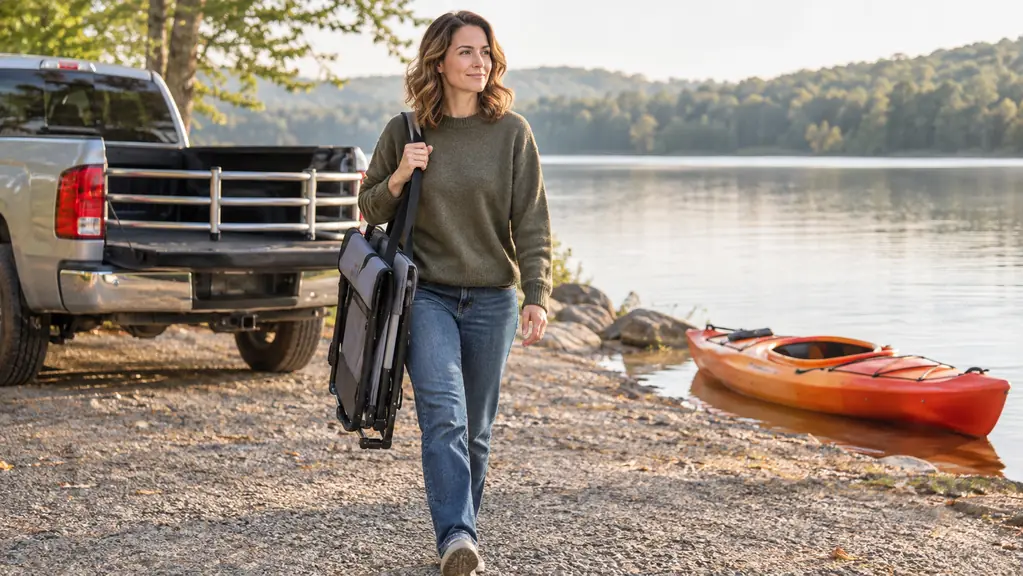
My kayak is about 60 pounds and rides in the bed of the silver pickup with a bed extender. The seat used to be one more thing to juggle along with the net and the dry bag. Now the strap goes over my shoulder and I carry it with one hand while the other hand has a paddle. Small thing. You notice small things when you are 61 and walking down a gravel ramp.
It folds flat enough to live in the truck bed
Folded, the GCI Outdoor seat measures 3.7 by 16.5 by 16.5 inches, which is about the size of a fat briefcase. Mine stays in the truck from April to October, parked next to the extra paddle. No hauling it in the house, no hanging it in the garage, no getting to the lake at daylight and realizing it is still on the workbench. If it is a nuisance to store, you will stop bringing it, and that is the truth.
The portage lock keeps it shut until you want it open
A fold-flat seat that pops open while you are carrying it across a parking lot is a nuisance you only tolerate once. The portage lock holds it closed on the walk, and it opens in one motion when you set it down on the boat. I go from truck to water without setting anything on the ground. If you have ever chased a folding chair across a windy ramp, you already know why this matters.
The 17 inch seat strap holds it where you put it
The seat goes on with a 17 inch strap and it stays put. I have had it in the chop that comes off a pontoon boat wake, and it did not slide out from under me. I run the strap snug, check it once at the ramp, and then forget about it for the rest of the day. There is nothing worse than a seat that shifts sideways the moment you lean into a stroke.
Rated for 250 pounds and it weighs under three
I am not a small woman and I lean on my gear. The seat is rated for 250 pounds and I have never felt it flex or groan underneath me, not once in a full season of weekends. It weighs 2.9 pounds, which is light enough that it does not change how the kayak floats or how it loads. You are adding a backrest, not a piece of furniture.
No assembly, no tools, no bag of leftover bolts
It comes out of the box ready to go. No bolts, no Allen wrench, no instruction sheet to lose in the garage. That sounds like a small courtesy until you have opened a box in July and found out you need a socket set and a second person. The GCI Outdoor seat was on the boat and in the water the same afternoon it showed up on the porch.
What I'd Skip
I would skip the foam pad that only cushions your rear and leaves your back hanging in the air. That is a cheap fix for half the problem, and half the problem is the half that sends you home early. I would also skip anything that requires drilling into the hull of a boat you plan to keep, and I would skip a full framed captain's chair on a 10-foot sit-on-top, because it is more seat than a small boat wants to carry.
And I will be straight with you about the tradeoffs. Adding a back raises you up a couple of inches, so a boat that felt steady before will feel a little less steady the first time you turn around to reach the cooler. That is real. I got used to it in one trip, but I noticed it. Setting the strap the first time took me a few minutes of fiddling in the driveway. After that it was a fifteen second job. Earl borrowed the GCI Outdoor seat once on a borrowed kayak and asked me to order him one, which from a man who does not ask for much is a fair review.
I felt the difference at the two-hour mark, which is exactly where I used to quit and paddle back in.
Four hours on the water instead of two
If your back is what decides when your paddle day ends, that is the cheapest upgrade on the boat. Check today's price, confirm the fit for your seat, and get back to fishing.
Amazon Check Today's Price on Amazon →