

Six years of kayaking out of Herrington Lake has taught me that the paddle matters more than most people admit on the way in. You hold the thing all day, and if it fights you, your shoulders and your lower back file a complaint by noon. I have a stiff lower back and shoulders that ache after long outings, so I went looking for something plain and dependable instead of something fancy. The OCEANBROAD kayak paddle is what I landed on, a two-piece oar with an aluminum alloy shaft and fiberglass reinforced PP blades at 90.5 inches, and I have used it through two full seasons on calm lakes, slow creeks and a few farm ponds. Here is what months of real use taught me.
The short version first. At 2.5 pounds it is light enough to carry in one hand from the truck bed down to the water along with my life vest. It comes apart into two sections, so it lies flat in the bed of my pickup instead of hanging out over the tailgate. The three locking positions let me set the blades where my wrists like them instead of where somebody at the factory decided. It is not a featherweight carbon paddle and it does not pretend to be. What it is, is a sensible recreational paddle that has not loosened, cracked or annoyed me, and on the water I fish, that is the whole job.
The Quick Verdict
Two seasons on flat water and the joint still seats solid. Light, simple, packs flat in a truck bed, and the only real compromise is shaft flex when you lean into a wind.
Amazon Check Today's Price →The Paddle That Lives in My Truck Bed From April to October
Two seasons on Herrington Lake and a handful of slow creeks. Breaks into two sections, weighs 2.5 pounds, and the blades stay where you set them.
Amazon Check Today's Price on Amazon →How I've Used It
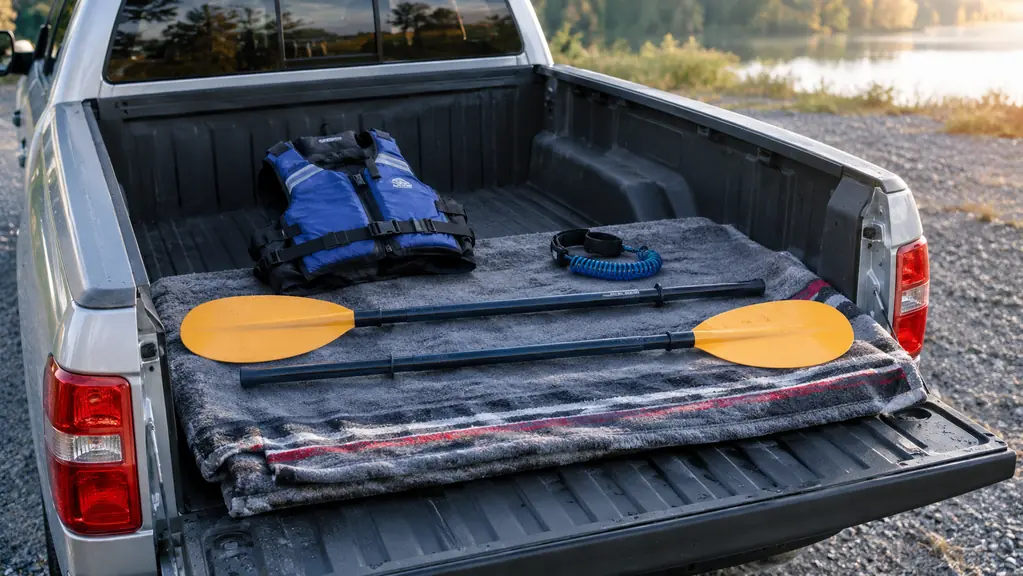
My kayak is a 10-foot sit-on-top fishing kayak that weighs around 60 pounds, and it rides in the bed of a silver pickup with a bed extender under the tail end. Most Saturday mornings from April through October I am on the water at first light and out for two to four hours. Sometimes it is a slow creek after a rain, when the water is up but still lazy. Sometimes it is a farm pond so flat you can see the treeline in it. I am not paddling whitewater and I am not crossing big open water. Calm water, slow current, and a lot of stopping to cast. Before this one I borrowed a one-piece paddle from a neighbor for a month. It was fine in the water and a misery on land. It hung two feet past the tailgate, so I was always lashing it down or wedging it against the wheel well, and twice I let the tailgate down on it. That is why the two-piece build is the feature I care about most, more than weight or blade shape.
The first season I used it the way it came out of the package. I stuck the two halves together, set the blades where they looked right, and went paddling. The second season I got fussier. I paid attention to where my hands sat on the shaft, how the joint felt after three hours, and whether my shoulders were sore at the end of a day or just tired. That second season is the one that told me the truth, because by then the newness had worn off and it was just the paddle I grabbed without thinking about it.
There was a morning last October that sums the whole thing up. I put in before daylight with a thermos and a jacket, paddled a mile and a half up the creek arm, and fished a fallen tree for an hour without catching anything worth mentioning. I was out close to five hours. My hands were the only part of me that complained, and that was from handling cold line, not from the paddle. I loaded up, drove home, and did not have to think about my back until I stepped out of the truck.
I also handed it to Earl, my husband, who is 64 and paddles a borrowed kayak when he comes along. He is harder on gear than I am and he has opinions about everything. His read after a morning with it was that it felt lighter than what he had been using and that the blades caught the water without a lot of fuss. Then he handed it back and went back to fishing, which is about as long a review as Earl gives anything.
The Two-Piece Shaft and What It Changes
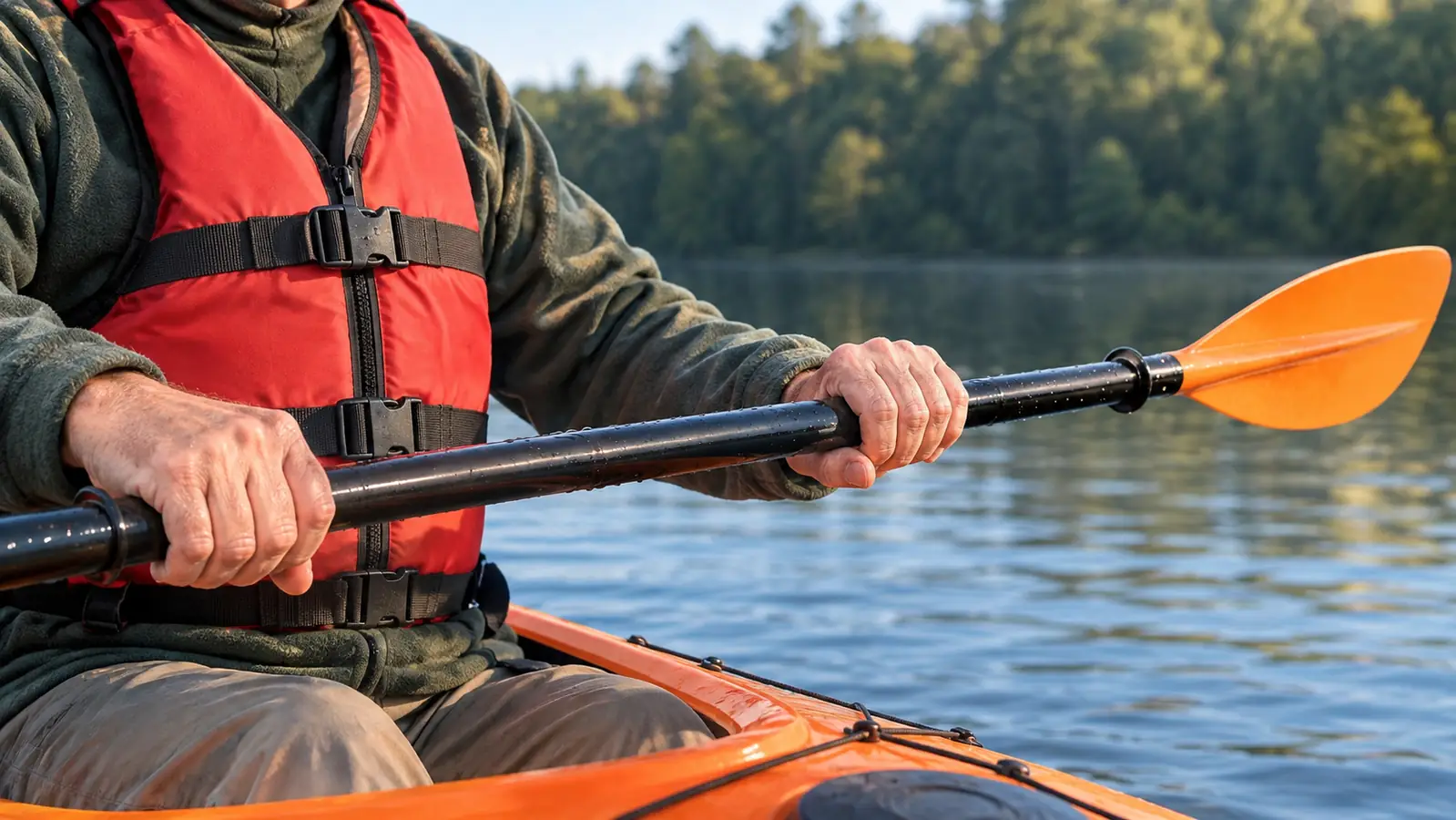
The OCEANBROAD shaft is aluminum alloy with a 1.1mm shell, and the paddle separates into two sections. Where the halves meet, a PE tube cover snugs the connection so you are not seating bare metal against bare metal. Mine has gone together and come apart a few hundred times, and it still stops solid rather than soft. I check it before I push off the same way I check my life vest straps. It has never come loose on the water, and that is the only test that counts.
The take-apart design is the reason this paddle lives in my truck instead of the garage. A one-piece 90.5 inch paddle in a 10-foot boat is a nuisance. It hangs past the tailgate, it slides around, and sooner or later you close the tailgate on it. Broken down, both halves lie flat in the bed next to the kayak and stay put. I can load the boat, drop the two pieces in, and be on the road. For a woman with a stiff lower back, fewer awkward reaches is the difference between going paddling and finding an excuse not to. Cold mornings tell you a lot about a joint. In April the truck bed is wet with dew and my hands are stiff, and I have put this paddle together in the dark more times than I can count, by feel alone. The halves line up and seat without me having to look at them. I have never had to fight it or wiggle it into place, and that is a small thing that turns into a big thing at five in the morning with a thermos in your other hand.
The habit I would pass along is simple. Take the joint apart at the end of the day and let it dry. Grit from a creek bank works into anything, and a joint packed with sand stops seating the way it should. I keep a rag in the truck for exactly this and wipe both ends down before I put the halves away. That is not a knock on this paddle. It is what two-piece gear asks of you, and it takes about ten seconds.
The Blades and the Three Locking Positions
The blades are fiberglass reinforced PP, which suits the water I fish. I spend time in creeks where the water runs thin over gravel bars, and I have pushed off the bottom with a blade more times than I can count. Two seasons of that has not split a blade or chewed an edge. They are not the stiffest blades I have held. Push hard into a headwind and you can feel them give a little. Give is not the same as fail, though, and on flat water the trade is worth it. One morning in June I worked a creek arm that had dropped six inches overnight. Twice I planted a blade in gravel to push the boat off a bar, and once I used it to fend off a half-sunk log. Neither blade showed a mark worth mentioning. I checked the edges when I got home out of habit and they were as they started. That is not a torture test, just what a creek does to a paddle in a season, and the blades have taken it.
The three locking positions change how the blades line up relative to each other, and that is a wrist comfort question more than anything else. I set mine so I can paddle with my wrists straight instead of cocked back. If you have ever finished a long morning with a sore wrist, you know why that matters. Three positions is a small menu. It is not an infinite adjustment, and if your wrists want something between two settings, you will pick the closer one and live with it. I found my setting in the first week and have not moved it since. What I care about is that it holds, and it holds.
Weight, Balance and a Full Day on the Water
The paddle weighs 2.5 pounds. That is neither the lightest nor the heaviest thing you can put in your hands. What matters on the water is how it swings, and this one swings without dragging. I have used borrowed aluminum paddles that felt like they were pulling my shoulders out of socket by the second hour. With this one my arms are tired at the end of a long morning but my shoulders are not angry, and for somebody with a bad lower back that is the number I care about. I keep a rough note of how I feel at the ramp. On a three hour morning my shoulders are tired but not hot, and my lower back feels the same as when I got in. That was not true of the heavier paddle I used my first year or two on the water, when I would stand at the truck and stretch before I could load the boat.
Pacing matters more than the paddle, if I am honest. I take breaks. I drift and fish. I do not try to cross a lake at speed for an hour straight. On the days I forget that and lean into a wind, I feel it, and the flex in the shaft shows up as a softness at the catch. This is not a racing paddle and it does not want to be treated like one. Use it the way a recreational paddler uses a paddle and it is comfortable from the first cast to the last.
It comes with a paddle leash, which I use more than I expected. Fishing means I set the paddle down across the deck while I deal with a line, and things slide off a sit-on-top kayak. The leash ties the paddle to the boat so it is not going anywhere. On a breezy day on a lake, that is good insurance. I clip it on, I forget about it, and it has already saved me one embarrassing swim.
The Parts I Don't Love
There are things I would change. The three positions are the main one. I would like a setting between the middle and the far one, because that is where my wrists want to sit. The alloy shaft flexes when you lean on it, which is fine on a pond and less fine if you are trying to cover ground against weather. And at 2.5 pounds this is a flat-water paddle. It is not what I would want on a long open crossing or in chop.
The other thing to know is that length is a decision you make once. The paddle comes in 86 inch, 90.5 inch and 95 inch options, and whatever you pick is what you own. There is no adjusting it later. I went with the 90.5 inch because it matches how wide my boat sits and how high I sit in it. If you are taller than me, or your kayak is wider, measure before you order instead of guessing the way I nearly did.
What I Liked
- Breaks into two sections, so it stores flat in a truck bed or a hatch
- 2.5 pounds, light enough to carry one-handed with the rest of the gear
- Three locking positions let you set the blades to your wrists
- PE tube cover keeps the joint snug after hundreds of assemblies
- Fiberglass reinforced PP blades have survived two seasons of pushing off gravel
Where It Falls Short
- The alloy shaft flexes when you push hard into a wind
- Only three blade positions, with no in-between setting
- Fixed length, so you choose 86, 90.5 or 95 inches once and that is it
- The joint needs rinsing and drying, or grit works in
Two seasons, a few hundred trips in and out of the truck bed, and the joint still seats with a solid stop instead of a soft one.
Who This Is For
This is a paddle for the person who paddles calm water and wants to stop thinking about their paddle. Recreational lakes, slow creeks, farm ponds, a sit-on-top fishing kayak, a canoe you paddle alone. It suits somebody who hauls a boat in a truck bed or a small hatch and does not have room for a one-piece oar. It also suits somebody with shoulder or back trouble who wants light and simple more than stiff and fast.
If you are buying your first paddle and you do not know what length you need, this is a reasonable place to start, provided you do the measuring. If you fish from your kayak and you set the paddle down a dozen times a morning, the leash and the two-piece build both earn their keep. And if you are the sort who would rather buy one decent thing and use it for years than replace a cheap thing every season, this fits that habit.
Who Should Skip It
Skip the OCEANBROAD if you paddle whitewater, surf, or big open water where you need a stiff blade and a shaft that will take a beating. Skip it if you are touring and covering fifteen or twenty miles in a day, because you will want less flex and less weight. Skip it if you need a paddle that breaks into four pieces for a pack, since this one breaks into two. And skip it if you want to fine-tune your blade angle in small increments, because three positions is what you get.
Two Seasons In, It Is Still the Paddle I Grab
Breaks into two sections for the truck bed, weighs 2.5 pounds, and the joint still seats solid after a few hundred trips down to the water.
Amazon Check Today's Price on Amazon →