

Short answer: the GCI Outdoor SitBacker does the one thing a foam cushion cannot, which is hold your lower back up off the kayak after the first hour. A plain foam pad does the one thing it can, which is make a hard plastic seat stop biting you for about ninety minutes. Everything past that is where these two stop being the same purchase.
I am 61, I paddle a 10-foot sit-on-top on Herrington Lake and a couple of slow creeks most weekends from April through October, and I have a lower back that starts talking to me around the second mile. I own both of these. The foam pad lives in the hull of my kayak right now, and the GCI Outdoor seat is the one I actually sit in when I plan to be out for a long morning. Here is the honest split.
| GCI Outdoor SitBacker | Plain foam cushion | |
|---|---|---|
| Back support | Solid back panel with a strap that sets the recline | No back at all |
| Adjustability | Recline strap lets you sit upright to cast or lean back to watch a bobber | Nothing to adjust, it is a pad |
| Weight | 2.9 pounds, carried with a shoulder strap | A few ounces, you forget it is in the boat |
| Packing it in the truck | Folds to 3.7 by 16.5 by 16.5 inches with a portage lock | Rolls up or stuffs behind the seat and stays there all season |
| Weight rating | Rated to 250 pounds | No rating printed anywhere on it |
| Setup at the ramp | Opens with Auto-Fold Technology, no assembly, but the straps need a minute of tuning | Set it down and sit |
| Things that can fail | Straps, buckles and a folding frame | Nothing to break, it is a foam pad |
| A four hour morning | The back panel is still working at hour three | You notice the missing back around hour two |
| Best for | Paddlers with a cranky lower back who sit still and fish | Short floats, guests, kids and borrowed boats |
Where the GCI Outdoor SitBacker Wins
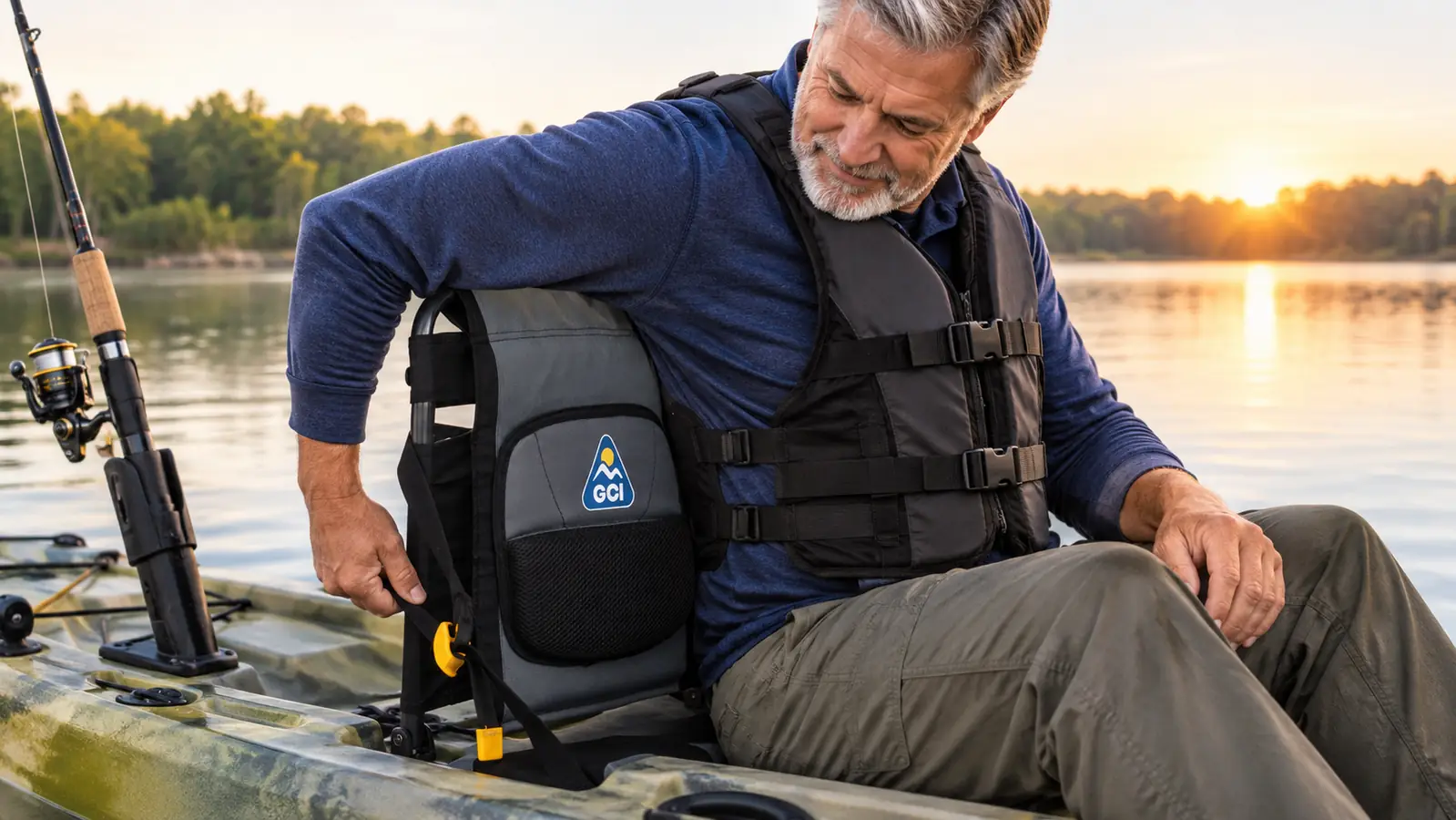
The back panel. Not a rolled pillow, not a wedge, a solid back you can lean into, plus a strap that sets how far back you want to recline. I did not think I cared about that until I spent a whole morning fiddling with it. Upright when I am casting and working a jig, tipped back a notch when I am eating a sandwich and watching a bobber. A foam pad has no opinion about any of it. At hour three the back panel on the SitBacker is still doing the job my lower back used to do, and for me that is the whole ballgame.
The rest of it is built for water and for a truck bed. It folds down to 3.7 by 16.5 by 16.5 inches, opens with what GCI calls Auto-Fold Technology, and it has a portage lock and a shoulder strap so I can haul it from the truck to the ramp with one hand while the other hand holds a paddle. No assembly required. Rated to 250 pounds, arm pads included. I am not a small woman and I have never felt it flex under me the way a wet foam wedge does when it starts sliding around on a molded seat.
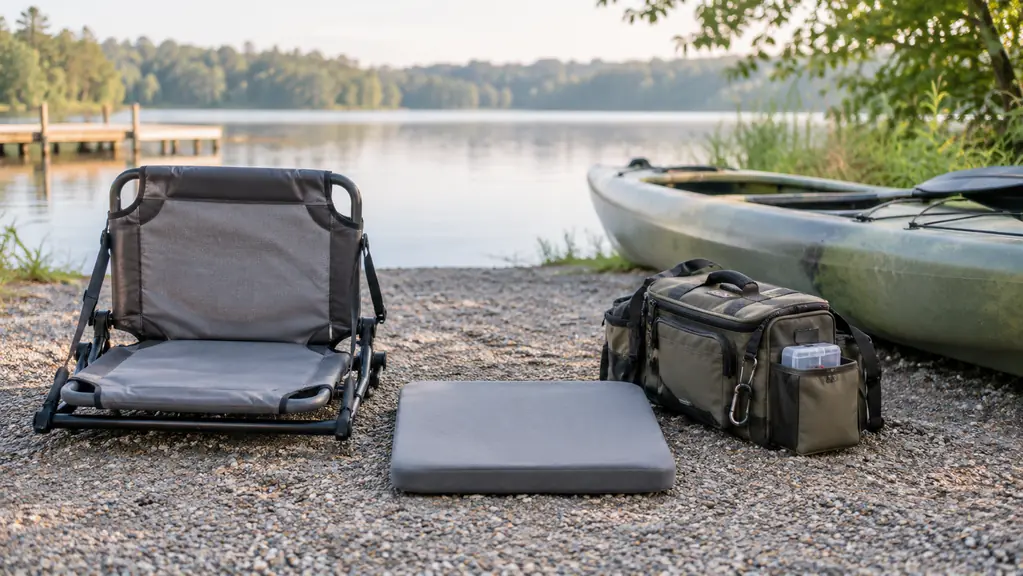
And the seat is not the same shape as the pad. The pad is a rectangle you sit on and it compresses down to a quarter inch by about the second hour, which is exactly when the molded plastic hump in the middle of my kayak starts finding my tailbone. The SitBacker sits 12.3 inches deep by 16.5 inches wide by 17.9 inches tall when it is open, so the back panel rides above the seat bottom instead of disappearing into it. The arm pads are the other thing I did not expect to use. I rest my forearms on them when I am working a jig slow along a dock, and it takes the load off my shoulders, which is a separate ache from the back ache and one I used to come home with every Sunday.
Two seasons in, the powder coated frame has not rusted and nothing has cracked. I do not leave it out in the rain, but I also do not baby it. It rides folded in the bed of a silver pickup truck on a gravel road to the ramp and has held up. The foam pad I bought in my second season of paddling went flat by August, and by the next spring I had bought another one, so the cost story is not quite as lopsided as it looks on the first trip.
Where a Plain Foam Cushion Wins
Cost and simplicity. A foam cushion is the least expensive thing you can buy for this problem, and if your back is basically fine and the only complaint is that the molded seat in your kayak feels like a church pew, a pad solves it. It weighs almost nothing, it never needs adjusting, and there is nothing on it that can crack, rust or lose a buckle. On a two-hour float in July I would be lying if I told you I could feel the difference.
It also goes places the other one will not. My foam pad stuffs into the hull behind the seat and stays there from April to October. If it blows out of the truck I am out almost nothing and I buy another one on the way home. The GCI Outdoor seat takes up real room until you fold it, and it makes you think about it, which is a small tax on every trip. On a borrowed boat, or a farm pond you fish twice a summer, that tax is not worth paying.
There is also the matter of guests. Earl paddles a borrowed kayak now and then and he is 64 with a back that has never given him a minute of trouble. When he comes along I do not put the good seat in his boat, because he does not need it and because I am not hauling two of them down the ramp. A pad goes in his boat, he fishes all morning, and he gets up out of it without a word. Not everybody needs a seat with a frame. Some people need a pad and a good paddle and they are done.
And a pad is honest about what it is. There is no strap tension to learn, no shoulder strap to untangle, no portage lock that takes three tries on a cold morning when your hands are stiff. If you are the kind of person who wants to push off the ramp in under a minute and not think about your equipment again until you are loading up, the pad wins that argument flat, and I will not pretend otherwise just because I like the other one.
Hour three is the problem. This is the fix.
Folds flat for the truck bed, opens with one hand at the ramp, and the back strap lets you sit upright to cast or lean back to watch a bobber. Rated to 250 pounds, 2.9 pounds of seat.
Amazon Check Today's Price on Amazon →What Six Years on the Water Taught Me
I started kayaking in my mid-fifties, and for the first two seasons I used a foam pad because it was what I had. I would come home, sit on the porch with a cold drink, and my lower back would stay tight for the rest of the evening. I blamed the kayak, then the paddle, then my age. My husband Earl, who is 64 and paddles a borrowed kayak when the mood hits, told me the seat was the problem. He was right, and I hate when that happens.
I went at it the wrong way first. I bought a thicker pad, the kind with the egg-crate bumps, thinking more foam meant more support. It helped for about two Saturdays and then it did what every pad does, which is compress and hold water. A wet pad in a sit-on-top is a miserable thing. It squelches when you shift your weight, it stays damp for days in the hull, and by August mine smelled like a wet dog that had been left in the sun. I tried a rolled towel behind my lower back another season. That worked for about twenty minutes, then the towel shifted and I spent the rest of the morning hiked up against nothing.
What changed was not comfort exactly. It was that I stopped holding myself up. On a foam pad you slouch back into the molded seat and your lower back spends the whole morning doing the work your seat should be doing. With a back panel behind you, that job moves off your spine. I noticed it in my shoulders first, then in how much less I wanted to quit at noon. My dog Biscuit rides along on calm days and has never once complained about either seat, so you will have to take my word for the rest of it.
A foam pad buys you about ninety minutes. The back panel is the part still working at hour four.
The Setup Detail That Decides Whether It Works
Neither of these is worth anything if it slides. The SitBacker straps down to the seat, and the strap tension is the whole trick. Set it loose and the seat shifts every time you lean forward to net a fish. Set it snug and it stays where you put it. The first time out, give yourself five minutes at the ramp before you push off, because fiddling with a strap out on the water with a paddle across your lap is a fine way to get wet.
The recline strap matters too. It runs behind the back panel, and if you leave the tail long it will find its way under your life vest or into the water. I tuck mine. The portage lock takes two or three tries before it becomes second nature, and the shoulder strap is the reason I can carry the seat and a tackle bag up the ramp in one trip instead of three. Foam has no setup at all, which is a real point in its favor. It also has no back, which is the trade you are making.
The other thing I got wrong early was where I put the seat. I had mine shoved forward against the front of the molded seat well, thinking that was where you sit. It is not, or not for me. Move it back so the back panel has something to lean against and the seat bottom sits under your hips rather than behind your knees, and the whole thing stops fighting you. It took me a full morning to figure that out, most of it spent shifting around and muttering. Now I can set it in about a minute, straps and all, because I know where it goes.
On a windy day I also run the bottom strap under the seat rather than over the sides, so the seat does not lift when I lean forward to pull a paddle back. That is not in any instructions. It is just what stopped the seat walking on me on a gusty morning at Herrington when the chop was coming over the bow and I was too stubborn to head in. If you take one thing from this whole article, take the strap tension and the seat position, because those two solve most of the complaints people have about seats like this one.
Who Should Buy Which
Buy the GCI Outdoor SitBacker if you sit still and fish, if your mornings run past two hours, if your lower back has opinions by the time you load the boat, or if the seat in your canoe was clearly designed by somebody who never sat in one. It is also the seat I would hand to anyone past 60 who is thinking about taking up paddling, because the difference between a good morning and a miserable one is usually that back panel.
Think hard about it if you fish out of a small cockpit rather than a sit-on-top. The seat is 17.9 inches tall open and it wants room behind it to lean back into, plus room to run those straps. In a tight recreational cockpit it can feel like more seat than the boat has space for, and no amount of adjusting fixes that. Sit in it in the yard first, or measure, before you assume it will fit whatever you paddle.
Buy the plain foam cushion if you take short trips, if your back is not the issue, if you are outfitting a borrowed boat for a guest, or if money is tight this season. It is not a bad buy. It is a smaller buy. It solves the hard seat problem and leaves the back support problem sitting right where it was, and only you know whether that second problem is yours.
The seat I keep in the truck, not the hull
Solid back panel with an adjustable recline, folds flat, 2.9 pounds, rated to 250 pounds, no assembly. Straps down to a canoe or sit-on-top seat and stays put.
Amazon Check Today's Price on Amazon →