

I bought the GCI Outdoor SitBacker after a Saturday on Herrington Lake that ended with me standing up in the kayak to paddle the last half mile home. Not because I wanted to stretch my legs. Because sitting down had stopped being something my lower back was willing to discuss. I am 61 years old, I drove a school bus for a living for a lot of years, and my back has been stiff since roughly the second Bush administration. When it goes out on the water, it goes out for the whole day.
So here is the honest version, up front. The SitBacker is sold as a canoe seat with back support, and that is exactly what it is. I run it in a 10-foot sit-on-top fishing kayak that weighs about 60 pounds, because that is the boat I own and I am not buying a second one to match a seat. Plenty of people at the ramp near me are doing the same thing. After a full season of weekends from April into October, on lakes, slow creeks and a couple of farm ponds, I know what this seat does well and I know exactly where it annoys me.
The Quick Verdict
Real, adjustable back support that folds flat and carries on a strap at under three pounds. It is a canoe seat, though, so in a sit-on-top kayak it sits on top of your molded seat and raises you up. Know that going in and you will be glad you bought it.
Amazon Check Today's Price →The seat that got me fishing past mile two again
Adjustable back support, folds flat, 2.9 pounds, rated to 250 pounds, and it goes from folded to sitting in about ten seconds. Mine has ridden in a truck bed since April and it still folds and locks the way it did on day one.
Amazon Check Today's Price on Amazon →How I've Been Using It
My season runs from the first warm Saturday in April until the water gets too cold to talk me into it, usually late October. Most weekends that means Herrington Lake, sometimes a slow creek with barely any current, and two or three times a summer a farm pond belonging to a neighbor who does not mind me and Earl showing up with kayaks in the truck bed. A typical trip is three to five hours on the water, with a stop on a gravel bar for lunch and a stretch.
Setting up is not complicated. The GCI Outdoor seat opens with the Auto-Fold Technology, the portage lock clicks it shut while you carry it, and then it sits on whatever you set it on. In my kayak that means on top of the molded seat pan that came with the boat. The 17 inch seat strap runs where it needs to run and the whole thing is stable enough that I stopped thinking about it after the first trip. Ten seconds, maybe fifteen if I am holding a coffee.
What I carry is not glamorous: one rod, a small tackle bag, a dry bag with a sandwich and my phone, a bottle of water, and Biscuit on the calm days when Earl stays home. The seat does not interfere with any of that. It sits low enough that my feet still reach the foot braces and high enough that my hips are not complaining by hour two. That balance is the whole trick, and it took me one trip to trust it.
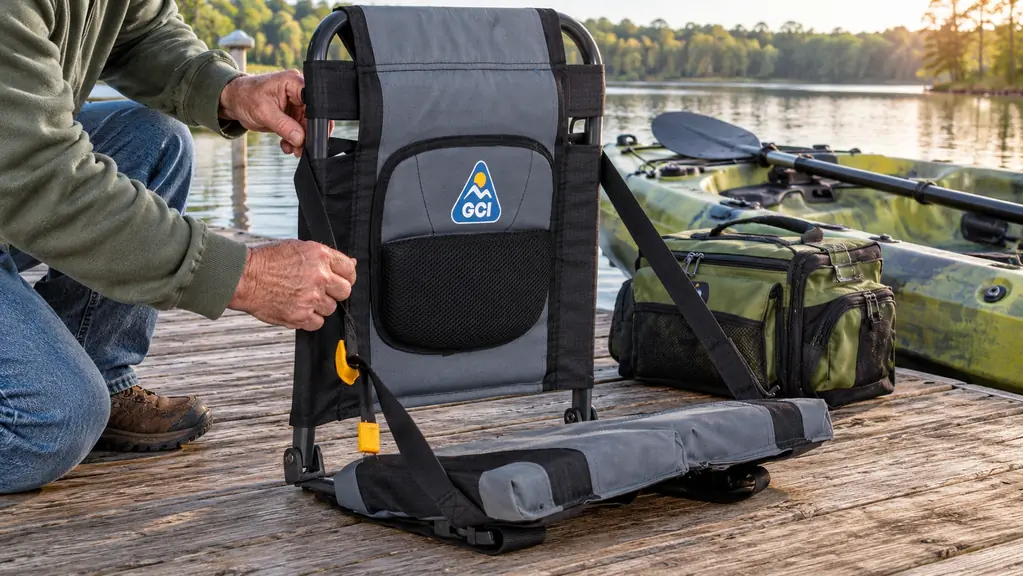
The Back Support Is the Whole Reason to Buy This
The listing calls it patented Back Comfort Technology with customized reclining, which sounds like catalog language and mostly is, but the thing it describes actually works. There is a strap you adjust to set how far back the backrest leans, and once you set it, it holds. I set mine fairly upright for paddling across open water and let it back a notch when I stop to fish a bank. That is the entire adjustment and it is the reason I keep the seat in the truck instead of the shed.
Compare that to the molded seat in a sit-on-top, which is a piece of plastic shaped like an opinion about posture. I tried a foam cushion before this. The cushion raised me an inch and did nothing for the ache between my shoulder blades. The SitBacker has a solid back panel that reaches roughly to my mid shoulder blade, and that reach is the difference between a five hour day and a two hour day for me.
It does not fix your shoulders. Nothing fixes your shoulders except paddling less and stretching more, and I am not doing either. What it does is let me sit upright instead of slouched, and sitting upright is what stops the shoulders from doing all the work. The arm pads that come with it are a fine place to rest your forearms while you are drifting. For a full paddle stroke they get in the way of my elbows, so I paddle with my arms inside them and rest on them when I stop. That is a fair trade, not a flaw.
Folding, Carrying and Living With It
Folded, the seat measures 3.7 inches deep by 16.5 wide by 16.5 tall. Open, it is 12.3 by 16.5 by 17.9. It weighs 2.9 pounds. What that means in real life is a flat square roughly the size of a small suitcase lid. It slides behind the truck seat, stands up in the corner of the shed, or rides in the open area of the kayak without eating the space a folding chair would eat.
It arrives with no assembly, which I appreciated more than I expected to. I am not handy and I have thrown away hardware from plenty of things that swore they needed none. Out of the box: unfold, set the strap, sit down. The powder coated frame has been rained on twice and left in the bed of the silver pickup for a full week, and it still folds and locks the way it did the day it came.
Where the SitBacker Falls Short
Now the honest part. This is a canoe seat. In a canoe, you sit on a bench, the seat sits on the bench, everything is level and everyone is happy. In a sit-on-top kayak, the SitBacker sits on top of the molded seat pan, which means you are now about three and a half inches higher than the boat's designer intended. On flat water I barely notice. In a chop, or climbing in and out at a dock, I notice. My first trip out I came home and told Earl the boat felt tippier. It did. It was.
The recline is a strap, not a lever. You set it where you want it before you push off, and if you decide to change it mid-paddle you are doing that with two hands or not at all. If you fish with one hand on a rod most of the afternoon, plan your angle before you leave the ramp. That is the one place where a purpose-built padded kayak seat with a lever has an advantage over this one.
One more thing to check before you buy. The seat is 16.5 inches wide and 16.5 inches deep in its footprint, and it is rated to 250 pounds. I am not a small woman and I am nowhere near that limit, but if you are a big paddler in a narrow boat, do the measuring before you order, because a seat that does not sit flat in the well is a seat that rocks all day and you will hate it by noon.
What I Liked
- Adjustable back support with a recline you set once and forget
- Folds flat and carries by a shoulder strap at 2.9 pounds
- Portage lock keeps it shut while your hands are full
- Rated to 250 pounds and arrives with no assembly
- Powder coated frame has shrugged off a season of truck bed abuse
Where It Falls Short
- It is a canoe seat, so in a sit-on-top it sits on top of the molded seat and raises your center of gravity
- Folds flat, not small: 3.7 by 16.5 by 16.5 still takes up room in a hatch or a crowded canoe
- The recline is a two-handed strap adjustment, not a one-handed lever
- Arm pads are for resting, not for paddling, and they crowd a full stroke
It fixed the thing that was making me quit early, and it did not fix anything else. That turned out to be enough.
How This Compares to the Cheaper Fixes
I tried the cheap fixes first, because that is how I am built. A foam pad, then a padded cushion with a low back, then a bungee cord holding a stadium seat in place, which lasted one trip and one gust of wind off the water. If I added up every one of those attempts it would have covered a good chunk of this seat. If your back only aches after five hours, the pad is cheaper and fine. If your back calls the day at hour two, buy the seat.
The difference is the solid back panel and the fact that you adjust it instead of hoping it lands where you need it. A pad sits under you, so it does nothing for your back. A low-back cushion gives you something to lean on until it folds forward under the weight of a wet afternoon. This one has a frame and a strap, and the strap is what holds the angle you chose. That is the whole engineering story and it is enough.
The Kayak Question, Answered Honestly
If your sit-on-top has a molded seat well, take a tape measure out to the driveway before you order. The GCI Outdoor seat is 16.5 inches square in its footprint, it weighs 2.9 pounds, and it is rated to 250 pounds. Most fishing kayaks will take it. Some will take it and sit you high enough that you feel the difference the first time a pontoon wake rolls under you. That is not a defect in the seat. It is a mismatch between a canoe seat and a kayak, and only you know how much of your day is spent in chop.
What I did about it: I kept the seat and accepted the height, because the back support bought me three more hours on the water and the extra height cost me a little confidence on windy afternoons. If you paddle big open water with heavy boat traffic, you may make the other trade and go with something built for a kayak. Neither of us is wrong. The point is to know which trade you are making before the box shows up on the porch.
Who This Is For
This is for you if your back is the thing that ends your day. If you paddle a canoe and want a backrest that folds flat and carries on a strap, this is close to a no-brainer and I would not spend much time thinking about it. If you are in a sit-on-top fishing kayak, you have a seat well that will take a 16.5 inch square, and you fish calm water and slow current like I do, you will get your use out of it.
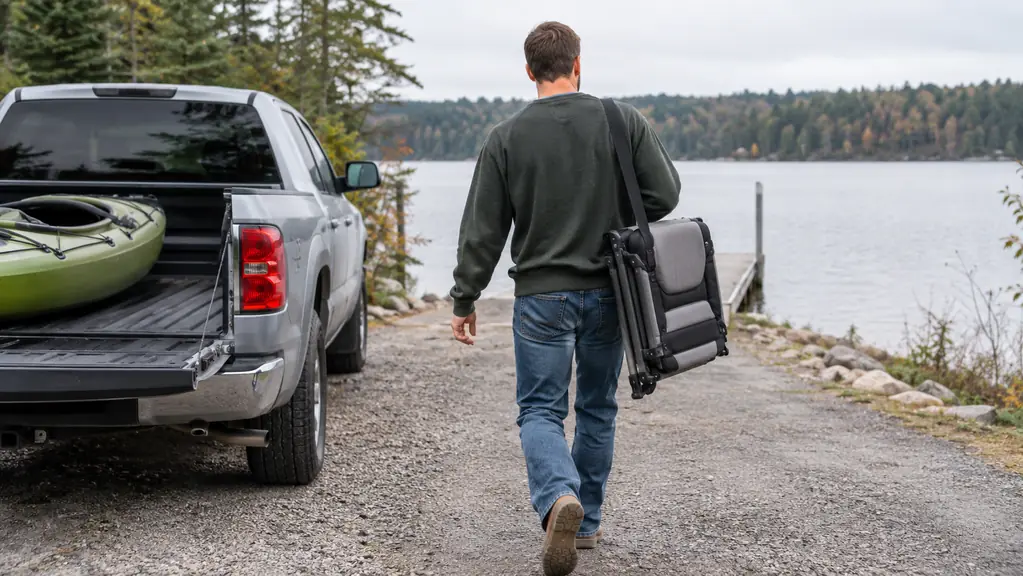
It is also for anyone who loads and unloads alone. The shoulder strap and the portage lock mean I can carry the seat from the truck to the water in one hand with the tackle bag in the other, and at 61 with a stubborn back that matters more than any line on the box. Nobody warns you that the carrying is half the work of kayaking. This seat makes that half easier.
Who Should Skip It
Skip it if you need a recline you can change one-handed with a fish on the line. Skip it if you paddle water with a lot of wake and you are already uneasy about stability, because sitting three and a half inches higher will not settle your nerves. And skip it if your kayak's seat well is smaller than 16.5 inches square, because no amount of wanting it to fit is going to make it fit.
Skip it too if you were hoping for a seat that packs down to the size of a water bottle. It folds flat, not small. 3.7 by 16.5 by 16.5 is a flat square, and it takes up the room a flat square takes up. In a truck bed with a bed extender that is nothing. In a hatch or a crowded canoe with two other people and a cooler, it is something you will have to think about every single trip.
What I'd Tell You at the Bait Shop
If we were standing in line at the counter and you asked me whether to buy it, I would ask you two questions. First, what boat? Canoe, yes, go. Sit-on-top, measure the well and be honest with yourself about how much chop you actually paddle in. Second, is it your back that hurts or your rear end? If it is your rear end, get a pad and save your money. This seat is built to hold your back up. It does that job and it is not a cushion.
And I would tell you the unglamorous part. My shoulders still get tired. My hands still get stiff. I still pull onto a gravel bar and stretch and complain to Biscuit about getting old. What changed is that the break happens because I want lunch, not because I cannot sit in the boat one more minute. For what I paid and what I got, that is a trade I would make again next April without thinking twice.
If your back is what ends your day, start here
Adjustable back support with a recline that holds, folds flat to 3.7 by 16.5 by 16.5, carries by a shoulder strap at 2.9 pounds, rated to 250 pounds. Measure your seat well first, then go fishing.
Amazon Check Today's Price on Amazon →