
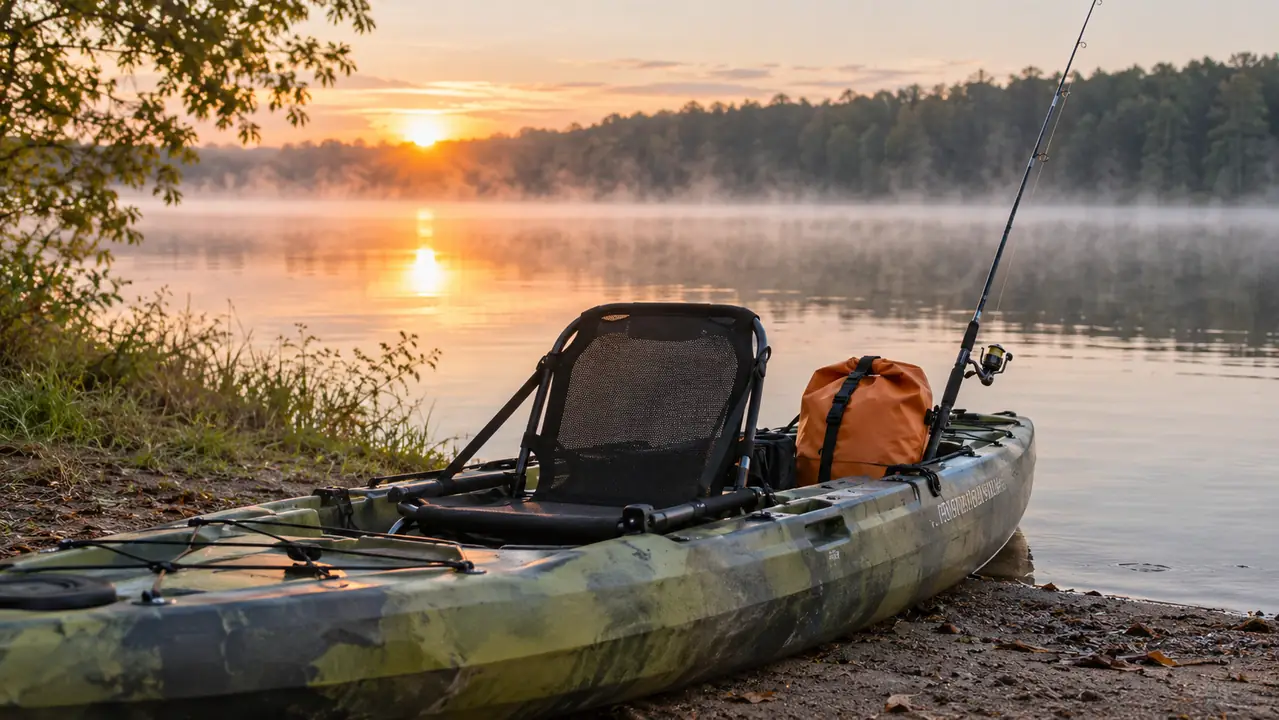
The first thing nobody tells you about a roll top dry bag is that the bag is not the waterproof part. You are. Roll it twice, snap the buckle and call it done, and water will find the gap. I learned that on Herrington Lake one April morning when the fog was so thick I could not see the far bank, and my sandwich came out of the bag sitting in an inch of lake water. So this is not the kind of review that tells you the Earth Pak dry bag is wonderful and stops there. It is the kind that tells you what it does well, what it does not, and the two habits that decide whether your gear comes home dry.
I am 61, retired from driving a school bus, and I paddle a 10-foot sit-on-top fishing kayak on Herrington Lake and a few slow creeks and farm ponds around Danville. Six years in, my lower back is stiff by the two hour mark and my shoulders complain about anything extra I carry. I bought the 20 liter Earth Pak bag for two reasons. More than 33,000 reviews is a lot of people to be wrong, and the bag weighs 13.6 ounces, which is not enough to notice in the truck bed or in the tank well. What follows is one full season of weekends, April through October.
The Quick Verdict
A tough, genuinely waterproof 20 liter sack once you learn to roll it properly. The strap is thin, the single compartment makes you dig, and it holds less than the liter count suggests. Still the bag I reach for every Saturday.
Amazon Check Today's Price →The bag that has not been replaced after a full season of lake mornings
20 liters, 13.6 ounces, 500D PVC shell with a roll top seal, and an IPX8 waterproof phone case in the box. Rated 4.7 by more than 33,000 buyers.
Amazon Check Today's Price on Amazon →How I Have Used It, and What Goes In It
A normal Saturday for me is on the water by seven and off by noon. The 20 liter bag rides in the tank well behind my seat, clipped to a deck line with a short piece of paracord. Inside there is lunch, a dry long sleeve shirt in case the morning stays cool, my phone in the case that came with it, keys, wallet, sunscreen, a small first aid kit and a folded hand towel. That is a full load and the bag still closes with room to roll three times. My pliers and my tackle box stay out of it. Treble hooks and a coated PVC shell do not mix, and a hook puncture is the one problem no amount of rolling will fix.
Earl, my husband, borrows a kayak now and then and throws his gear in a canvas tote, which is why he came home with a wet phone in June and I did not. The bag has been in the bed of a silver pickup under a bed extender, on a sandy bank, on gravel, and once on the floor of a jon boat that took on more water than the owner wanted to admit. It has not leaked since I started rolling it right, and that qualifier is doing a lot of work in that sentence.
Loading it is the part nobody warns you about. A roll top sack has no frame, so it does not stand up on its own. On a windy dock you are holding the bag open with one hand, stuffing with the other, and hoping the whole thing does not flop into the lake. What I do now is load it on the tailgate before I walk down to the water. Ten seconds of planning saves a wet sock and some language the church crowd would not approve of.
A Saturday in May taught me the rest of it. The wind was out of the southwest at maybe fifteen, the kind that pushes a sit-on-top sideways while you are trying to set up, and I had the bag open on the deck with my back turned for maybe twenty seconds. It went over. Nothing inside was wet because the buckle was snapped, but the outside came up slick and I had to dry my hands on my shirt before I could get a grip on the top to open it again. What I took from that morning is that the bag gets closed the moment I am done taking something out of it, not at the end of the trip when I get around to it. That one habit has done more for my gear than anything else I have bought.
There is a utility pocket on the outside, and it is small, which is the point. It holds my fishing license and a spare hair tie, and that is about the size of it. I would not put a phone in it and I would not put keys in it, because it is not the sealed part of the bag. Treat it as a place for things you can afford to get wet and it does its job.
What the Roll Top Actually Does Well
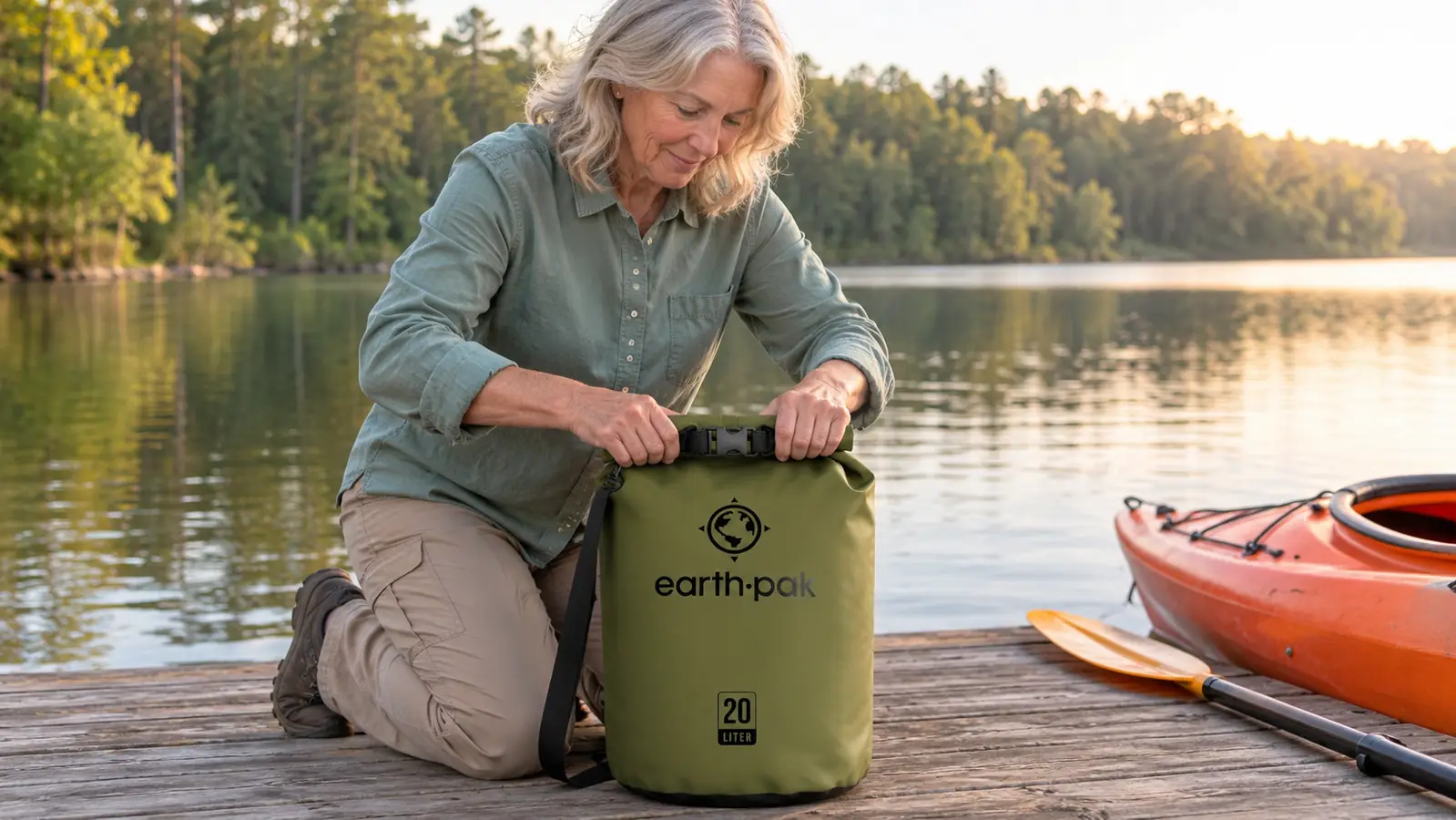
The seal is the whole point and it works, provided you close it like you mean it. Line up the top edges, press the air out, fold it over at least three times, then bring the two ends of the snap closure together. Three rolls is the number. Two rolls will pass a little water in a chop and it will not tell you until you open the bag at the truck. Once closed properly the top is genuinely watertight, and the Earth Pak sack floated when I set it in the shallows to test the seal, which is more than I can say for the contents of Earl's tote.
I tested that seal at home in the kitchen sink in April before I ever took it out on the water, because I would rather find out in the kitchen than in the middle of the lake. I put a dry paper towel inside, rolled it three times, snapped it, and held it under water in a five gallon bucket for a full minute. The towel came out dry. Then I did the same thing with two rolls instead of three, and I could feel a damp spot on that towel after about thirty seconds. That is the whole difference right there, and it is why I keep saying three rolls like a broken record.
The 500D PVC shell is the other thing. It is thick enough that gravel, dock edges and the aluminum gunwale of a borrowed canoe have not left a mark that mattered. I have dragged it across a parking lot by the web handle, which I do not recommend and which it survived. After a season it still looks like a bag I bought this spring. That is not a small thing when the alternative is replacing gear every year.
It also does something I did not expect to care about. It keeps the inside of the kayak tidy. Everything wet, sandy or smelly goes in one place, and at the end of the day I turn the bag inside out over the porch rail, hose it, and hang it by the strap. Twenty minutes later it is dry and there is no lake water pooled in the footwells. For a 61-year-old back, not bending into the hull to fish out a soggy towel is worth something.
Three rolls is the number. Two rolls will pass water in a chop, and it will not tell you until you open the bag at the truck.
The Stuff Nobody Mentions
The bag is one single compartment. There are no dividers, no mesh pockets inside, nothing to keep your keys away from your sandwich. If the thing you want is at the bottom, you take everything out to get it. I now pack in the order I will need things, which sounds organized and is really just me being tired of digging for sunscreen with wet hands while the fish are biting.
The roll top eats space. The bag measures 9.5 inches by 9.5 inches by 17 inches, and 20 liters sounds generous until you realize that a closed roll top takes two or three inches of that height out of play. My honest estimate is that a fully rolled 20 liter bag holds about what a plastic grocery sack and a half holds. If you are packing for two people, or for a full day with a change of clothes, go bigger. I would buy the 30 liter if I were starting over, and I would still keep the 20 for short mornings.
The strap is thin. The 20 liter comes with a 24 to 42 inch adjustable shoulder strap, and it is fine when the bag is light. Load it with a full lunch, a bottle of water and a wet towel and it will cut into your shoulder on the walk from the truck to the ramp. The walk at the ramp I use is maybe four hundred yards from the parking lot down to the water, and I have made that walk with a full bag more times than I can count. Halfway down, the strap is a rope over my shoulder and I have shifted the bag to the other side twice. Earl carried it for me once in July and said something unkind about that strap that I will not repeat here. If your walk from the truck to the water is short, none of this matters at all. Mine is not short.
The material is stiff, and it gets stiffer when the weather turns. In July it folds up small enough to shove under the seat. In late October, with the mornings in the forties, it holds a crease and does not want to flatten. I have taken to leaving it unrolled on the porch overnight the night before a cold trip so it relaxes enough to load without a fight. That is the trade for a shell that shrugs off gravel. Also, and this is true of every roll top bag, whatever goes in wet comes out wet. A damp towel will fog the inside and your dry shirt will smell like a lake. Pack damp things in a separate sack or do not pack them.
What I Liked
- Roll top seal with a snap closure holds tight once you commit to three folds
- 500D PVC shell takes gravel, dock edges and boat rash without tearing
- IPX8 waterproof phone case is included, not sold as an add-on
- 13.6 ounces and a 9.5 by 9.5 by 17 inch footprint fit a kayak tank well
- 24 to 42 inch adjustable shoulder strap on the 20 liter carries it from truck to ramp
- Rinses and dries fast when you turn it inside out
Where It Falls Short
- One compartment and no inner pockets, so you dig for anything at the bottom
- Roll top removes two or three inches of usable height
- Thin shoulder strap bites when the bag is loaded heavy
- PVC holds a crease in cold weather and does not fold flat
- Wet gear stays wet inside until you unpack it
- The utility pocket is small and not sealed
The Phone Case Is Better Than I Expected
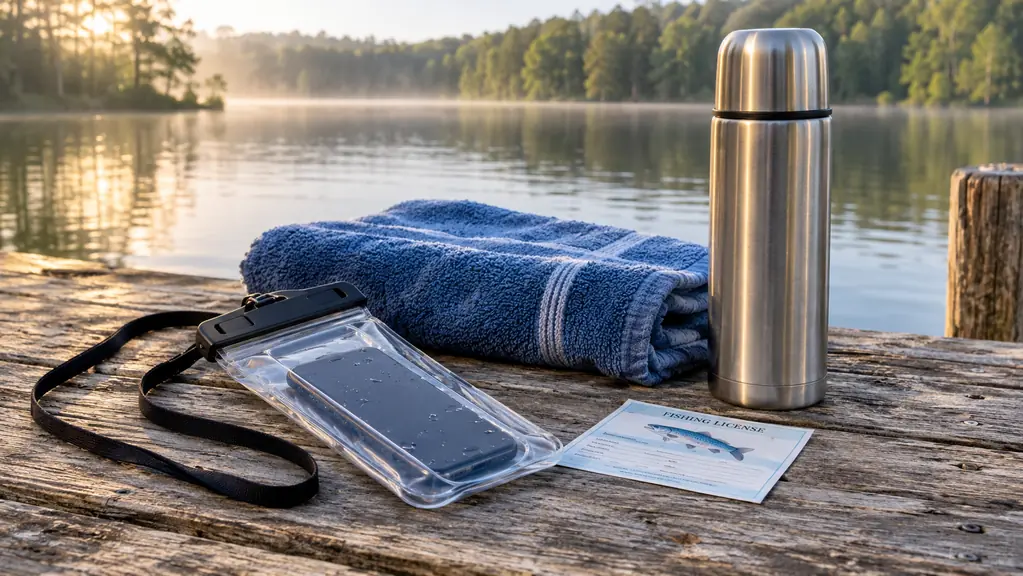
The bag ships with an IPX8 certified waterproof phone case, and I figured it was a giveaway item. It is not. My phone has ridden in it on every trip since April, and it stayed dry through rain, spray and one memorable moment when I set the bag down in six inches of water while I untangled a line. The plastic softens the touchscreen a little, so typing a text through it is slow, but taking a photo through it worked fine, and the lanyard means it hangs around my neck instead of going into the lake.
The one catch is that it takes up room. A phone in a case is thicker than a phone, and it is one more thing to keep track of. On days when I am only out for two hours I leave the case at home and put the phone in the bag. On days when I want it in my hand, the case earns its place.
Sizing, and the Question I Get Asked Most
The Earth Pak line comes in 5, 10, 20, 30, 40 and 55 liters. The 10 and 20 liter sizes include the 24 to 42 inch adjustable shoulder strap, and the bigger sizes carry differently, so check the listing for your size before you order. If you are a kayak angler packing for one person for half a day, the 20 is right at the line. It fits a tank well, it does not crowd the deck, and it slides behind the seat. If you camp off the boat or carry a change of clothes for after work, the 30 is the smarter buy and I would not argue with you.
I measured it in the truck bed with a tape before I committed to it, because I am that person now. At 17 inches tall the bag sits about a hand's width below the top of my tank well, so it does not block my view when I turn to look behind me, and on a fishing kayak that matters more than I expected it to. A taller bag in that spot catches the wind and turns into a sail. I have watched people strap a 40 liter sack upright behind the seat and fight it all morning long. The 20 sits low enough to stay out of the way, which is one more reason I would not go bigger unless I truly needed the room.
The other question is whether it will fit. On a sit-on-top kayak you are not worrying about a hatch, you are worrying about the tank well and the deck. Nine and a half inches square and 17 inches tall is roughly the footprint of a milk crate, so if a crate fits back there, this does. That is the measurement I would check before ordering, not the liter count.
Who This Is For
This bag is for the paddler who wants one place to put the things that must stay dry and does not want to spend the morning thinking about it. It suits calm water, slow creeks, farm ponds and lake mornings, which is my whole world. It suits a sit-on-top kayak with a tank well or a deck with a place to clip a line. It suits someone who will take ten seconds to roll the top properly every single time, because the bag rewards that habit and punishes the other one. If you fish from a kayak and you are tired of a wet phone and a soggy sandwich, this is the fix.
Who Should Skip It
Skip it if you want a pack with structure, a hip belt and a pocket for every item. This is a sack with a strap, and it will not organize your gear for you. Skip it if you are packing for two people or for an overnight, because 20 liters will not do it and you should be looking at the 30 or 40. Skip it if you paddle in cold weather often and want something that folds flat when empty, because the PVC holds a crease. And skip it if you are not going to roll the top three times. No dry bag ever made will save gear from a closure that was done halfway.
If you will roll it right, this is the one that keeps your gear dry
20 liter roll top, 500D PVC, 13.6 ounces, IPX8 phone case included. Read the current reviews from kayak anglers and check today's price before your next trip.
Amazon Check Today's Price on Amazon →