

I bought the OCEANBROAD kayak paddle in April, paddled it most weekends through October on Herrington Lake and a handful of slow creeks around Boyle County, and I am going to tell you the parts the product page leaves out. Not because it is a bad paddle. Because the complaints I have are the kind you only find after the return window shuts, and you ought to hear them before you buy one. There is plenty to like here. There are also three things that aggravate me on every single trip, and one of them nearly got this paddle sent back in June.
The short version. The OCEANBROAD is a two-piece paddle, 90.5 inches long, with an aluminum alloy shaft and a 1.1mm wall, a fiberglass-reinforced polypropylene blade, three locking positions for blade angle, and a paddle leash in the box. It weighs 2.5 pounds. On flat water in a sit-on-top fishing kayak, doing the kind of paddling most of us actually do, it works and it works well. It is not the paddle I would want in current pushing me toward a fallen tree, and it is not what I would hand somebody with bad shoulders who plans to be out six hours.
The Quick Verdict
A dependable two-piece paddle for calm water and casual fishing, held back by aluminum weight, a cold shaft in spring, and a coarse three-position blade setting.
Amazon Check Today's Price →If your water is flat and your trips run a few hours, this is the one in my truck bed
Two pieces, 90.5 inches, three blade positions, a leash in the box, and a joint that has stayed tight all season. It is what I reach for every Saturday from April to October.
Amazon Check Today's Price on Amazon →A typical Saturday for me is four hours on the water. I launch before the bass boats get loud, paddle a mile or so up the lake, drift and fish a point, then paddle back against whatever breeze came up while I was not paying attention. My kayak is a 10-foot sit-on-top, about 60 pounds, and it rides in the bed of a silver pickup with a bed extender. Biscuit, my hound, comes along on the calm days and sits between my knees, which means I spend part of every trip paddling around a 45-pound dog with opinions. Earl, my husband, joins me now and then in a borrowed kayak.
How I've Used It
The paddle lives behind the truck seat in two pieces when it is not in use, and that is the whole reason I wanted a two-section shaft. A one-piece paddle is stronger, I know that, but a one-piece paddle does not ride quietly behind a seat and it does not go into the garage without me moving the lawnmower first. The two sections push together, the shrinking PE tube cover slides over the joint, and it is ready. From the truck to the water is maybe thirty seconds of assembly. I have done it in the dark at a ramp with a headlamp and did not have to think about it. Packed down, the two halves measure about 47 inches, short enough to lay flat behind the seat and long enough that I am not wrestling it through the cab door. My first season I used a borrowed one-piece paddle, and every launch started with me sliding it in at an angle and hoping it would not catch the headliner. I gave that up. A paddle I can stow in ten seconds is a paddle I actually bring, and that counts for more than a stiffer shaft.
Most of my water is flat. Herrington Lake on a weekday morning is as calm as a bathtub. The creeks I fish have current so gentle you can paddle upstream holding a cup of coffee in your other hand. The ponds are ponds. I say all of that up front because this paddle was built for exactly that water, and if you are reading this hoping it will handle something else, it will not, and no review is going to change that for you.
What OCEANBROAD Gets Right
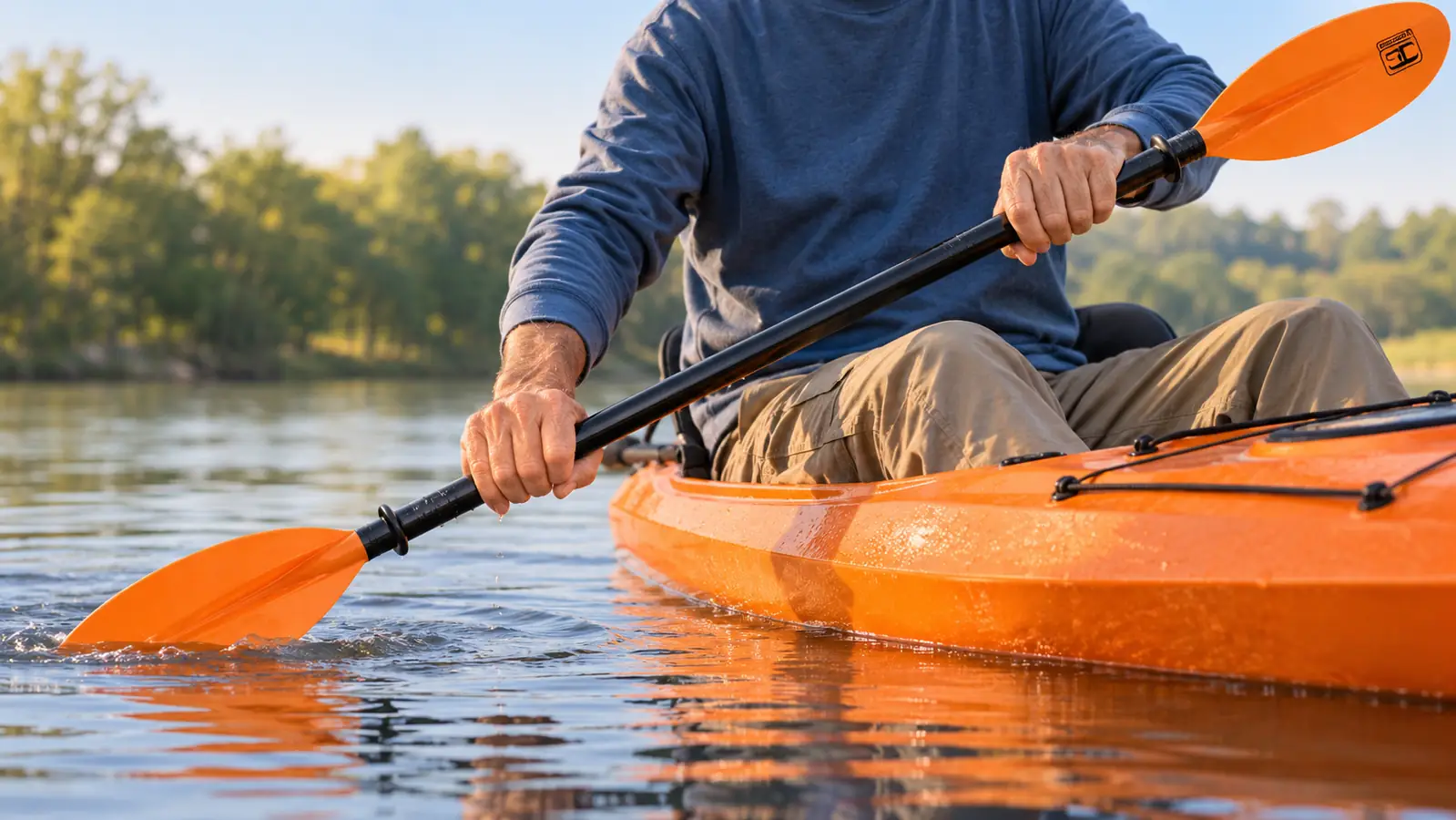
The joint is the thing I expected to fail, because on inexpensive two-piece paddles the joint is always the first thing to go. It shows up as a wobble you feel before you see it, then a rattle, then a paddle you do not trust anymore. Mine has stayed tight through a full season. The shaft is an aluminum alloy with a 1.1mm wall, and OCEANBROAD puts a shrinking PE tube cover over the connection. It is a plain solution and it works. The sleeve takes the slop out of the joint and it keeps lake water from working into the seam. If you take one thing from this review, take that one.
The blade is fiberglass-reinforced polypropylene, which in practice means it is stiff enough to catch water and tough enough to survive me. I have bounced it off creek rock more than once and there is not a chip in the edge. Load it hard and there is a little flex, and I have decided I like that, because a blade with some give is easier on my shoulders than a board. That is a preference, not a fact. Some paddlers hate flex and they should know it is here before they buy.
It also comes with a paddle leash, which sounds like a throwaway until the first windy day on a big lake when you set the paddle down to unhook a fish and watch it start to slide. Tethered, it does not leave. Nearly 7,900 buyers have rated this paddle 4.7 out of 5, and after a season with it that number does not surprise me. It is a sensible paddle for ordinary paddlers who are not trying to win a race.
The Flaws Nobody Puts in the Listing
Two and a half pounds does not sound like much. Pick it up in the store and it feels like a broomstick. Now hold it out at arm's length for four hours with a blade full of water on the end of it, and it stops feeling like a broomstick. Aluminum is less expensive than carbon and it is heavier than carbon, and there is no arithmetic that makes that go away. By hour three on a windy day my right shoulder is filing a complaint. Here is the day it got to me. Late June, I launched at daylight and paddled up a creek arm to a sunken brush pile I like. The wind was supposed to stay under five miles an hour. It did not. By the time I turned around it was pushing a steady chop straight down the arm, and that is a forty-minute crossing when the water is flat and closer to an hour when it is not. I made it back, but I made it with my right hand choked up on the shaft, and my shoulder told me about it that night when I tried to sleep on my side. If you paddle two-hour trips, this will never bother you. If you paddle six-hour days, it will bother you plenty.
Aluminum is also cold. On an April morning with frost still on the ramp, that shaft feels like a piece of pipe that has been sitting in the barn since November. The first cold morning was the second Saturday in April, frost on the ramp and thirty-eight degrees according to the truck. I got about a quarter mile out before my fingers quit working properly, turned around, and went home. That is not the paddle's fault exactly, but it is a thing aluminum does that wood and composite do not, and nobody mentions it in the listing. I started keeping a pair of thin gloves in my life jacket pocket from March through May and again in October, and that fixed it. It is a small thing. It is also the kind of small thing that decides whether you actually go out on a cold morning or roll over and go back to sleep.
The three locking positions are the one feature I would change if I could change one thing. Three positions means three choices for how the blade sits relative to your hand, and if your wrist wants something in between two of them, you are out of luck. I found a setting that works for me in the first week and I have not moved it since. But a paddler with wrist trouble, the kind who needs to fine-tune the angle by a few degrees, will not find that here. Three positions is a coarse adjustment dressed up as a feature.
Last one, and it is minor, but it is real. On a wet and windy day water runs down the shaft to my hands. There is nothing on the shaft to stop it. I noticed it in a crosswind in May and I notice it every time the wind picks up now. A towel in the cockpit helps. So does paddling with the wind instead of across it, which is free advice that applies to any paddle you will ever own.
What I Liked
- Two-piece shaft breaks down and rides behind the truck seat without fuss
- The joint has stayed tight through a full season of hard use
- Fiberglass-reinforced blade has taken rock hits without chipping an edge
- Three blade positions cover what a casual paddler needs
- Comes with a paddle leash, which matters more than people expect
- Sold in 218cm, 230cm and 241cm so you can match your kayak width
Where It Falls Short
- 2.5 pounds of aluminum gets heavy by hour four
- The metal shaft is cold on spring and fall mornings
- Only three blade angle positions, with no fine adjustment
- The blade flexes under a hard, loaded stroke
- Not the paddle for current, strong wind or long open crossings
The joint is where inexpensive two-piece paddles go bad, and mine is still tight after a season of being thrown behind a truck seat.
The Three Blade Positions, and How I Set Mine
Blade angle is not a fancy concept. It is how the flat of the blade lines up compared to your knuckles. Line them up level and you get a neutral stroke that is easy on the wrist. Rotate the blade and you can slice the recovery through the air with less wind drag, which matters on an open lake with a breeze running across it. Three positions gives you a neutral setting, a moderate rotation and a fuller rotation. Nothing in between.
I run mine on the middle setting. Earl, who has longer arms and a longer reach than I do, tried the fuller rotation on a borrowed trip and liked it, then went back to the middle on the way home because he said it made him think about his hands too much. That is the honest truth about blade angle for a recreational paddler. Whatever setting lets you stop thinking about the paddle is the right one, and this one gives you three shots at finding it.
Picking the Right Length, Because This Is Where People Go Wrong
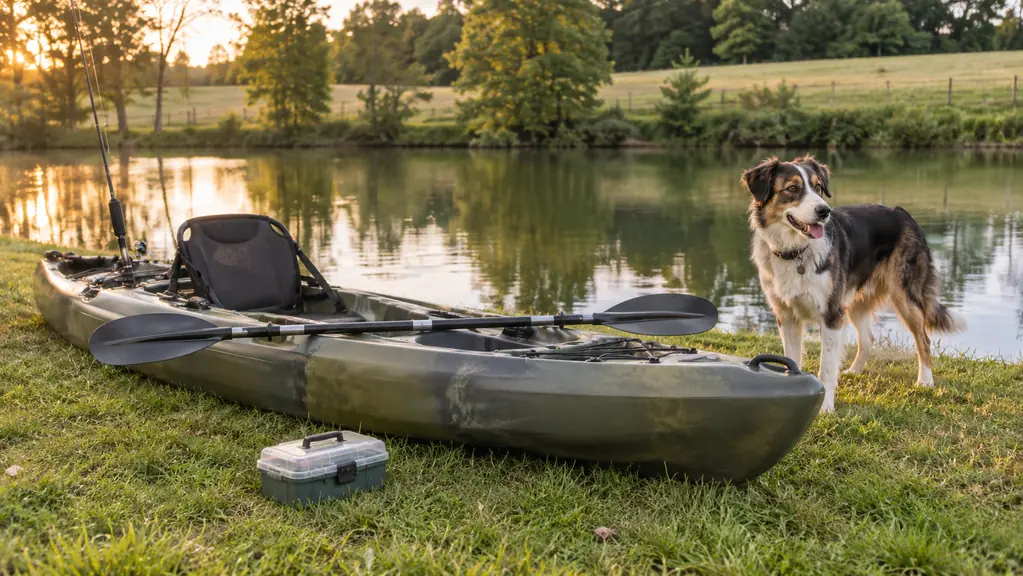
OCEANBROAD sells this paddle in three lengths: 218cm, 230cm and 241cm, which is 86, 90.5 and 95 inches. I have the 230cm version, and it is what I would buy again for a 10-foot sit-on-top fishing kayak, because those boats are wide and a wide boat pushes your hands out. If your kayak is narrow, or you sit low in it, the 218cm will feel better and you will not be lifting as much shaft on every stroke. If you are tall with a long torso, or your kayak is the width of a dining table, go to the 241cm. When I ordered, I nearly bought the 241cm because the listing made it sound like the safer choice. That would have been a mistake on a 10-foot boat. I measured on the grass in the yard, came up with something between the 218 and the 230, and went with the 230 because a wide fishing kayak wants the extra reach. Six months in, my knuckles have not scraped the gunwale once, and I am not lifting shaft I do not need.
This is the part I wish somebody had explained to me six years ago when I started. Most people who decide a paddle is terrible simply bought the wrong length. Too long and you are pushing water at a shallow angle all day. Too short and you are reaching over the side and scraping your knuckles on the gunwale. If you are between sizes, sit in your kayak on dry grass and have somebody hold a tape measure from your top hand down to the waterline, then buy the size that measurement gives you instead of guessing.
One more piece of housekeeping, because it is the difference between a paddle that lasts and one that loosens up. Take the two sections apart when you get home instead of leaving them together in the truck all week. Wipe the joint dry and let the PE sleeve air out. Sand and grit are what wear a two-piece joint out, and grit is exactly what a truck bed full of fishing gear provides. It takes ten seconds and it is the only maintenance this paddle asks of you.
Who This Is For
This paddle is for the person who paddles a recreational or fishing kayak on lakes, ponds and slow creeks a few hours at a time. It is for the angler who needs the paddle out of the way while they fish and who does not want to baby their gear. It is for the beginner who does not yet know what they like and does not want to learn that lesson on an expensive paddle. And it is for anybody who wants a spare behind the truck seat so a friend, or a husband in a borrowed kayak, has something to use. On that water, at that pace, the OCEANBROAD does its job without fuss.
Who Should Skip It
Skip it if you paddle long days, because the 2.5 pounds will find you by afternoon. Skip it if you have shoulder or wrist problems that call for a light paddle or a fine blade adjustment, because this one gives you neither. Skip it if your water has real current, rock gardens, surf, or wind you have to fight for miles, because that is not what it was built for and you will be unhappy with it by the second trip. And skip it if you have already decided you want carbon. Nobody is going to talk you out of that, and nobody should.
The honest bottom line: buy it for flat water, skip it for long days
If your Saturdays look like mine, four hours on a lake with a rod in the holder and a dog on the deck, this paddle will do everything you ask. Check the three lengths before you order and get the one that matches your kayak width.
Amazon Check Today's Price on Amazon →For what I do, which is drift and fish and look at the herons on a calm Saturday morning, this paddle has earned its spot behind the truck seat. It is not fancy. It has three flaws I can name without thinking hard, and I named them. It has also never let me down, never come apart on the water, and never left me wishing I had brought the other one. That is about the best thing I can say about any piece of gear, and I mean it.