
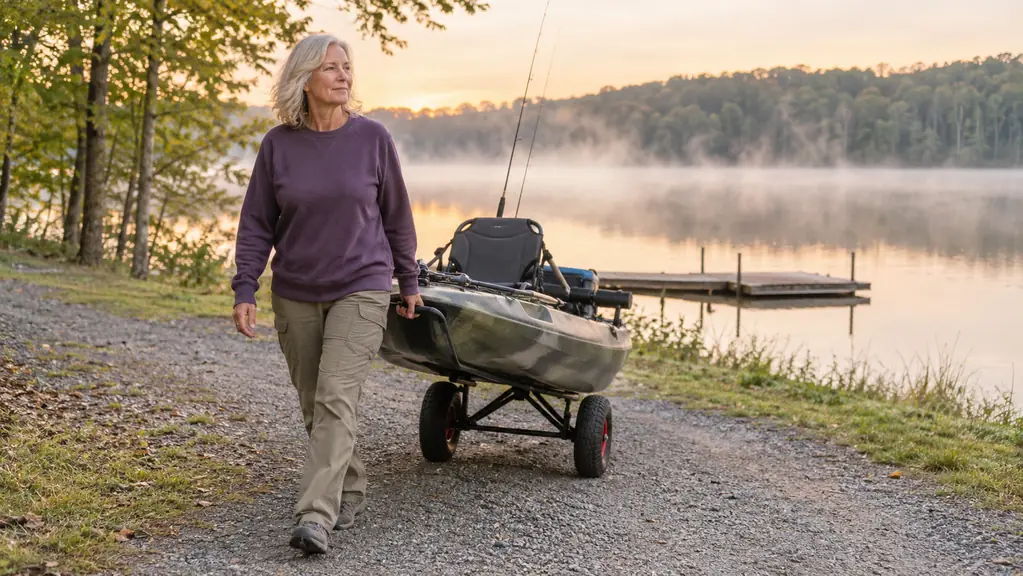
I can carry my coffee, my paddle and my tackle box in one trip. What I cannot do is carry a 10 foot sit on top that weighs about 60 pounds from the truck bed to the water. Not with a lower back that has opinions and shoulders that ache after a long morning of casting. For my first four seasons I did it the hard way. Drag by the rear handle, stop, rest, drag again. Scrape the hull on gravel. Get to the water already tired, then paddle tired.
Then I watched a fella at Herrington Lake roll a loaded fishing kayak down the ramp on two fat wheels, one hand on the nose, whistling. That was the whole lesson. A kayak cart does not make you stronger. It turns a 60 pound dead lift into a rolling push, which is a job your legs are already good at. The one I ended up with is the Bonnlo kayak cart, an aluminum folding dolly rated for 200 pounds, riding on two solid 10 inch tires and packing two ratchet straps. This is how I use it, step by step, on the calm water I actually paddle.
The walk to the water stops being the hard part
Aluminum frame, 200 pound capacity, two solid tires that never need air, and it folds flat enough to live in the truck bed all season.
Amazon Check Today's Price on Amazon →What a Cart Actually Does, and What It Doesn't
A cart does one thing. It puts the weight of the boat on wheels so your legs can push it. It does not make the boat lighter, it does not help you get the boat up onto the truck at the end of the day, and it does not fix a steep, rooty bank with no path down to it. If your only launch is a set of stairs, a cart is extra luggage you have to carry.
What it does solve is the long, flat, boring walk that ruins the start of a paddling day. Eighty yards of gravel. A concrete boat ramp. A mowed path through a hayfield. A packed sand beach. That is Herrington Lake and every farm pond I fish, and it is most of the water within an hour of Danville. If that sounds like your launch, a folding cart earns the space it takes up. What convinced me was the hull. Four seasons of dragging put a flat spot on the stern of my boat about the size of my palm, and the plastic wore thin enough that I could see light through it on a sunny day. That flat spot is my fault, not the cart's, but it is the reason I stopped dragging. The cart did not fix the hull. It stopped making it worse.
Step 1: Park and Unload With the Tailgate Down
Pull in nose first if the lot is empty, or back in if you will want to pull straight out later. Either way, get the tailgate down and the bed extender out before you touch the boat. I park where the ground behind the truck is firm and flat, not on the soft sand at the edge of the ramp, because a cart with a boat on it sinks in loose sand faster than you would believe. On a busy Saturday I walk the route to the water once with nothing in my hands. Last April at Herrington I skipped that walk because the lot was empty and I was in a hurry, and I spent the next ten minutes hauling a loaded cart out of a mud pocket that looked like packed gravel from the driver's seat. Now I walk it every time, even when mine is the only truck there. It costs me ninety seconds.
Slide the kayak out stern first so the nose stays resting on the tailgate while you get your feet under it. That keeps you from doing the thing I did for years, which is catching 60 pounds of plastic with my knees. Set the boat down on the grass or gravel beside the truck, right side up, and take the paddle, the seat and the tackle box out first. A lighter boat on the cart is a boat that behaves.
This is also when I tie Biscuit to the truck bumper if he came along. A hound who decides to help is not help. He is seven and he still thinks a kayak is something to investigate with his nose, and a nose in the scupper holes while I am lifting is how somebody gets knocked flat. Earl usually wanders off to talk to somebody about the water level, so I plan on doing this part alone and I am fine with that.
Step 2: Open the Cart and Check It Before You Load It
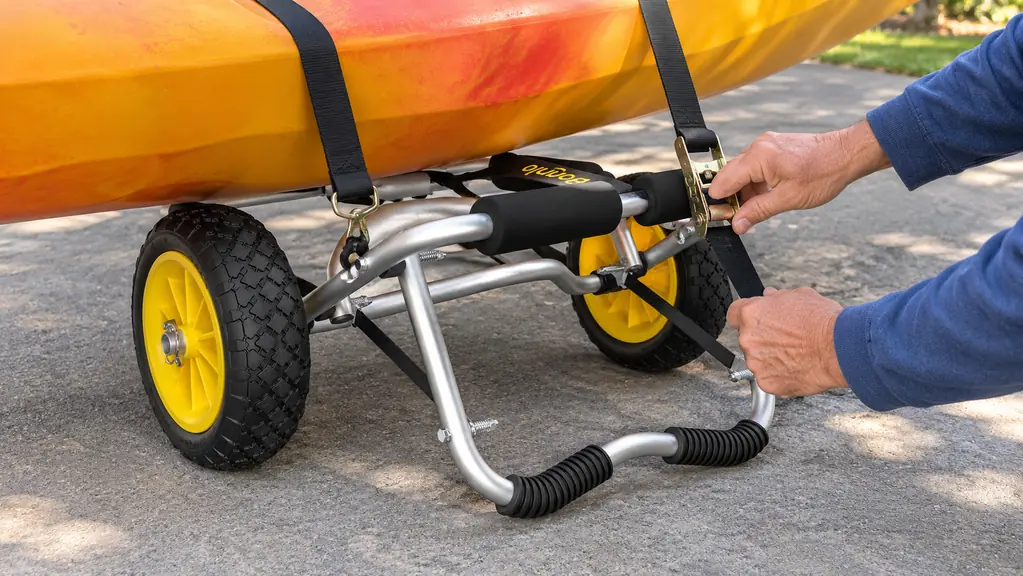
The Bonnlo cart folds, which is the reason it lives in my truck bed from April to October instead of in the garage behind the mower. I set it on flat ground, open the frame out, and push down until everything seats. Then I stand it up and rock it side to side with one hand. If there is slop in the frame, I want to find it now, with nothing on it, instead of halfway down a ramp with 60 pounds rolling.
The wheels are solid polyurethane, 10 inches across and 3 inches wide, so there is no air pressure to check and no pump to remember. That matters more than it sounds. I used to keep a hand pump in the truck for a bike trailer and I was forever the woman airing up at the launch while everybody else was already fishing. Now I spin each wheel, listen, and go.
The frame is aluminum and the whole cart weighs about 5 pounds, so if I ever wanted to carry it down to the water instead of rolling it, I could. I do not, but I could. The capacity is 200 pounds and my loaded boat with the seat and rods is nowhere close to that, which means I am never asking the cart to work at its limit.
Step 3: Set the Boat on the Cart at Its Balance Point
I lay the two ratchet straps out flat on the ground where the boat will sit, pick up the nose of the kayak, and walk it forward until the hull is over the cart. Then I slide the cart forward or back until the boat balances. Put your fingers under the nose and lift. If the nose wants to drop hard, the cart is too far forward. If the nose feels light and the tail is digging in, the cart is too far back. A quick way to find it: set the cart roughly a third of the way back from the nose, then nudge it an inch at a time. On my 10 footer that lands the cart just about where the seat sits.
I like the nose just barely heavy, maybe two or three pounds of weight in my hand. That keeps the tail from swinging around behind me and it means I am steering with a light touch instead of wrestling the thing across a parking lot.
Then the straps. The cart comes with two ratchets and two is the right number. One goes across the hull in front of the cart frame, one behind it, both hooked down to the frame and pulled snug. Snug, not angry. You are keeping the boat from sliding off, not crushing a plastic hull. My first season I over-tightened one so hard it left a dent that is still there, right where the front strap sits, and I have been careful with the ratchet ever since. I give the boat a shove sideways with my hip before I walk away. If it moves, the straps are not right and I start over.
Step 4: Walk Beside It, Not Behind It
Both hands on the nose, cart behind me, and I walk beside the boat rather than pushing it from the back. Pushing from behind means the boat sits between me and where I am going, and I cannot see the front two feet of it. Walking beside it, I can see the ground ahead and I can steer with one hand when I need to.
Gravel is fine. Packed dirt is fine. Asphalt is fine. Wet concrete on a boat ramp is the one to respect, because those solid tires will slide on it if I get moving too fast, and a sliding kayak cart goes where it wants to go. I shorten my stride and take the ramp at a slight angle. There is a ramp on the north side of Herrington that stays damp under the trees until noon, and I watched a fella lose a jon boat off a hand truck there one June. He was fine. The boat was not. Roots and rocks I go around instead of over. It costs me ten seconds and saves me a fall.
If there is a curb or a set of steps, I stop and lift the whole rig, or I take the boat off and carry it in two trips. The cart is rated for 200 pounds but the person pushing it is rated for a good deal less. My rule is simple. If I have to strain, I have set something up wrong.
Step 5: Launch It, Then Park the Cart Where You Will Find It
I roll the boat to the water's edge, nose toward the lake, and stop while there is still dry ground under the wheels. Then I unbuckle both straps and slide the cart out from under the hull. If the water is shallow and firm I will float the boat first and pull the cart out from underneath it, which is easier on the hull than dragging it off over gravel.
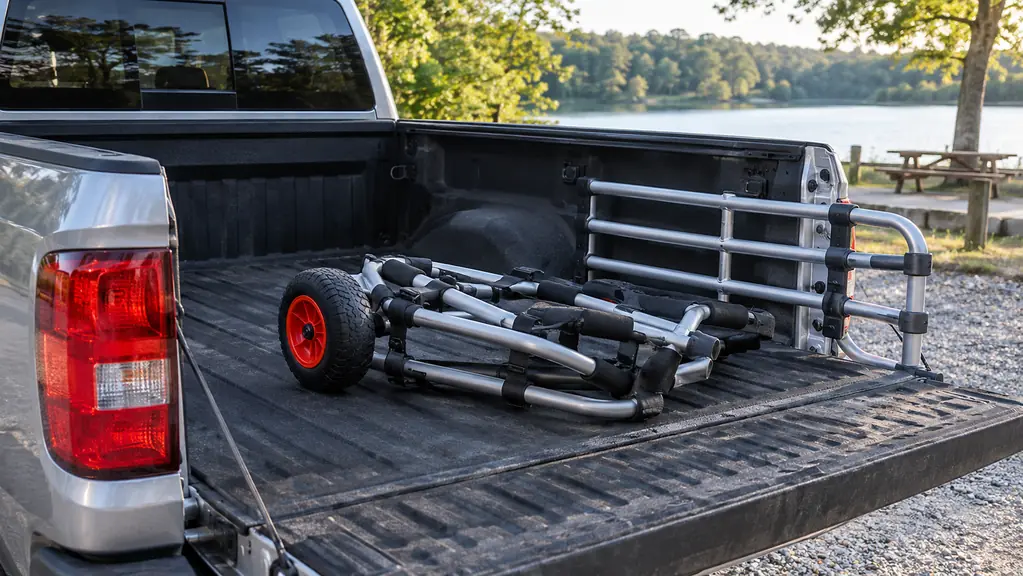
The cart folds back down and goes in the truck bed, flat, near the tailgate, or tucked under the bed extender. It weighs 5 pounds, so this takes about four seconds. What I do not do anymore is leave it standing up in the bed where it slides around and knocks into things on the drive home.
If I am coming back to the same launch, sometimes I fold it and lean it against a post at the top of the ramp. I have never had one walk off, but I also never leave the straps with it. Those come with me. And I always lay the cart back under the boat for the return trip before I walk away from the water, because coming back to a boat on the beach and a cart in the truck is a long walk taken twice.
The cart weighs 5 pounds and carries 200. My boat is 60. That math is the whole reason my back stopped arguing with me on Sunday mornings.
What Else Helps
A bed extender changed my loading more than the cart did. My 10 footer hangs out the back of the truck without one, and a hanging boat is a boat that wants to slide. With the extender, the tail sits supported and the whole thing rides steady to the lake. I also keep an old rubber mat on the tailgate so the hull is not grinding on bare metal every time I slide it out.
Other small things that earn their space in the truck. Shoes with real tread for slick ramps. A length of strap for the bow on windy days. A folding stool at the takeout, because pulling my boots back on is easier sitting down. And I walk the route to the water once on a new lake before I commit to it with a loaded cart. Sand, mud and a two inch lip at the end of a concrete ramp all look different with 60 pounds rolling at you. I still take two trips when the ground is bad. The Bonnlo cart is a tool, not a dare.
Load it once, roll it once, and get on the water
Two ratchet straps included, aluminum frame, solid tires that never go flat, and a fold down size that fits behind the seat. Current price and reviews are on the listing.
Amazon Check Today's Price on Amazon →