

The first time I hauled my ten-foot sit-on-top fishing kayak from the truck bed down to the water by myself, I made it about forty yards before I had to set it down and shake the feeling back into my arms. Sixty pounds does not sound like a lot. Sixty pounds over loose gravel with a stiff lower back is a whole different conversation. I did the two-trip shuffle for two seasons, boat first, then paddle and crate and cooler, and I was worn out before I ever got a line wet. So last spring I bought a Bonnlo kayak cart, mostly because it was the one that kept surfacing in the search results with close to three thousand reviews and I was tired of thinking about the problem.
What follows is one season of honest use, April through October, at Herrington Lake and a few slow creeks and farm ponds near home. I am sixty-one, I paddle one sit-on-top that runs about sixty pounds, and I load and unload alone most Saturdays because Earl is either still asleep or still hunting for his coffee cup. If you are in that same spot, this will save you some time. If you paddle whitewater or drag a seventeen-foot touring boat, I am not writing this for you.
The Quick Verdict
A sturdy, simple answer to the forty-yard carry. It is a two-wheel dolly you balance with your hand on the boat, not a hands-free trailer, and once you accept that it does its one job well.
Amazon Check Today's Price →Stop Carrying Sixty Pounds to the Waterline
The cart itself is listed at about five pounds and rated to 200, so the boat weight comes off your arms and shoulders and onto two wheels. Check today's price and the current tire and strap details on the listing.
Amazon Check Today's Price on Amazon →How I've Used It
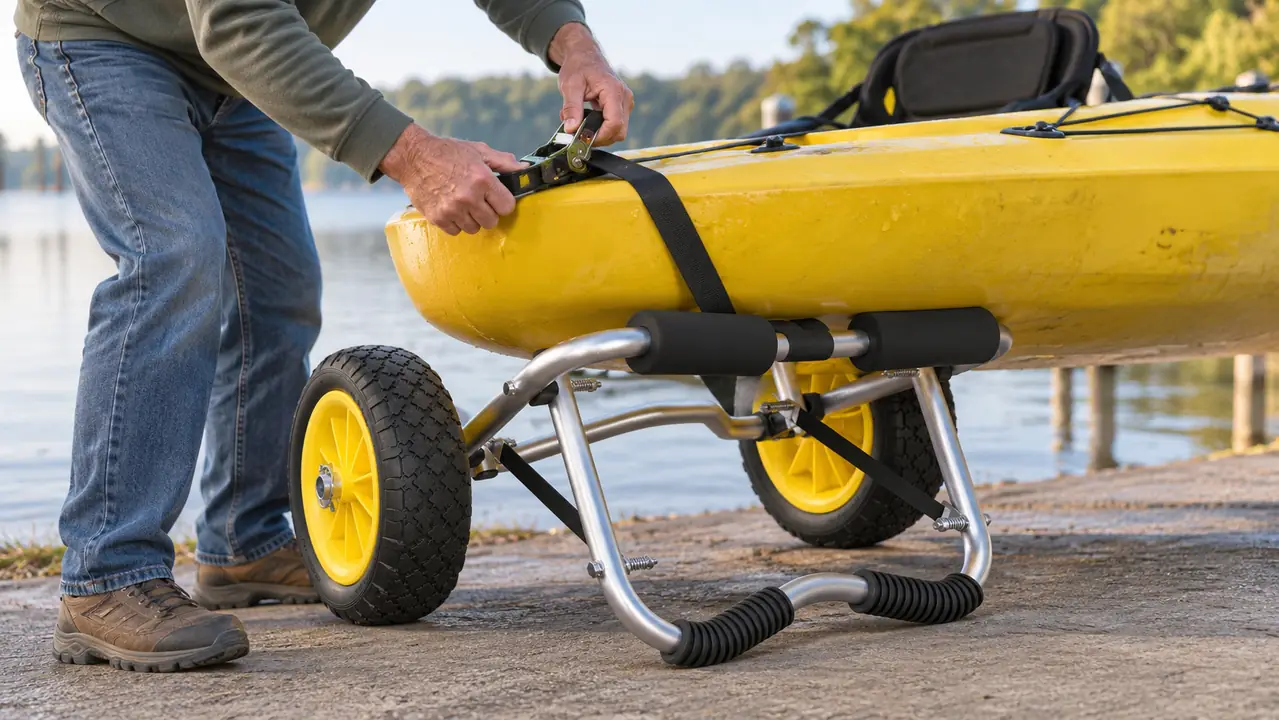
My Saturday routine has not changed much, but the order of it has. I back the silver pickup to the top of the ramp, pull the folded cart out of the bed, and open it up on the gravel. The boat slides off the bed extender and settles across the cart. Then I run both ratchet straps over the hull and down to the frame, click, click, and pull each one down snug. From there I take the nose of the kayak in one hand and walk it to the water. One trip. It used to be three.
The part I did not expect is that the whole shape of a launch day changes, not just the lifting. Before the cart, I planned every trip around how close I could legally park to the ramp. Now I park where there is shade and room to turn the truck around, and I walk the boat in from wherever, because walking it is easy. That sounds like a small thing. It is not. It turns a chore you dread into a chore you do without thinking.
I have put somewhere around thirty-five launches on this cart in a single season. It has been over gravel, packed dirt, a concrete ramp, mowed grass, and once through about four inches of mud at the top of a creek put-in after three days of rain. Nothing has bent, nothing has rattled loose, and nothing has made me stop and troubleshoot at the water's edge with people waiting behind me. That is about the highest compliment I can pay a piece of gear that does one boring job.
What You Actually Get
The Bonnlo cart is an aluminum frame, a pair of solid tires, and two ratchet straps. That is the entire product, and I mean that as praise. The frame is built from 20 by 2 millimeter aluminum pipe, and the listed capacity is 200 pounds, which is more than three times what my boat weighs. The whole thing is listed at five pounds, and that feels honest when I pick it up with one hand and set it in the truck bed. You are not adding a heavy piece of equipment to a load you already have to manage.
That 200-pound number gives you room to stop worrying. My boat, my paddle, my crate and my cooler do not come anywhere close to it, and I have never once heard the frame complain or felt it flex under a loaded boat. If you paddle a heavier fishing setup than mine, you still have plenty of headroom. If you are hauling a two-person canoe with gear in it, check the math on your own load before you assume, because capacity is the one number that matters and it is printed right there.
The Tires Do More Work Than You Think
Nearly every cart I looked at before this one had air tires. Nearly every person I know who owns an air-tire cart has a story about the morning the tire was flat and the boat stayed on the truck. Air tires roll beautifully and they absorb bumps like nothing else. They also find every goathead and every stray nail in a parking lot, and they go soft sitting in a hot garage all winter waiting for April.
The Bonnlo cart uses solid polyurethane tires, 10 inches across and 3 inches wide. In a full season I have not thought about tire pressure one single time, which is exactly what I want out of a wheel. The tradeoff is real and I will not pretend otherwise. Solid tires are firmer. Over gravel and packed dirt they pass more bump up through the frame into your hand than an air tire would. On a concrete ramp they are completely fine. On the rooted path down to my favorite creek spot, I feel it in my wrist by the time I reach the water.
Ten inches turns out to be a good size for this work. A little hard wheel catches on every pebble and stops dead. These roll across a gravel lot without me having to muscle them over each stone. The three-inch width keeps them from cutting straight down into soft ground at the ramp, which is where a narrow wheel will bury itself and leave you pulling uphill against nothing. I would not take them through deep loose sand. Then again, I would not take any cart through deep loose sand, so that is not a knock on this one.
Getting It In and Out of the Truck
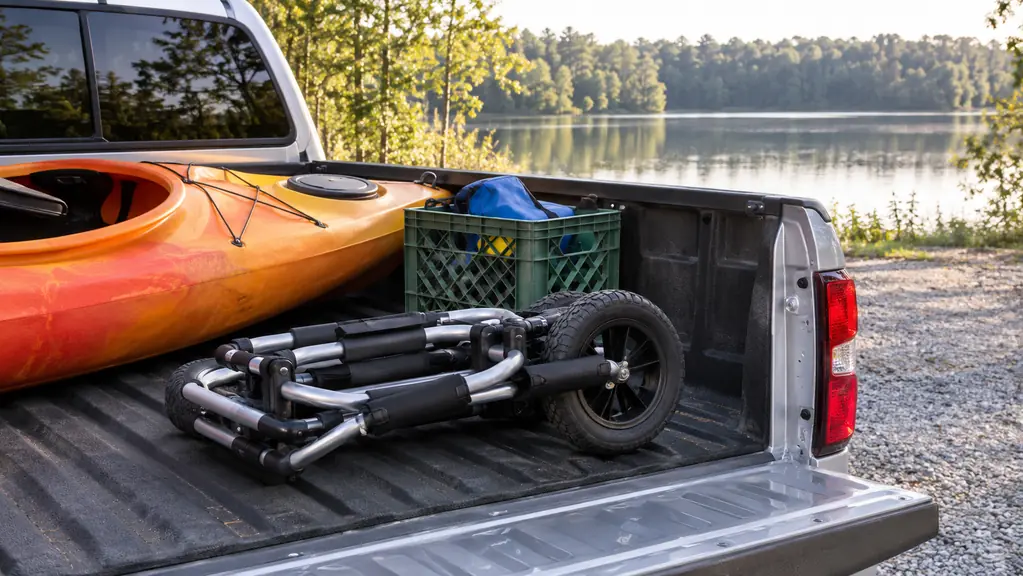
The cart folds down, and that is the difference between it riding in the truck bed with everything else and it living in the garage because there is no room. Folded, it lies flat alongside the crate and the cooler with room to spare, and it does not slide around and bang into the side of the bed on turns. Unfolding it at the ramp takes a minute. The first two or three times, that minute felt like ten because I was doing it in front of people.
So do what I did after that first awkward morning. Practice folding and unfolding it in your own driveway, twice, on a quiet afternoon. Learn where your hands go and which way it wants to open. Then at the ramp you will look like you have done it before, and more importantly, you will not be kneeling on hot concrete trying to work it out while a line of trucks waits behind you. It is a simple mechanism. It just is not self-explanatory the first time in front of an audience.
Loading a 60-Pound Kayak Alone
Here is the honest part about every kayak cart on the market. The cart is not the hard part. Getting one end of a sixty-pound boat up onto the cart is the hard part, and no cart on earth solves that for you. What this one does is let me tip the nose of the kayak up, walk forward under it, and set it down across the cart instead of trying to deadlift the whole thing. The lift is short and I am never holding the full weight with my back.
The two ratchet straps are the difference between a cart and a mess. Over the hull, down to the frame, click, click, snug. I watched a man at the ramp one morning try to walk his boat down on a cart held by a single bungee cord, and I watched that boat slide off sideways about halfway down the concrete. Nothing good happens after that. Use both straps every time, even for a fifty-yard walk on flat ground, and especially on any kind of slope.
Thirty-five launches in one season, over gravel and mud and hot concrete, and I have not touched the tires once. That is the whole case for solid wheels in one sentence.
Where It Fights You
This is a two-wheel dolly. All the weight sits on two wheels in the middle, and you balance the boat with your hand on the nose. If you let go on a slope, it goes wherever gravity wants it to go, and gravity does not care about your kayak. On flat ground and gentle ramps that is nothing at all. At the steeper put-in on the north end of the lake, I have learned to walk it down with both hands and not get clever about it.
The other adjustment is mental. You are walking beside it the entire way, not pulling it behind you on a strap. That is not a flaw in the design, it is what a two-wheel cart is, but if you came here hoping for something you can tow hands-free while you carry the paddle and the cooler, this is not that product and I would rather tell you now than have you find out at the ramp.
And one more thing that is not the cart's fault but is worth saying. It does not make your boat lighter and it does not shorten the walk. It moves the weight from your arms and back to a pair of wheels. If your launch is ten feet from the truck, you are solving a problem you do not have, and a cart will just be one more thing to fold and unfold. Measure your walk before you buy anything.
What I Liked
- Listed at 5 pounds with a 200-pound capacity, so there is real headroom over a typical sit-on-top
- Solid polyurethane tires, 10 inches by 3 inches, with no pressure to check before a launch
- Two ratchet straps included, which is the right number and the right kind
- Aluminum frame that handled gravel, concrete, mud and grass for a full season without complaint
- Folds down and rides flat in the truck bed next to the crate and cooler
Where It Falls Short
- Two-wheel design means you balance the load yourself the whole way
- Solid tires are firm, so you feel gravel and roots through the handle
- Folding and unfolding takes a minute and is clumsy until you practice it
- No help whatsoever with lifting the boat up onto the cart
Who This Is For
If you are a recreational paddler or a kayak angler with a sit-on-top or a recreational boat in roughly the forty to eighty pound range, and you launch by yourself, this is the piece of gear that quietly fixes your Saturday. Same if you have a back that complains, or shoulders that are already sore before you even push off. My lower back is the reason I bought it and the reason I would buy it again tomorrow.
It is also the right call if your walk from parking to water is longer than you would want to carry sixty pounds. That is the whole test. Stand in the parking lot, look at the distance to the ramp, and ask yourself whether you would carry a bag of dog food that far. If the answer is no, a cart earns its place in the truck bed. If the answer is yes, save your money and keep walking.
Who Should Skip It
Skip it if you are hauling something well beyond a recreational kayak, or a long touring boat that outweighs what two ten-inch wheels want to manage on a slope. Skip it if your launch is a beach with deep loose sand, because a two-wheel cart with hard tires will dig and you will fight it the whole way. And skip it if you want a hands-free trailer you tow behind you, because this is not that and it never claims to be.
Skip it too if your back is bad enough that balancing a load on two wheels worries you. A cart takes weight off your spine but it does not take away the job of steering and steadying a boat on a slope, and if that is the part that hurts, talk to somebody who knows more about your back than I do. There is no shame in a second pair of hands or a different put-in.
One Trip to the Water Instead of Three
The Bonnlo cart has done one boring job every weekend for a season without a single flat tire or a single trip back to the truck. Check today's price and confirm the current strap and tire details on the listing before you order.
Amazon Check Today's Price on Amazon →