
Short answer first, because that is what I wanted when I started looking into this. If the water sits close to where you park, keep carrying your kayak and hold on to your money. If it does not, the Bonnlo kayak cart earns its keep fast. I am 61, I live outside Danville, Kentucky, and I paddle one kayak, a 10-foot sit-on-top fishing rig that weighs right around 60 pounds. Hauling that from the truck bed down to Herrington Lake used to be the worst ten minutes of my Saturday. Now it is the easiest part.
Here is what the cart actually is, without the sales talk. It is an aluminum frame that folds down, rated to a maximum of 200 pounds, and it weighs about 5 pounds on its own. The wheels are solid polyurethane, 10 inches across and 3 inches wide, so there is no air inside them to leak out on a gravel ramp in July. Two ratchet straps come in the box. That is the whole thing. No motor, no brake, no twelve-page manual. You unfold it, you set the kayak on it, you strap it down, and you pull the bow line. So the comparison below is not this cart against some other cart. It is this cart against what I did for five years before I bought one, which was carrying 60 pounds on my shoulder and telling myself it did not hurt.
| Bonnlo Kayak Cart | Carrying by Hand | |
|---|---|---|
| Setup at the ramp | About a minute to unfold and strap, once you have done it twice | Nothing to set up, lift and go |
| Weight on your body | The frame carries the kayak, you push and steer | Around 60 pounds on your shoulder or overhead |
| A long walk or a hill | Rolls the whole way with one hand on the bow line | Two or three rest stops, and the trip back is worse |
| Stairs and steep banks | You still lift the kayak over the bad stretch | No wheels to drag and no frame to carry |
| Soft sand | The 10 inch tires roll better than narrow ones, but deep sand still fights you | Dragging and carrying are both miserable in deep sand |
| Loading alone | The kayak sits on the frame while you cinch the straps | You wrestle it off the bed and hope your footing holds |
| Room in the truck | Folds down and weighs about 5 pounds | Takes up no room at all |
| The end of the day | Roll it back to the truck instead of carrying it | Same carry as the morning, only you are tireder |
| Hull scuffs | Straps and frame touch the hull, so snug straps and care matter | No frame contact, just whatever you set it down on |
| A loaded fishing kayak | Rated to 200 pounds, so a 60 pound boat plus gear and cooler is fine | Your back sets the limit |
| Things that can fail | A strap can slip and a wheel can jam on a root | Nothing to fail |
Where the Bonnlo Kayak Cart Wins
Distance is the whole argument, and everything else is a rounding error. The ramp I use most on Herrington Lake sits roughly 200 yards from where I can legally park. Two hundred yards does not sound like much until you are the one underneath the boat. The first year I paddled, I carried my kayak that distance on my shoulder and stopped twice each way. My lower back would tighten up before I ever got on the water, and by the time I slid the boat in I was already tired. With the cart, the kayak rides and I walk. That is the entire improvement, and it changed my weekends more than any paddle or life vest I have bought.
There is one morning I keep coming back to. It was the second Saturday in July, the air already thick at seven in the morning, and the parking area was full enough that I had to take the far spot near the dumpster. That added maybe forty yards. Before the cart, that would have been three stops and a bad attitude before I ever got wet. I strapped the kayak down, pulled the bow line, and walked it the whole way in one go with my tackle bag hanging off my shoulder. My back did not say a word. That is not a small thing at 61 with a lower back that has opinions.
Loading it by myself is the second thing, and it matters most if you fish alone like I do. When you carry, getting a 60 pound boat off a truck bed and onto your shoulder is the one moment where a slip costs you a season. With the cart I set the kayak down on the frame at waist height, lay the two ratchet straps over the hull, cinch them, then lift the bow and start walking. Nobody has to hold the other end. Earl, my husband, helps when he comes along, but he does not have to, and that is the point. Gear that only works with a second person is gear that sits in the garage.
Capacity is the quiet advantage. A 10-foot sit-on-top with a crate, a cooler, two rods and a dry bag is not a 60 pound load anymore, it is closer to 90. The cart is rated to 200 pounds, so there is a wide margin there and the frame is not groaning under a load it was barely built for. I have never felt the aluminum flex or the wheels bog down under a normal fishing load. That margin is the difference between a cart that lasts several seasons and one you are replacing in year two.
Where Carrying It by Hand Wins
Twenty feet. That is the distance where a cart stops making sense. There is a farm pond I fish in the spring where you park on grass and the bank is a short, flat walk. Unfolding a frame, strapping a boat down, rolling twenty feet, unstrapping it and folding the frame again is more work than just picking the kayak up. If all your water is like that, a cart is a solution to a problem you do not have, and I would rather you kept the money in your pocket.
Banks, stairs and bad ground are where wheels lose. A couple of the creek put-ins around here drop off at an angle no wheel likes, and one has a set of railroad tie steps that were built for people on foot. A cart with a kayak strapped to it does not climb steps and it does not like a 30 degree muddy slope. You end up unloading and carrying anyway, only now you are carrying the kayak and dragging a cart. If your access is rough, hand carrying is not a compromise, it is the correct tool.
There is a creek put-in off a county road where the bank drops about four feet at a pitch steep enough that you go down sideways, holding the kayak by the grab handle and hoping your boots hold. I tried rolling the cart down that bank once. The wheels went sideways, the kayak shifted, and I spent five minutes re-cinching straps in the mud while Earl stood at the bottom offering advice I did not ask for. Now I carry that one. Twenty seconds of grunting beats five minutes of fussing, and the fish do not care which way the boat got there.
And carrying has one advantage no cart can touch: nothing to forget and nothing to break. A cart is one more object in the truck bed. Leave it on the garage floor and you are carrying that day whether you planned to or not. Straps can slip. A wheel can wedge under a root and stop dead while you keep walking. None of that is a reason to avoid the cart, but it is a reason not to pretend it has no cost.
If your put-in is a walk and not a step, this is the fix
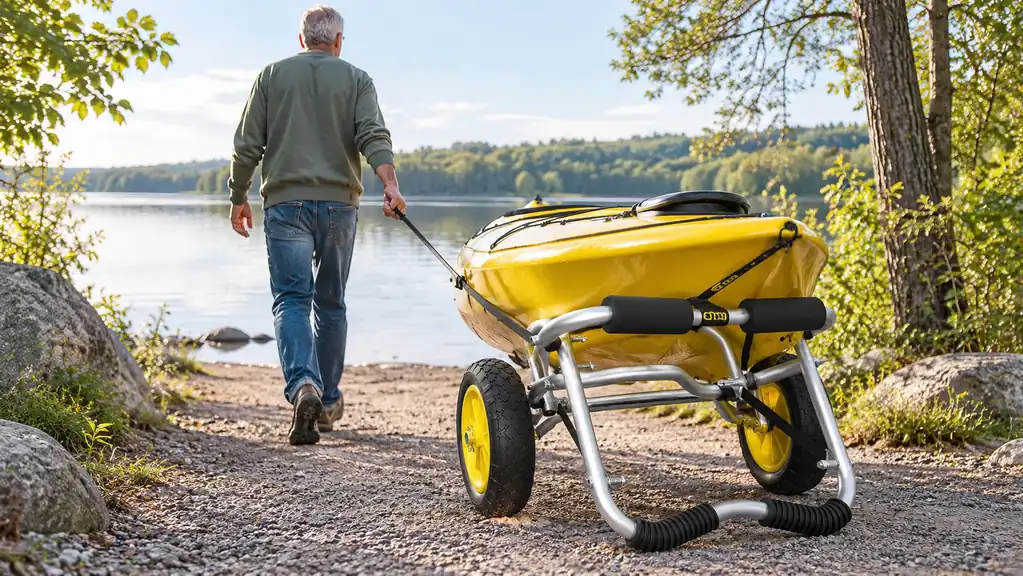
The Bonnlo kayak cart folds down, weighs about 5 pounds, and is rated to a 200 pound maximum. Solid 10 inch tires mean no flats. Two ratchet straps come in the box.
Amazon Check Today's Price on Amazon →How It Behaves on Real Ground
On gravel and packed dirt it does exactly what you want. The 10 inch solid tires roll over crushed rock and hardpan without the chatter you get from small hard wheels, and the 3 inch width keeps them from knifing into soft spots. Solid polyurethane means no flats, and that is not a small thing on a ramp littered with broken glass and bait hooks. I carry a pump for my truck tires. I have never needed one for this cart.
Deep sand is the honest limit. Wide as those tires are, they are not sand tires, and a loaded kayak in loose sand is work no matter what you roll it on. Shallow sand and wet packed sand at the water line are fine. The dry stuff up by the parking area will make you earn it. Mud is the same story. If your launch is a sand pit, plan on lifting the bow and helping the cart along.
There is a beach launch up the lake where the last thirty feet is loose, dry sand that has been walked to powder. I have watched people with narrow hard wheels sink to the axle and give up. The 3 inch width helps, and the solid tires do not dig the way a thin wheel does, but I still lean into it and take the bow in both hands for that stretch. Wet sand at the water line is a different story. Once the ground darkens and packs, the cart rolls like it is on pavement. Mud after a rain is the worst of the three, because the tire loads up and turns into a slick donut. Know which one you are walking into and you will not be disappointed.
Folding and stowing is where it earns a permanent spot in the truck. It folds down flat enough to sit in the bed next to the boat, and at about 5 pounds it is not something you notice. The two ratchet straps are the part I would look after. Mine live in a bucket in the truck bed because a ratchet strap left in the sun all summer gets stiff and stops holding well. Treat the straps like rope and they will outlast the rest of the cart.
Two hundred yards of gravel used to cost me two rest stops each way. Now it costs me one hand on the bow line.
What the Cart Does Not Do
It does not turn a bad put-in into a good one. If your access is a steep, rooty bank with a drop at the end, the cart will get you across the flat ground and then wait while you carry the kayak the rest of the way. That is still a win on a long flat approach, but it is not a fix for rough terrain, and I would not want you to buy one expecting it to be.
It also does not make you younger. You still pull the boat, you still lift the bow, and you still carry the cart itself, which is about 5 pounds of folded aluminum. What it does is take the 60 pound part of the job and hand it to a frame with wheels. That is a real trade, not magic, and I have been glad to make it every weekend since April.
Who Should Buy Which
Here is my own version of the test. I park a silver pickup with a bed extender, so the kayak rides with the tailgate down and the last two feet hanging out past the box. Getting it out of that bed and onto my shoulder was always the worst lift of the day, worse than the walk, because the tailgate height puts the boat above my waist and my back has to do the rest. With the cart I slide the boat off onto the frame, which sits low to the ground, and there is no lift above waist height at all. If your kayak rides in a truck bed or up on a roof rack, that one change is worth more than the walking.
Buy the Bonnlo cart if any of this sounds like your Saturday. Your walk from the truck to the water is longer than about 50 yards. You load and unload alone. Your kayak is a sit-on-top fishing boat with gear on it. Your back or shoulders complain after a paddle. You paddle the same lakes and slow creeks I do, where the ground is mostly gravel, grass and packed dirt. Any two of those and the cart will change your trip. All five and you will wonder why you waited.
Keep carrying if your put-ins are short, flat and close. If your kayak is light enough to throw on your shoulder without thinking about it, if you launch from a farm pond where you park at the water's edge, or if your access involves stairs and steep banks, save the money and the garage space. Earl still carries his borrowed kayak most trips because his put-in is ten feet from the truck, and he is right to.
One less thing your back has to do before you ever get on the water
Aluminum frame, folds flat, 200 pound maximum rating, about 5 pounds empty. Solid 10 inch tires and two ratchet straps included.
Amazon Check Today's Price on Amazon →