
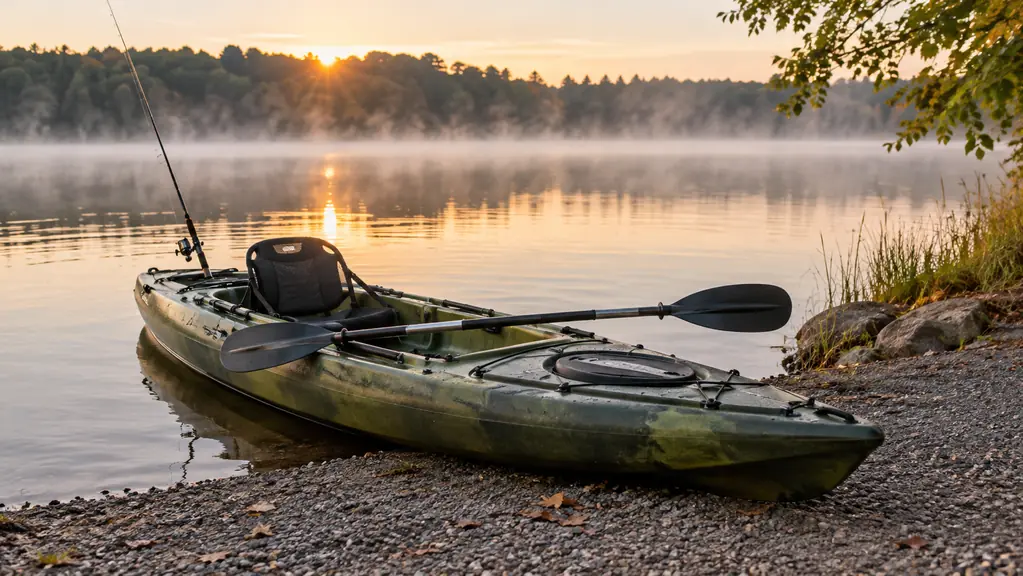
I came off Herrington Lake one Saturday last July with shoulders so tight I couldn't lift the cooler into the truck bed without making a face. Two hours of paddling, three days of paying for it. By then I had already blamed my age, my lower back, the wind, the boat, and the fact that I spent most of that morning fighting a headwind across a wide cove.
It was the paddle. Not the boat, not the wind, not the fact that I turned 61 in March. It was the paddle, the way I was holding it, and about four other small things I had never bothered to learn in six years of kayaking. I paddle a 10-foot sit-on-top that weighs somewhere around 60 pounds, I fish more than I travel, and I am not a paddling instructor. But I have put two full seasons on the OCEANBROAD paddle that comes apart in two sections and rides behind the seat of my truck, and my shoulders do not ache anymore unless I earn it. Here is what made the difference, in the order I would do it again.
The paddle I should have been using three years ago
OCEANBROAD comes in 218cm, 230cm and 241cm, with an aluminum alloy shaft, fiberglass reinforced PP blades, and three locking positions for blade angle. Mine is the 230cm, and it lives in the truck from April to October.
Amazon Check Today's Price on Amazon →Why Your Shoulders Ache After Two Hours
It is almost never one thing. It is a stack of small ones, and they pile up faster than you would think.
A paddle a couple of inches too long or too short makes you lean, and leaning makes you shrug. A blade angle set wrong for the day makes your wrist roll against the pull. A grip that is too tight puts your forearm and shoulder on the bill for every stroke. Pulling with your arms instead of turning your ribcage loads the smallest muscles in the chain. And never stopping, never stretching, never getting out of the seat, means all of that repeats for two straight hours without a break. Fix any one of those and you buy yourself some relief. Fix all five and it stops being a problem.
I figured that out in the wrong order. I bought a seat cushion first, then a back band, then a pair of gloves, and none of them touched it. What finally pointed me at the paddle was a stretch of creek so narrow and shallow that I could only take short, choppy strokes for about a mile. My shoulders came out of that creek better than they do out of a wide open cove, and that made no sense until I understood that reach, not effort, was the thing setting them off.
Step 1: Match the Paddle Length to Your Body, Not the Boat
OCEANBROAD sells this paddle in three lengths: 218cm, which is about 86 inches, 230cm at 90.5 inches, and 241cm at 95 inches. I have the 230cm. I am 5 foot 6, my kayak is a wide sit-on-top, and 90.5 inches lets me put a blade in the water without leaning out over the side.
Here is how I checked it, and you can do this in your driveway before you ever get wet. Sit in the kayak on flat ground. Hold the paddle the way you actually hold it, one hand on each side, shaft across your chest. Now look at where the blades would meet the water. If you have to lean or drop a shoulder to bury a blade, the paddle is short for you and that boat. If you can bury it sitting straight up but the whole thing feels like a long lever out in front of you, it is longer than you need.
Length matters more than weight here. The whole paddle weighs 2.5 pounds, so it is not the heft that wears you down, it is the reach. Two extra inches of lean on every stroke, at forty strokes a minute, is a lot of shrug by the end of a mile. I felt the difference the first weekend. Same lake, same wind, same me. I measured once out of curiosity. Sitting straight up in the seat with my hands on the shaft, the blades clear the gunwales by a couple of inches on each side. On a narrower boat that same 90.5 inches would be a lot of paddle hanging out there in the air. On my wide sit-on-top it comes out about even.
Step 2: Set the Blade Angle Once, Then Leave It Alone
The paddle locks in three positions at the joint where the two halves meet. That is your blade angle, and it changes how the blades sit relative to each other when you are pushing into wind.
I tried all three over a couple of weekends. One felt natural until the wind picked up. One felt fine in the wind and strange on still water. One I stopped noticing after about ten minutes, and that is the one I keep. I have not moved it since May, and that is the point. Every time you change it mid-paddle you change the way your wrist has to roll, and your wrist and shoulder complain about the switch before they complain about the position.
While you are there, make sure the joint is actually locked. The paddle breaks into two sections so it fits behind a truck seat, and if the joint is not seated all the way, the whole paddle feels loose and vague in the water. A loose-feeling paddle makes you grip harder to compensate. You can guess how that ends.
Step 3: Loosen Your Grip Until It Feels Almost Wrong
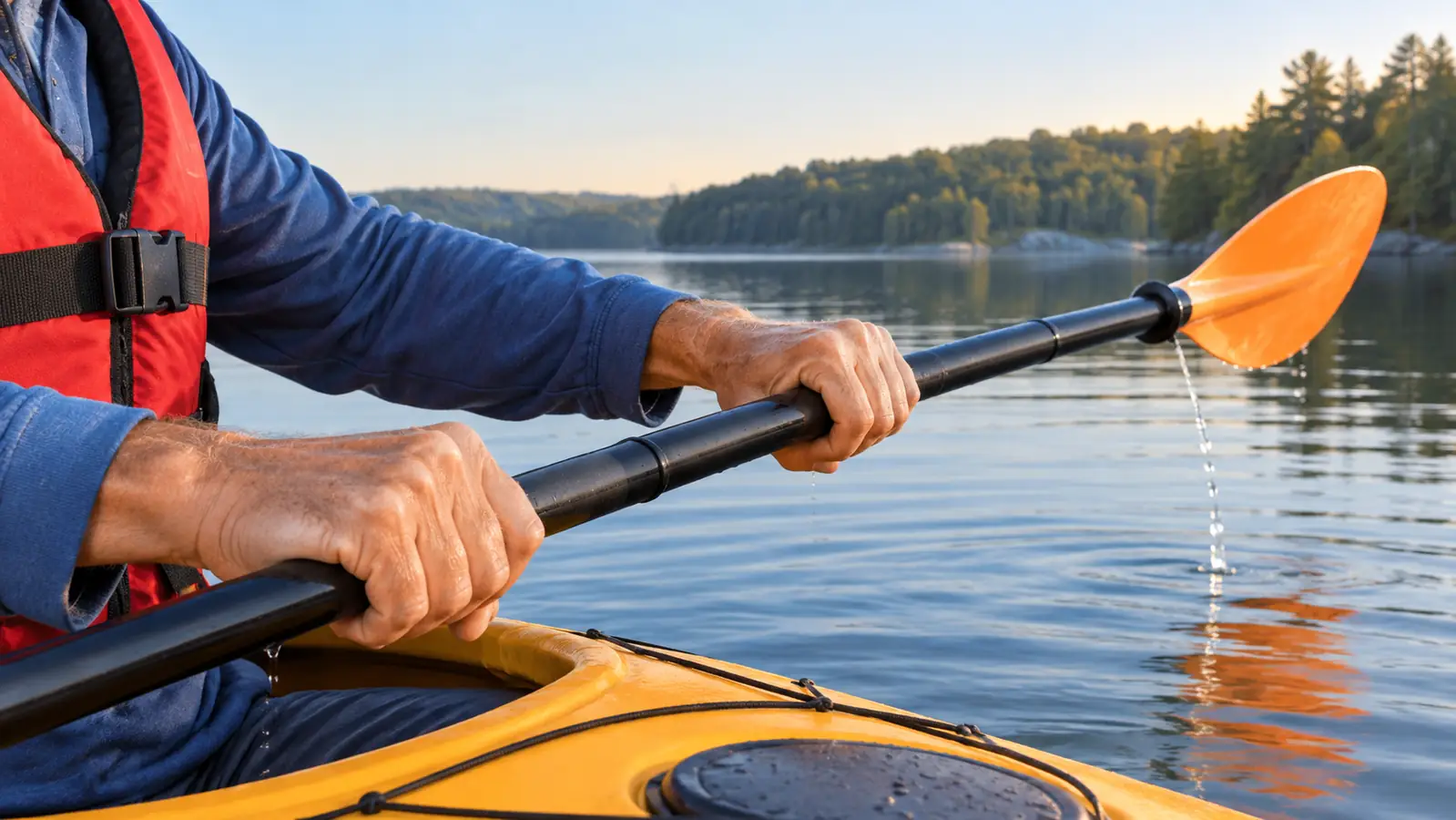
Nobody believes this one until they try it. You are probably holding the paddle tighter than you need to, and the tighter you hold it, the more work your shoulders do.
The shaft is aluminum alloy with a shell about 1.1mm thick, and it has a shrinking PE tube cover on it. I am not going to tell you it feels like a foam grip, because it does not. It is a metal shaft with a cover. What I will tell you is that if you squeeze it like you are mad at it, your forearms will be talking to you by the second mile, and once your forearms go, your shoulders start helping, and once your shoulders start helping, you are done.
So on the recovery, when the blade is out of the water and swinging forward, open your fingers. Let the shaft roll a little in your hands. I caught myself white-knuckling every time the wind came across the cove, which was exactly when my shoulders hurt worst, which should have told me something a lot sooner than it did.
The first Saturday I tried the loose grip I dropped the paddle twice in twenty minutes, and neither time was because my hands were relaxed. It was the opposite. I had gone right back to squeezing without noticing. The leash the paddle comes with helped me stop worrying about the drop and start paying attention to my fingers.
Step 4: Turn Your Ribcage, Not Your Shoulder Socket
A paddle this light lets you get away with arm paddling for about twenty minutes. That is the trap. Arm paddling works right up until it does not.
The stroke I use now starts in the belly. Sit up, turn your ribcage toward the side you are planting on, and put the blade in the water down near your toes instead of out at your hip. Push with the top hand, pull with the bottom one, then let your torso unwind and bring the other blade forward. Your arms are connecting rods. Your back and stomach are the engine. When I catch myself reaching with my shoulder instead of turning, I feel it in about four strokes.
This is where the adjustable blade angle earns its keep. If the angle fights the way your torso naturally unwinds, you end up muscling the blade through the water instead of letting the rotation carry it. Get the angle right, turn your ribcage, and the stroke gets quieter and easier at the same speed.
Step 5: Stop Every Twenty Minutes and Reset
I set a timer on my phone for twenty minutes. When it goes off, I stop. No big production, just stop, sit up straight, and let the boat drift. Twenty minutes is about when I start compensating, and compensating is how a small ache turns into a three-day one.
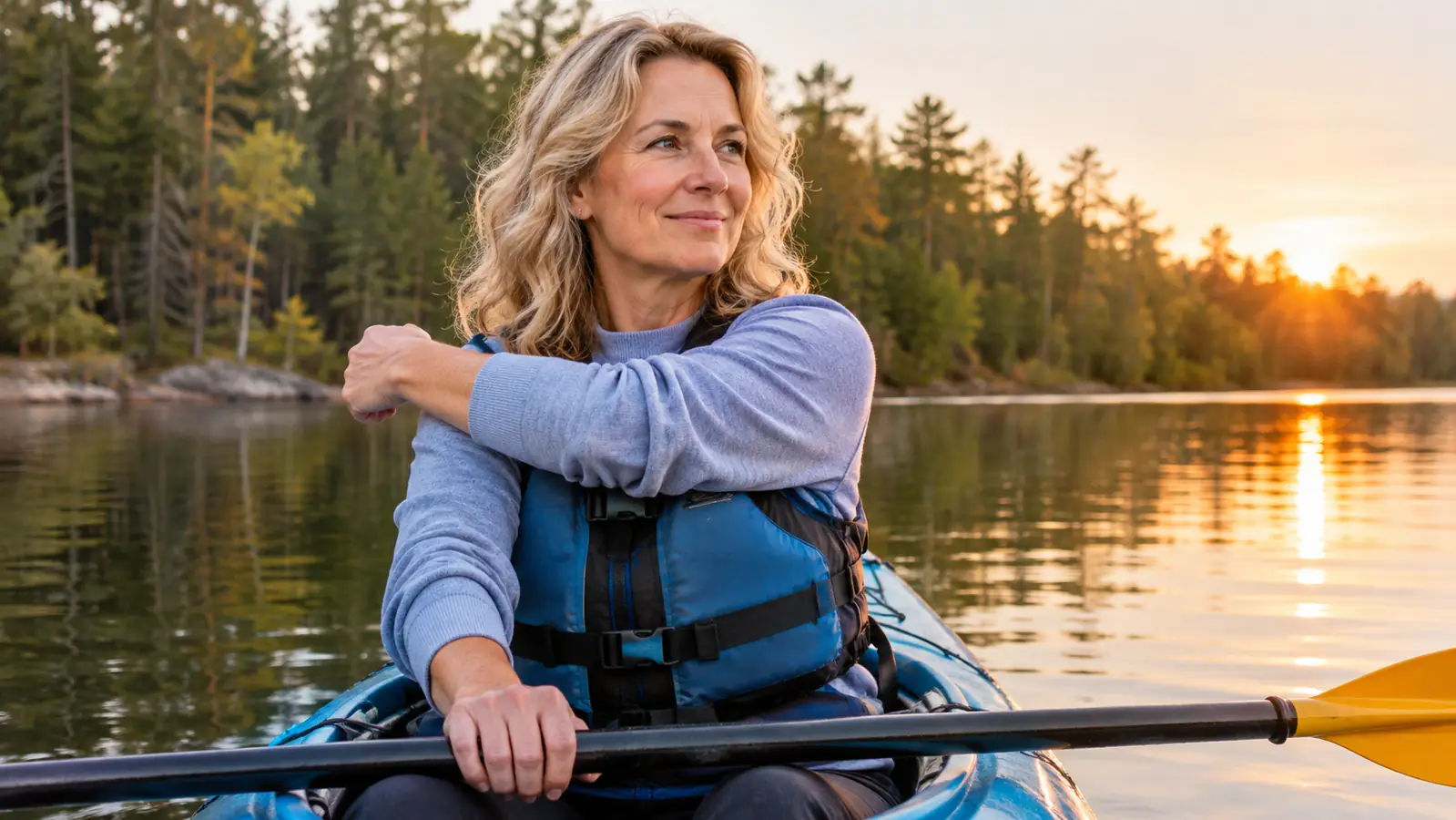
What I do in that stop: roll both shoulders back five times and drop them, pull one arm across my chest and hold it for a slow count of ten, then the other, then a few easy neck turns. If the bank is close and shady I get out and stand up, because sitting in a kayak seat for two hours shortens everything from the hips up. There is a little gravel point up past the second cove on Herrington that I use for exactly this. Twenty minutes sounds too often until you count it out. On a two-hour paddle that is five stops and maybe six minutes off the water total, and I lose less distance than I did when I was pushing through a knot in my shoulder for a solid hour. Earl laughed at the timer the first time. He quit laughing the Saturday he tried it.
Then I check the joint lock one more time before I push off. The paddle bangs around on the deck while I am messing with a rod, and a joint that has worked loose will have me gripping harder for the rest of the afternoon.
Two hours on Herrington Lake used to cost me three days of sore shoulders. Same lake, same boat, same 61-year-old shoulders, and now I load up and drive home with nothing worse than a stiff back from sitting.
What Else Helps
The paddle is the biggest lever, but it is not the only one. Seat position sits right behind it. If your back band has you slumped, your shoulders roll forward and you lose most of the reach you just paid for. I moved my seat back one notch and raised the back band, and it changed my stroke more than I expected. A life vest that binds across the top of the shoulders does the same thing, so check that before you blame the paddle.
Use the leash. The paddle comes with one, and it is not only about not losing the thing over the side. If you are worried about dropping it, you grip it. If you grip it, you are right back at step three. Clip it to the deck and let your hands relax.
And go shorter than you want to at first. My trips right after I made these changes were an hour, not three. A new stroke has to become automatic before it helps you, and it will not become automatic in one afternoon. I wrote up the long version in my OCEANBROAD review if you want the two-season verdict, and I also set it against a fiberglass paddle for anybody wondering whether that upgrade is worth it.
Who This Paddle Is Not For
I paddle calm lakes, slow creeks and farm ponds. That is the whole of my experience, so if you are running whitewater, surf, or long open crossings, take advice from somebody who does those things, not from a retired school bus driver in central Kentucky.
Also, if you want the lightest paddle on the shelf, this one is 2.5 pounds of aluminum alloy with fiberglass reinforced PP blades. It is not carbon and it is not trying to be. And if you are the kind of person who will never touch those three locking positions, you are leaving part of what you paid for sitting in the box.
Fix the paddle before you blame your shoulders
Three lengths, three locking positions, two sections that fit behind a truck seat. Mine has done two seasons on Herrington Lake and it still goes in the truck every April.
Amazon Check Today's Price on Amazon →