

For five years, the worst part of kayaking was not the paddling. It was the 80 yards between my truck and the water at Herrington Lake. My sit-on-top weighs about 60 pounds, and by the time I got it to the bank I was already tired and my lower back was talking to me. I tried carrying it. I tried dragging it on an old towel. I tried a borrowed dolly that had two flat tires and a mind of its own. Then I bought a Bonnlo kayak cart, and that long drag turned into a short walk.
Here is what the Bonnlo cart is, without the sales talk. It is a foldable aluminum frame cart rated for 200 pounds. It weighs 5 pounds. The tires are solid PU, 10 inches across and 3 inches wide, so there is no air to leak out and no pump to remember. It comes with two ratchet straps. It folds down when you are done. That is the whole thing. No app, no battery, no assembly manual the size of a magazine.
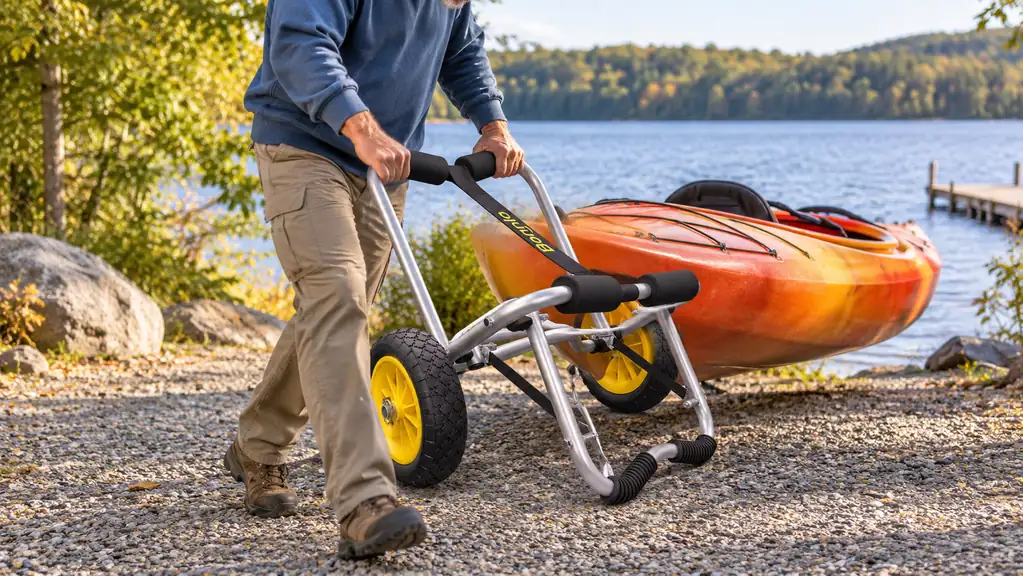
The first Saturday I used it, Earl and I pulled into the gravel lot at Herrington a little after seven. Biscuit was in the back seat doing his usual patrol of the windows. I unfolded the cart, set my kayak on it, and ran the two straps over the hull. I will not pretend the first strap job was pretty. It took me a couple of tries to get the kayak centered. But once I did, I took hold of the frame and walked. The cart rolled over the gravel, down the little grass slope, and right to the water's edge.
That is the part I want to explain to anyone who has not used a cart. When you carry a 60-pound kayak, your arms get tired and your back takes the load. When you roll it on a cart with 10-inch solid tires, the load goes to the ground. The cart is rated for 200 pounds, so my kayak is not even close to the limit. The wide tires do not sink into the packed sand at the launch the way a narrow wheel does. I still have to steer it. I still have to watch for ruts. But I am not carrying the boat.
It is not perfect. If you are by yourself, lifting the kayak onto the cart takes some care, especially on uneven ground. I set the cart beside the kayak, tip the kayak up, and slide the cart under it. On a windy day at the ramp, the kayak wants to slide before you get the straps tight. The straps themselves take a minute to run and tighten. And on soft mud, any cart will work harder. I have learned to park where the ground is firm and take the extra 20 steps.
I am 61 with a stiff lower back, and I can now get my 60-pound kayak from the truck to Herrington Lake by myself in one trip.
The walk to the water should not be the hard part
The Bonnlo kayak cart carries up to 200 pounds on solid PU tires and folds down for the truck bed. Two ratchet straps are in the box.
Amazon See the Bonnlo Kayak Cart on Amazon →The ramp at Herrington is not a paved launch. It is gravel, then a lip of concrete, then water. The first time I rolled down that lip, I expected the cart to hang up. It did not. The 10-inch wheels stepped over the edge and the kayak stayed put. I walked it into ankle-deep water, unfastened the straps, and slid the kayak off. The whole unloading took less time than tying my shoes. I backed the empty cart up the ramp and left it by the truck.
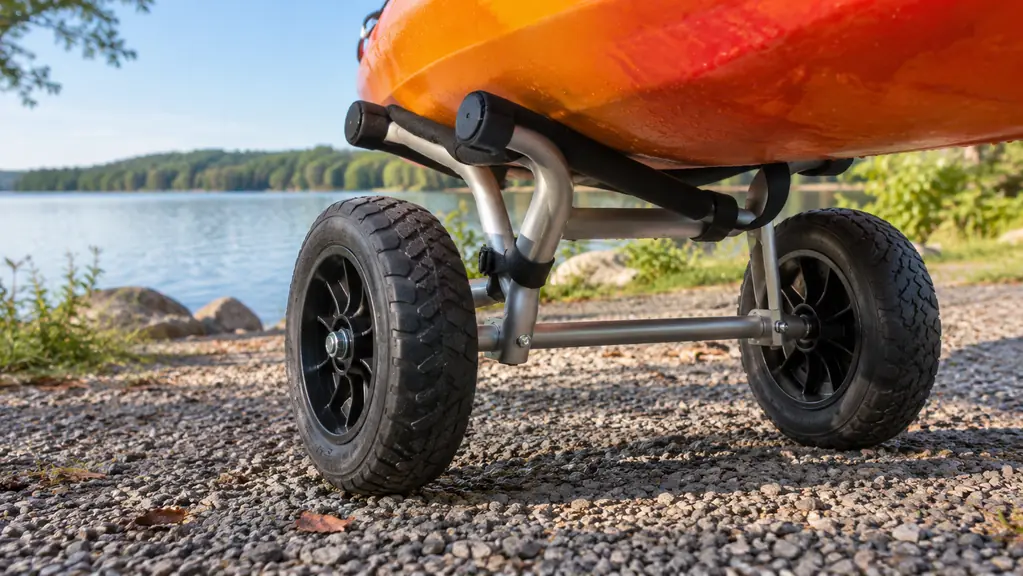
Earl borrowed it for his borrowed kayak one afternoon. He is 64 and does not like to admit that his shoulders bother him. He came back up the ramp and said, "That thing does what it says." From Earl, that is a review. Biscuit supervised from the shade. I have used the cart every weekend since April, sometimes twice a weekend, and the tires have not gone soft because there is nothing inside them to go soft.
I keep it folded in the bed of the pickup. It takes up less room than a bag of dog food. When I get to the lake, I pull it out, unfold it, and I am ready. The aluminum frame has not bent. The straps have not frayed. I rinse it off when it gets muddy and let it dry in the sun. That is the whole maintenance routine.
What I notice most is not the cart. It is that I am not worn out before I start paddling. My back used to ache on the drive home. Now the ache comes from sitting in the kayak for four hours, which is a different and more honest kind of ache. I get out on the water faster, and I come back to the truck with more energy. For a 61-year-old with a stiff lower back, that is worth more than any gadget I have bought for this hobby.
What I'd Tell You If We Were Sitting at My Kitchen Table
If we were sitting at my kitchen table, I would tell you to think about the distance from your truck to the water before you buy another paddle or another lure. That distance is the part that keeps people home. A cart is not exciting. It is a tool. The Bonnlo cart is a good one because it is light, it rolls on solid tires, and it folds up small. It is not magic. You still have to strap your kayak down and steer it.
I would also tell you to practice loading it in your driveway before you take it to the lake. Learn where your kayak balances. Use both straps, not one. Park on firm ground. And if your back is already sore, ask for help the first time. That is not a weakness. That is how you keep paddling into your sixties.
Get your kayak to the water without the long drag
The Bonnlo kayak cart holds up to 200 pounds, weighs 5 pounds, and folds down for the truck bed. Solid PU tires mean no flats and no pump.
Amazon See the Bonnlo Kayak Cart on Amazon →