
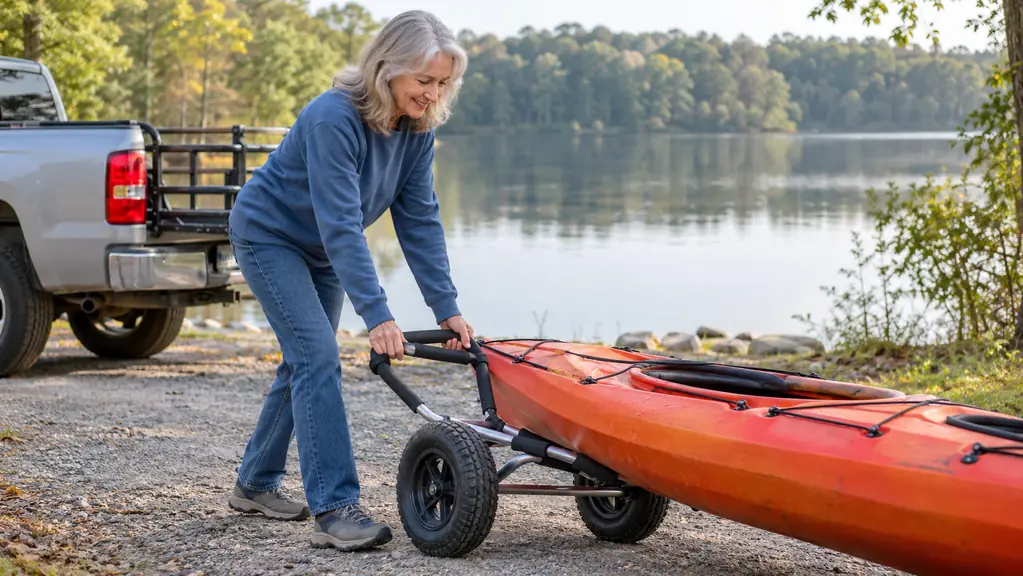
The kayak cart is the piece of gear nobody researches properly. I know, because I did not. I bought a cheap folding cart from a big-box store four summers back, and it dumped my 10-foot sit-on-top on the concrete ramp at Herrington Lake in front of three people who all stopped to watch. My lower back still brings that up when it wants to win an argument. So when I replaced it, I got picky. The Bonnlo kayak cart has been riding in the bed of my silver pickup ever since, and it has been over gravel, packed dirt, wet sand at a farm pond, and about a mile of rough chip-seal road I would not wish on anybody. I have opinions about it, and not all of them are flattering.
This is not the review where I tell you a cart changed my life. It is the review where I tell you what the product listing leaves out. Where it rolls easy. Where it fights you. And the one small habit that decides whether you love this thing or cuss it every single trip.
The Quick Verdict
A five-pound aluminum frame rated to 200 pounds, with solid no-flat tires that do not care about goatheads or gravel. The two included ratchet straps are the part you will end up re-tying.
Amazon Check Today's Price →The cart that lives in my truck bed instead of a shelf in the garage
Five pounds, solid tires, folds flat, rated to 200 pounds. Check today's price before your next launch day.
Amazon Check Today's Price on Amazon →What Nobody Tells You About Kayak Carts
Here is the first thing that never makes it into a listing photo. The wheels are almost never what goes wrong. Ask anybody who has burned through two or three carts and you will hear the same story. A solid tire either rolls or it does not, and a solid PU tire like the ones on this cart does not care about goatheads, gravel, or a stray nail in a parking lot. What fails is everything between the cart and the boat. Straps creep. Frames flex under a shifting load. The cart walks out from underneath the hull on a sidehill and the next thing you know you are carrying a kayak in your arms like a sack of feed. Any money you spend on a cart is really money spent on a frame that does not fold up under weight and a strap arrangement you trust at the end of a long day. My old cart did not fail at the wheels either. The cross pin that held the axle sheared off about a quarter inch from the end, right there on the slab at Herrington Lake, with the boat halfway down. Nothing dramatic happened. The frame simply leaned over and set the hull down on the concrete and I stood there holding a strap with nothing attached to the other end. That pin was a stamped part about the size of my little finger and it took the whole cart out of service for good.
The second thing is what a weight rating means in practice. The Bonnlo is rated to 200 pounds. My kayak is a 10-foot sit-on-top, about 60 pounds dry, and by the time I load the paddle, the fishing crate, the cooler and the tackle bag I am somewhere near 90. So I am nowhere close to the ceiling, and that matters more than people think. A cart rated at 200 pounds is comfortable at half that and honest at three quarters of it. If you paddle a heavy two-person boat or a loaded touring kayak that runs 130 or 140 pounds with gear, you are still inside the rating, but you are asking more of the same frame and the same two straps than I ever ask of mine.
The third thing is that sand is a different planet. Nearly every cart review you read was written on a concrete boat ramp, and concrete is the easiest surface a cart will ever see. Gravel is a step harder. Wet sand at a farm pond is a whole separate negotiation, and no two-wheel cart with any tire on it solves that completely. I will get to it in detail, because it is the part of this review that matters most if you launch off a beach instead of a ramp.
How I've Used the Bonnlo Cart
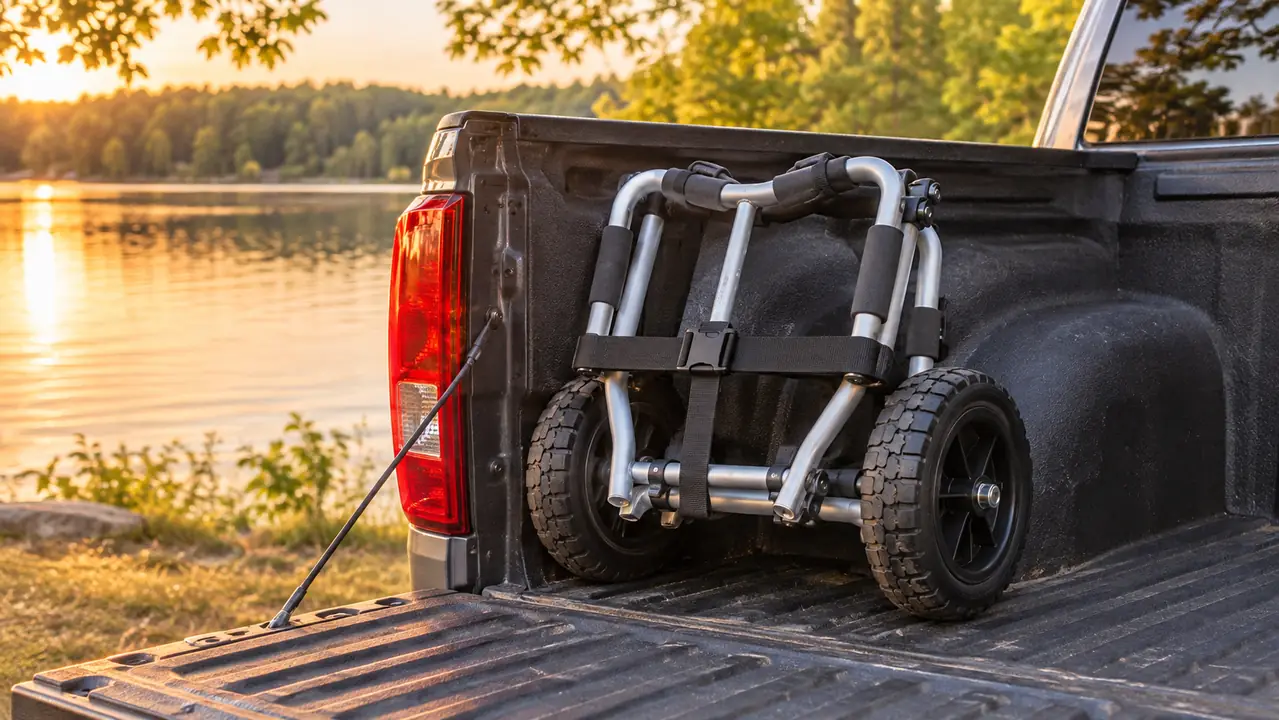
I am 61 and I drive a school bus no more, so my weekends from April through October mostly involve a kayak and a lake. The cart stays assembled or folded in the truck bed depending on how lazy I was the trip before. It folds down small enough to lie beside the bed extender without me unloading anything else, and at five pounds I can pick it up with one hand while I am holding a paddle in the other. That sounds like a small thing until you are the person who has to make three trips up a ramp. Folded, it sits crossways behind my toolbox and flat enough that I never have to move anything out of the bed to reach it. I keep a tape measure in the truck because I am that sort of person, and the folded bundle comes in shorter than the arm of the bed extender. That is the whole reason it lives back there instead of on a hook in the shed where I would forget it until launch day.
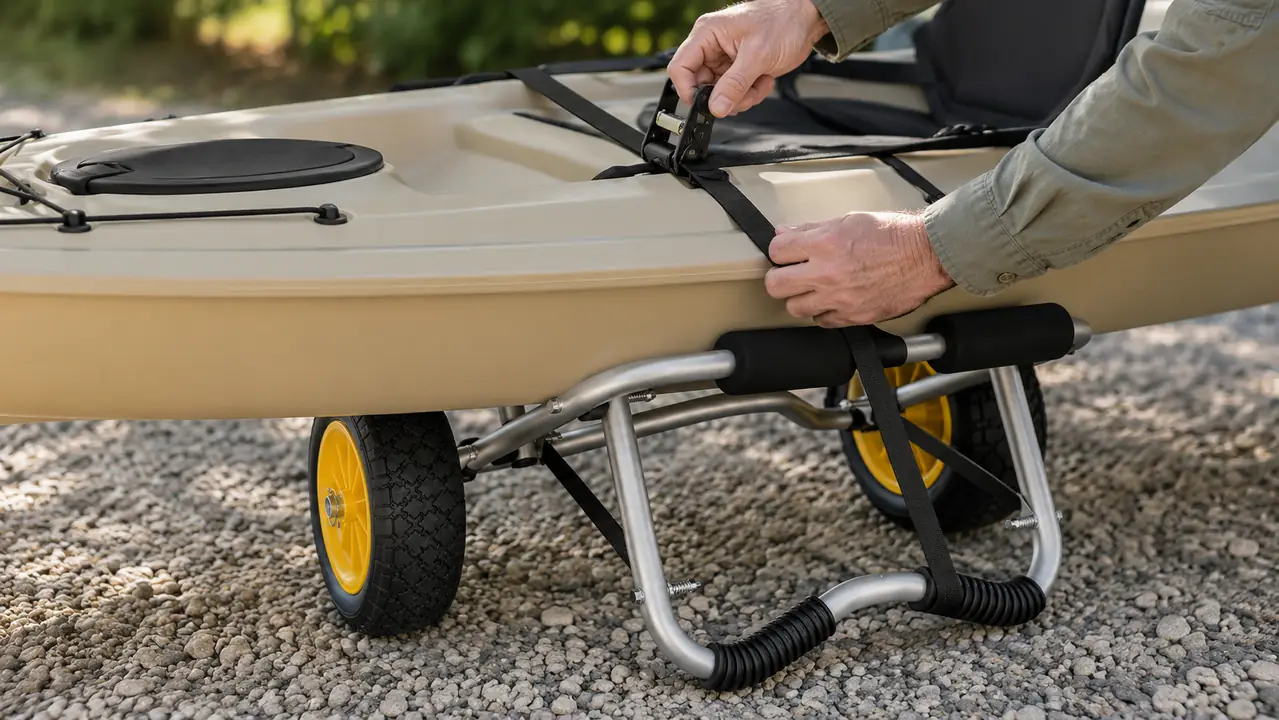
My routine goes like this. I set the folded cart on the ground behind the truck and open it out. I lift the bow of the kayak onto the frame, walk to the stern, lift, and slide the hull forward until it sits balanced between the wheels. Then the straps go over the deck and I ratchet them down snug. I do not crank them like I am tying down a tractor. Snug, then check. That last part is the whole ballgame and I will explain why in a minute.
My husband Earl borrows a kayak now and then and I have hauled his boat on this cart too, and it behaved the same as mine because a cart does not care whose name is on the hull. Our dog Biscuit rides along on the calm days and supervises from the shade while I load. Biscuit has never once offered to help, but he has also never once complained about the walk, so we are even.
Sand, Gravel and Concrete: Three Different Jobs
The ramp at Herrington Lake is concrete with a lip at the bottom where the slabs meet. On concrete this cart is quiet and easy and you could push it with two fingers. The solid tires do not flex, so there is no bounce and no squirm, and the whole rig tracks straight behind me. If your launch is a proper ramp, you are going to wonder why anybody complains about kayak carts at all.
The path down to my favorite creek put-in is gravel and packed dirt, maybe two hundred yards, with a couple of roots across it. The tires chatter over the loose stuff, which is what hard tires do, but they do not dig in and they do not bog down. Ten inches across and three inches wide is enough footprint to stay on top of gravel and packed clay. I have pulled a loaded boat through that stretch at a walk with my back straight, which is more than I could say for the cart I owned before this one.
Now the sand, and here I have to be straight with you. Loose dry sand is where a two-wheel cart of any brand starts to work against you. The tires are solid and relatively narrow compared with a beach cart built for the purpose, so in deep dry sand they sink and start to plow. On wet sand near the waterline, or on a hard-packed lane, it rolls fine. Last August I put in at a farm pond off the back side of a pasture, and the last forty feet down to the water were loose sand that had dried out in the afternoon sun. I got maybe ten feet before the tires quit rolling and started pushing, and I ended up dragging the boat by the bow handle with the cart still underneath it like a sled. Earl laughed. I did not. A hundred yards over on the packed lane it rolled exactly the way it does on gravel, no complaint at all, which tells you the cart is fine and the surface is the problem. In the loose stuff you need speed and a prayer and you will be breathing hard at the end. If your regular launch is a wide beach of soft sand, this cart will test your patience, and that is physics talking, not a knock on Bonnlo.
The Straps Are Where It Earns or Loses Your Trust
The cart comes with two ratchet straps, and they are decent straps. They are not magic straps. A sit-on-top hull is wide, flat and slick on the bottom, and a strap that goes over the deck of a wide boat has a lot of hull to cross before it does any real holding. The first few times I used it, I set the boat down on the frame, strapped it, and by the time I got twenty feet down the ramp the whole thing had shifted an inch and a half to one side.
The habit that fixed it took me two trips to figure out. I check the straps after the first twenty feet, every single time, and I give them one more click. A hull that shifted when you first set it down will keep shifting, and a hull that has settled is a hull that stays put. It costs me ten seconds and it has saved me a dropped boat more than once. If you only take one thing from this review, take that one.
The other strap note is chafe. Straps rubbing on a plastic hull in the same spot, trip after trip, will leave a mark and eventually a scuff you can feel with a fingernail. I fold a bar towel double and put it under the strap where it crosses the widest part of the deck. That is a cheap fix and it keeps the boat looking like somebody takes care of it. Two more small things I learned the hard way. These straps are long enough for a wide sit-on-top deck, which means there is a good deal of tail left over once you are tight, and a loose tail will flap against the hull on rough pavement for a quarter mile and you will hear every slap of it. I roll the excess and tuck it under itself. And on a breezy morning at the ramp I run the forward strap just behind the seat area instead of over the middle of the hull, because a wide boat wants to weathervane in wind and the rear strap alone will not keep the bow from swinging.
A cart never fails you on flat concrete in the middle of the afternoon. It fails you at dusk, when your back is already talking and the boat starts to slide.
Folding It Down and Living With It
The cart folds flat, and that is the reason it stays in my truck instead of getting left in the garage. Folded, it takes up about as much room as a folding camp chair and it slides under the stuff I already carry. There is no disassembly, no bag of loose pins to lose, no tools. Open it, roll it, fold it, done.
The tires are the reason I stopped worrying. They are solid PU, so there is no valve, no pump, and no topping off in April after a winter in the shed. I have had inflatable tires on a garden cart before and I spent more time with a pump than I did with the cart. These have been rolled over gravel, dropped off a tailgate, and left out in the sun, and they still roll round.
Two honest annoyances. First, it does not carry itself. If the walk from the truck to the water is long, you are still making the trip twice, once with the boat and once back for the paddle and the crate, same as any cart. Second, in the bed of a pickup it will rattle against the bed extender over rough road, so I keep a short bungee in the truck and hook it to something solid. Neither of those is a deal breaker. I just do not want you to buy this expecting it to solve problems it was never built to solve.
What I Liked
- Solid PU tires, so no flats and no pump, ever
- Five-pound aluminum frame rated to 200 pounds, which is plenty for a loaded sit-on-top
- Folds flat enough to ride in a truck bed without unloading everything else
- Two ratchet straps included, so it works out of the box
- Rolls quiet and straight on concrete ramps and packed gravel
Where It Falls Short
- Two wheels sink and plow in deep loose sand
- Included straps need a re-check after the first few feet of travel
- It rattles in a truck bed unless you tie it down
- Does not reduce the number of trips between vehicle and water
Who This Is For
This cart is for the paddler who launches from a real ramp or a gravel bank and wants to stop carrying a boat on a sore back. If your kayak is under 200 pounds loaded, if you have a truck or an SUV with room for something that folds flat, and if your back has started negotiating with you about weekends, this is the cart that fits that job. It is also a good match for fishing kayak folks, because a loaded sit-on-top with a crate and a cooler is exactly the kind of weight that makes a cart worth owning.
It is also for the person who has already owned a cheap cart and got burned. Bonnlo's solid tires and light aluminum frame are the two things that separate this from the folding cart at the hardware store, and those two things are the whole reason a cart works or does not. I have hauled mine out of the truck bed well over a hundred times now and the frame is still square and the axle is still where it started.
Who Should Skip It
If your usual launch is a wide beach of soft dry sand, skip it, or at least go in knowing what you are getting. Two narrow solid wheels on soft sand will plow, and no brand of two-wheel cart fixes that. Look at something built specifically for beach launches with much wider tires, and accept that it will weigh more and take up more room. If you paddle a heavy two-person boat that lands near 180 or 190 pounds with gear, you are close enough to the 200-pound rating that every bump in the ramp is going to feel personal.
And if you want a cart that stays strapped under the hull all day while you paddle, this is not that design. This is a cart you load at the truck, roll to the water, take off, and leave on the bank. That is how I have used it for six seasons and it suits me fine, but it is worth knowing before you buy.
Five pounds of cart beats a bad back every time
Solid no-flat tires, 200-pound rating, folds flat in the truck bed, two straps in the box. Check today's price and get your launch day back.
Amazon Check Today's Price on Amazon →