

I have paddled in the Onyx Kayak Fishing Life Jacket for two full seasons now, and I am going to tell you the parts the five-star reviews skip. Not because it is a bad vest. It is the one I reach for every Saturday from April through October, and I have never once been tempted to leave it in the truck. But my first month with it was aggravating, and most of that aggravation came from things nobody mentions in the listing photos.
Quick background so you know who is talking. I am 61, retired from driving a school bus for close to thirty years, and I live outside Danville, Kentucky. I paddle a 10-foot sit-on-top on Herrington Lake and a few slow creeks and farm ponds nearby. Calm water, no whitewater, no ocean. My lower back aches after about two hours in any seat, and my shoulders are sore the day after a long paddle. So a life jacket has to do more than float me. It has to stay out of the way of the paddle stroke and off the small of my back. That is the bar I judged this one against.
The Quick Verdict
A genuinely comfortable high-back vest for sit-on-top paddlers, once you get the straps dialed in. The pocket layout flatters the photos more than it flatters a real tackle loadout.
Amazon Check Today's Price →The Vest I Stopped Thinking About by July
It is not the fanciest vest on the shelf and it is not the lightest one either. It is the one I quit noticing, which is the only review that matters four hours into a paddle.
Amazon Check Today's Price on Amazon →What Nobody Tells You Before You Buy
Two things decide whether you and this vest get along, and neither one is in the bullet points. The first is the high-back cut, which is a shape decision, not a comfort feature. The second is how you set the straps, and the factory setup is not it. Get those two right and the vest stops being something you think about. Get them wrong and you will spend a whole season tugging at your shoulders and wondering why everybody else likes theirs.
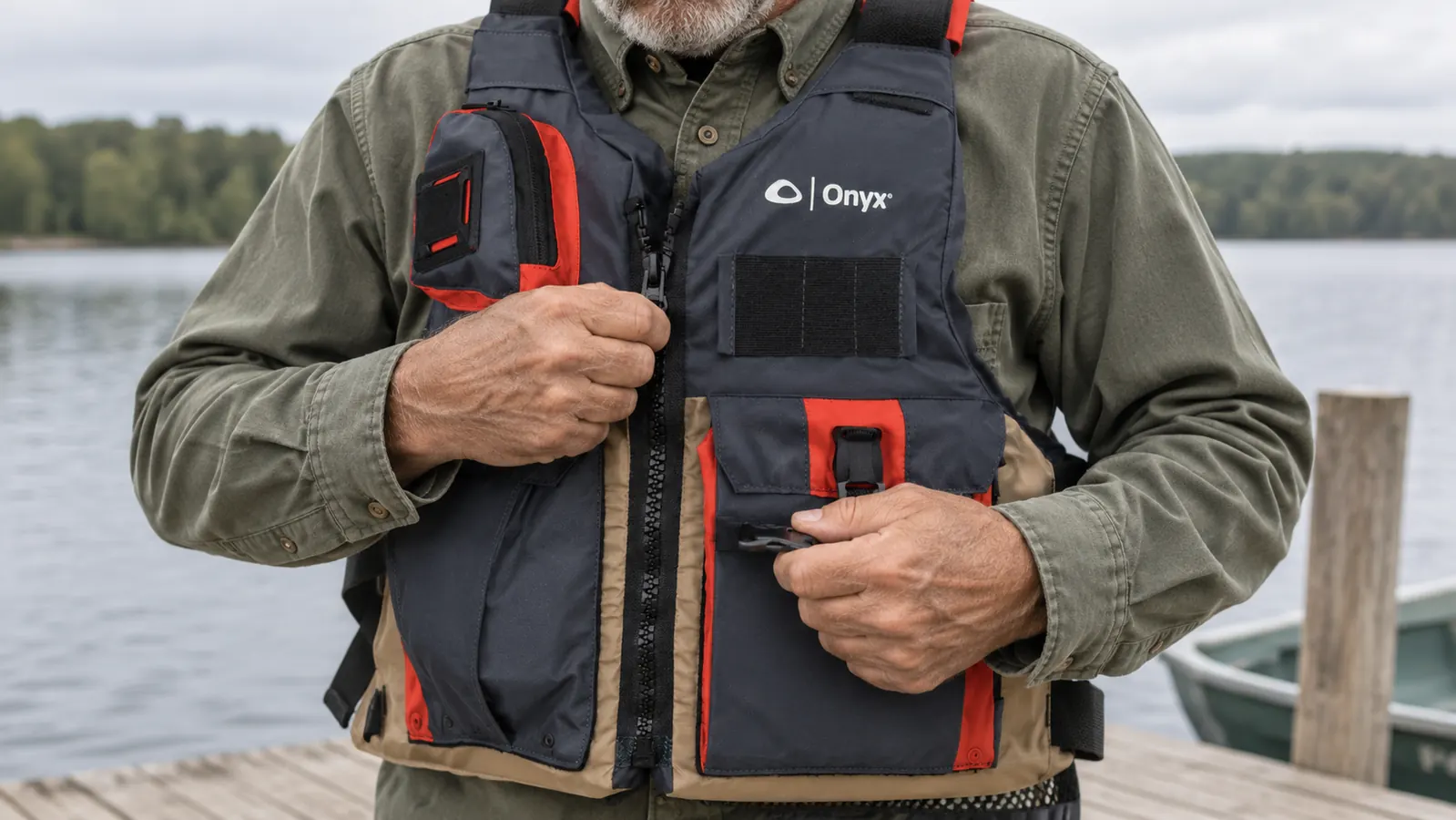
The vest is simple on purpose. Nylon shell, 400 denier, a heavier weave than the thin stuff on the vest I owned before this one. Zipper and buckle closure, not one or the other. Neoprene pads on the shoulders and fleece lining inside the pockets. A mesh panel across the lower back and shoulders. It weighs 1.4 pounds on my kitchen scale, close enough to the listed weight that I stopped checking. Nothing about it is fancy and nothing about it feels flimsy.
It is also Coast Guard approved, which is the one piece of paperwork I actually care about. Kentucky wants a wearable life jacket on every paddler, and I have been checked once at the Herrington ramp in six years, so the approval matters less for the fine and more for the fact that April water up there is cold enough to change your mind about everything in about ninety seconds. I want the vest I am wearing to be a real one.
How I've Used It
I have worn this vest on Herrington Lake in July heat, on a creek in October when the water was 54 degrees, and on a farm pond so shallow my paddle hit mud every third stroke. Four to six hours a trip, most Saturdays and a fair number of Sundays, roughly thirty outings a season. My husband Earl comes along now and then in a borrowed kayak, and he has worn the Onyx twice when he forgot his own. He is broader through the chest than I am and it fit him well enough to finish the day without complaint.
One Saturday last June I put in at the Herrington ramp at six in the morning and did not come off the water until nearly one. Six and a half hours, longer than I usually go. The lake was flat, the shade was gone by ten, and I drank most of a two-quart jug. Somewhere around eleven I noticed I had not touched the vest since I put it on, not once, and that is the whole review right there. In the vest I owned before this one I would have been pulling at the shoulders by nine and taking it off to eat lunch.
I wear it in the truck on the way to the ramp, which tells you something. A vest that is miserable to sit in gets taken off the second the kayak is loaded. This one I forget about until I stop for gas. That is a small thing that turns into a big thing over a season.
And yes, Biscuit rides along on the calm days. Forty-five pounds of hound standing on the front of a sit-on-top is its own kind of stability test, and this vest has never shifted on me while I was reaching out to steady him.
The High-Back Cut Is the Whole Point
Most life jackets have a panel of foam running straight across the back at roughly seat height. On a sit-on-top with a molded seat and a raised backrest, that panel fights the seat and pushes the whole vest up around your ears. The Onyx high-back design cuts that panel away so the vest sits above the seat back instead of on top of it. On my kayak that is the difference between a vest that rides up all afternoon and a vest that stays where I put it.
If you paddle a canoe or a sit-inside with a low seat, this cut buys you nothing. It is not worse, it just is not doing the job it was built for. That is the single most important thing to understand before you buy. The high-back shape is a solution to a specific problem, and if you do not have that problem you are paying for a feature you cannot feel.
The Pockets: Some Earn Their Keep, the Rest Are Decoration
The listing says multiple pockets and tool holders, which is true and also misleading in the way listings usually are. There are several pockets across the front plus D-ring attachment points, and the zippered ones are the ones that matter. A zippered pocket swallows a phone in a dry bag, a license, and a handful of soft plastics. The fleece lining in them is real and it does keep a phone from sliding around when you lean.
What I actually carry, after two seasons of trial and error: phone in a dry bag in a zippered pocket, license in another, a rag in one lower pocket, a granola bar in the other, and a line clipper on a D-ring on a short tether. That is the whole loadout and it works. What did not work was the spring I tried to carry a small tackle box up front. It fit. It also put a hard corner against my ribs every time I leaned forward to net something, and I moved it behind the seat after two trips.
The lower pockets are where the design gets optimistic. They are flat, and once you add a pair of pliers, a line clipper and a spool of leader, they bulge out in front of you at exactly the height where your hands come through on a paddle stroke. I quit using them for anything hard after the second trip. Now they hold a rag and a snack bar and nothing else. If you carry a full tackle loadout on your chest, this vest will disappoint you, and no amount of reorganizing fixes it.
What Annoys Me After Two Seasons
The zipper is the first thing. It is a good zipper, but it sits behind a buckle, so every time you put the vest on you are doing two closures, and in a cold wind with wet hands that is one more step than I want. I have gotten fast at it. I have not gotten to like it.
The second thing is drying. Four hundred denier nylon with fleece-lined pockets takes a while to dry if you leave it in the truck bed overnight, and a vest that smells like lake water in August is a vest you stop looking forward to. I learned that the first August. Left it in the bed of the silver pickup after a Sunday paddle, and by Tuesday the fleece in the pockets smelled like something had crawled in there and given up. I washed it in the bathtub with a little dish soap, rinsed it twice, hung it in the garage with a box fan pointed at it, and it came back fine. Now it goes on the hook before I even pull the bed extender out.
The third thing is the shoulders. Neoprene pads feel good against a bare shoulder in July, but over a long-sleeve shirt they grab, and the vest does not rotate with you when you reach forward. After about three hours of casting I notice it. It has never hurt, exactly, but it is the reason I take a break at the three-hour mark instead of pushing to five.
The collar sits higher than I expected. If I turn my head hard to look behind me it catches my jaw. Minor, but it is why I moved my rear rod holder off to the side instead of keeping it straight back behind the seat.
What I Liked
- High-back cut clears a molded kayak seat instead of fighting it
- 1.4 pounds, light enough that I forget I have it on
- Mesh across the lower back and shoulders vents real heat in July
- Zippered pockets are actually sized for a phone in a dry bag
- Neoprene shoulder pads and fleece-lined pockets are comforts you feel in hour four
- Adjustable straps and a universal fit that also worked on my broader husband
Where It Falls Short
- Two closures, zipper plus buckle, every single time you put it on
- Lower pockets bulge into your paddle stroke once you load them
- Nylon and fleece hold water and need to hang dry overnight
- Shoulder pads grab a long-sleeve shirt and limit how far you reach
- The high-back cut is wasted if you paddle a canoe or a low-seat sit-inside
Four hours into an August afternoon on Herrington Lake, the mesh panel across my lower back was the difference between fishing until dark and loading up at two.
Sizing and the Adjustment That Fixed Most of It
Mine is the oversize, and on my frame that was the right call. I am not a small woman and I wanted room for a hooded shirt in October and a plain t-shirt in July. Out of the box it fit like a barrel. The straps were set for somebody taller and it rode up under my arms every time I lifted the paddle.
The oversize cut is roomy on me without being sloppy once the straps are set. If you are between sizes, I would not size up just because the label says oversize. Earl is taller and broader than I am and it fit him with the side straps let out, but he said it was snug across the chest, and he was glad to hand it back to me at the ramp. The one year manufacturer warranty is the piece of fine print worth knowing about. In two seasons I have not needed it.
What fixed the fit was fifteen minutes on the living room floor with Earl pulling straps while I sat in a kitchen chair. Snug at the waist first, then the shoulders, then the side straps last. The order matters. Tighten the shoulders first and the waist rides up, and you will fight it all day. After that adjustment the vest stopped moving and it has not needed touching since. That is the whole trick and it is not in the instructions.
How It Handles a Cold Morning
April in central Kentucky is 48 degrees at the ramp and 72 by two in the afternoon. That swing is where a vest earns or loses its keep. Over a hooded sweatshirt this one goes on snug and stays snug, and the buckle and zipper still work with numb fingers once you have practiced the sequence a few times. In July I wear it over a plain t-shirt and the mesh across my shoulders and lower back is doing real work by noon. The one thing I do differently in April is loosen the side straps a notch before I get in, because a vest cinched down over a hooded sweatshirt rides up when I twist to reach behind me for the paddle. Ten seconds at the ramp and it saves me a morning of fussing.
I have not gone in on purpose. Nobody does. I did step off the side of the kayak in shallow water one October in my old vest and got a reminder of how fast cold water takes your breath away. That is the whole argument for buying a vest you will actually keep on for six hours instead of one you shed at the first sign of heat. Comfort is not a luxury in a life jacket. It is the reason you are still wearing the thing when it matters.
What I Gave Up Compared to My Old Vest
My last vest was a plain front-zip model with a low back panel and about half the pockets. It was lighter and it dried faster, and for a couple of weeks I genuinely wondered whether I had traded up. The old one rode up over the seat back every time I leaned forward to net a fish, and by July I was pulling it back down constantly. That is the trade. I gave up a little bit of weight and a little bit of drying speed and got a vest that stays put. It had no D-rings either, so my line clipper lived in the footwell and I lost it twice before I learned to tether one to the new vest.
The pockets are the other half of that trade. My old vest had one small pocket that held a license and nothing else, so I carried a soft bag behind the seat instead. This one lets me keep the phone and the license on my body, which I like, without carrying so much that I feel like a tackle shop. That is the right amount for the way I fish. For somebody who fishes differently it will not be.
Who This Is For
This is for the paddler in a sit-on-top fishing kayak with a molded seat and a raised backrest, the one who is out for four to six hours and wants a vest that quits announcing itself. It suits a casual angler who carries a phone, a license, a rag and a couple of soft plastics rather than a full box of hardware. I also think it is a fair pick for a grandparent taking a grandkid out on a farm pond, because the zipper and buckle are big enough to work with cold hands and the vest is not fussy to put on. And it suits anybody whose back complains after a long sit, because the Onyx high-back cut and the mesh panel do more for that than any cushion I have tried.
Who Should Skip It
Skip it if you paddle a canoe, a pack canoe or a sit-inside with a low seat, because the high-back cut is wasted on you. Skip it if you fish with a serious chest loadout, because the lower pockets will not hold it and you will be miserable by ten in the morning. And skip it if you want one closure you can work with cold, wet hands, because this vest has two and neither is going to change.
Two Seasons, Thirty Outings a Year, Still My Vest
Set the waist first, hang it to dry, and stop loading the lower pockets. Do those three things and it is a comfortable, honest vest that will serve you for several seasons.
Amazon Check Today's Price on Amazon →