
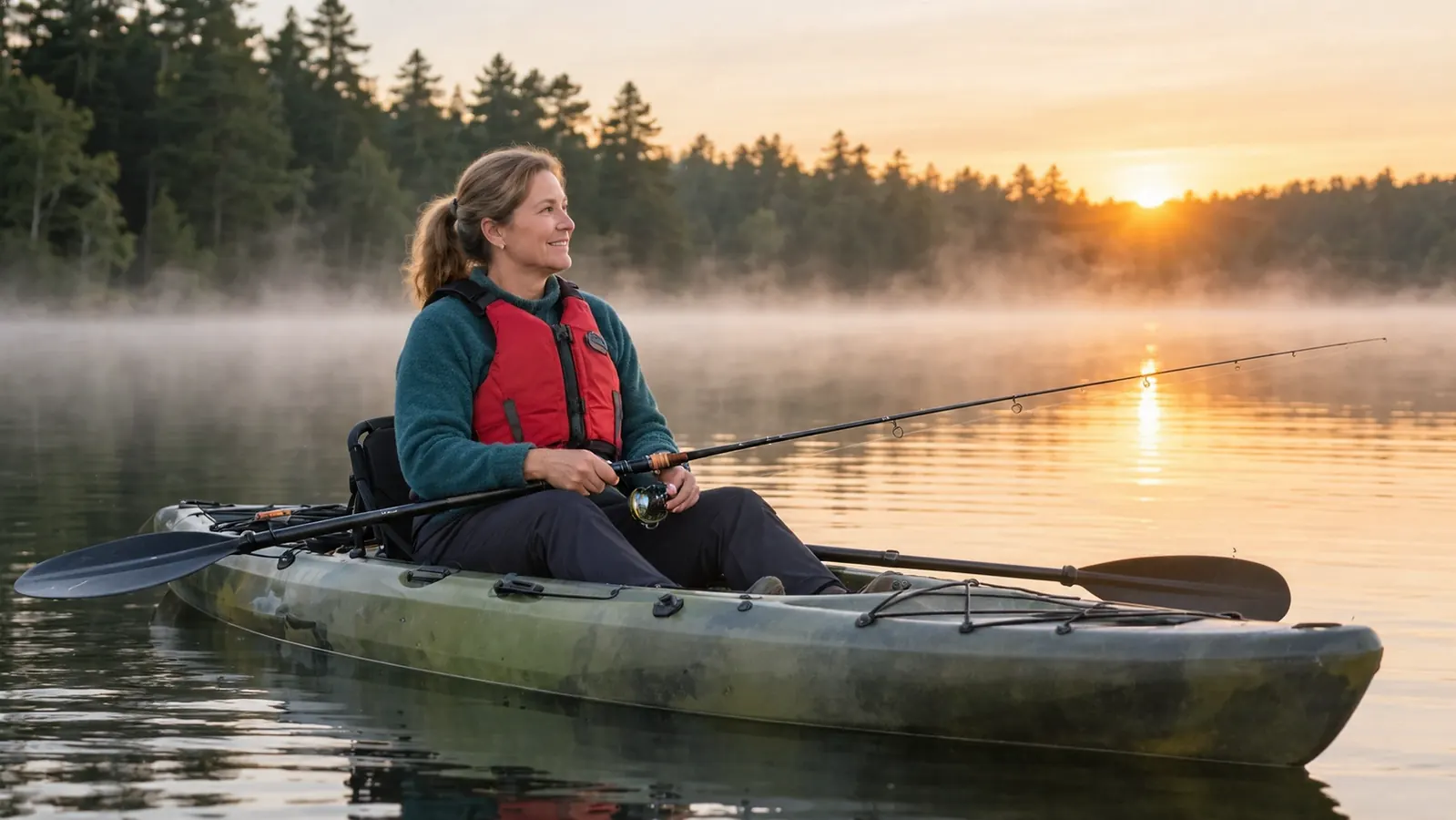
I bought the Onyx Kayak Fishing Life Jacket in April and wore it on every trip from opening weekend through the last warm Saturday in October. That is more than thirty launches, mostly on Herrington Lake plus a handful of slow creeks and farm ponds within twenty minutes of the house. I am 61 years old, I have a lower back that files a complaint after about two hours in any seat, and I fish out of a 10-foot sit-on-top that runs around 60 pounds empty. A life jacket that rides up around my ears, pinches my neck, or fights the back of my kayak seat does not get a second chance with me. I have donated enough of those to the back wall of the garage.
The Onyx is the first one I have owned that I quit thinking about by mid-morning. That is the review in one sentence. Everything after this is the why, and the places it still falls short.
The Quick Verdict
The first life jacket I have worn for a six-hour paddle without once reaching back to adjust a strap. Not the lightest vest on the rack and the pockets are not dry storage, but for a sit-on-top angler it earns its spot.
Amazon Check Today's Price →The vest I stopped noticing by 9 a.m.
A high-back cut that clears a kayak seat, mesh where the vest meets your back and shoulders, and pockets that hold what a morning on the water actually needs. Look over the size chart before you order.
Amazon Check Today's Price on Amazon →How I've Used It
My season runs April to October, weather permitting. I aim for one morning a weekend, sometimes two. A good session is four hours on the water with maybe an hour of that actually fishing and the rest paddling, drifting, and working through a thermos of coffee. Earl, my husband, comes along maybe one trip in four in a borrowed kayak. Biscuit rides in the front well on the flattest days only, and he is a 45-pound hound, so his idea of flat and mine are not the same.
That adds up to something like thirty-five trips with the Onyx on my back, in temperatures from about 48 degrees in April to the mid-90s in August. I have worn it over a t-shirt, over a long-sleeve sun shirt, over a light fleece in the spring, and over a rain shell twice when the forecast got it wrong. I have worn it soaked after a clumsy re-entry at the ramp. I have worn it for six hours straight on a July Saturday when the fish were cooperating and I could not talk myself into leaving.
The trip that settled it was a Saturday in early June on a farm pond. Flat water, no wind, fish biting. I put in at 6:30 and pulled out a little before one. Six and a half hours. I stood up twice to stretch and sat the rest of it, and the only part of me complaining at the end was my lower back, which complains regardless of what I am sitting in. The vest never crossed my mind. My old one would have had me loosening side straps by nine.
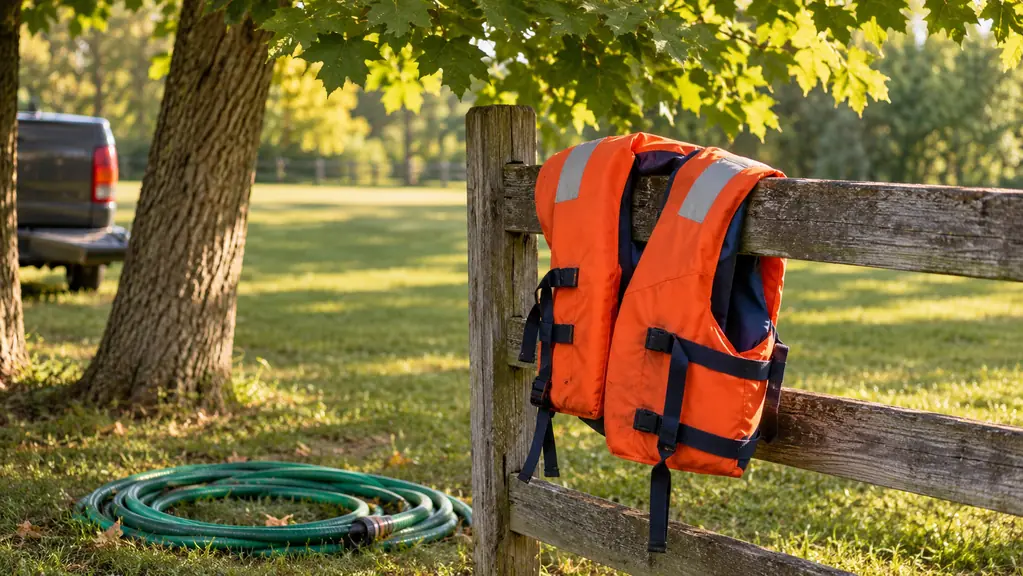
At home I rinse it with the yard hose, hang it over the fence rail in the shade, and let it dry overnight. That is the whole care routine. It has not complained once.
The High-Back Cut Is Why I Kept Wearing It
Most life jackets are cut straight across the back. On a sit-on-top, your kayak seat has a tall back panel, and a straight-cut vest gets pushed up by that panel every time you lean back. After an hour you are holding your shoulders forward to keep the vest down, and by hour three your neck is sore and you are blaming the paddle. I know this because I spent five years doing exactly that.
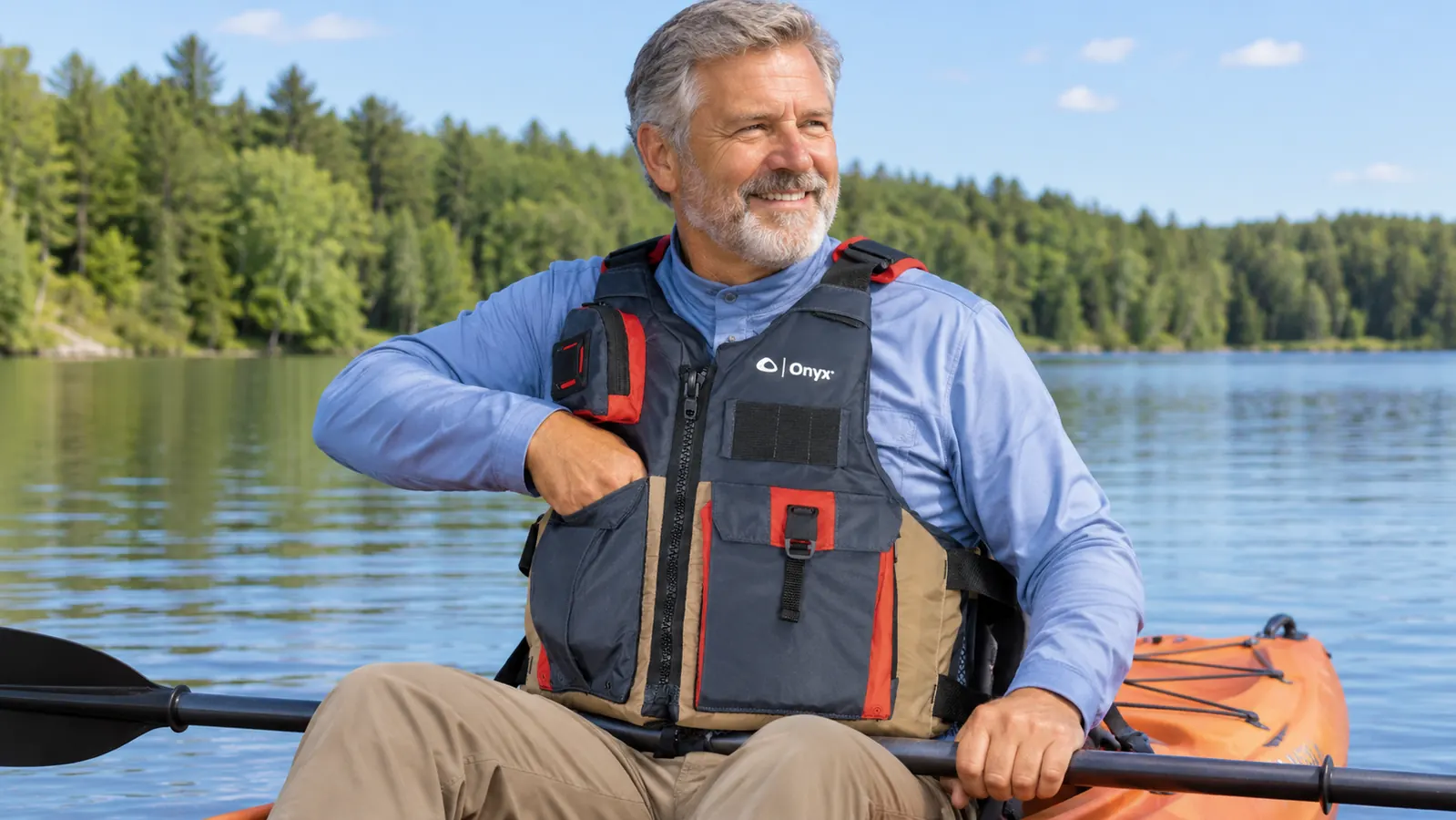
The Onyx has a high-back design, which means the foam at the back is cut away to clear the seat rather than padded straight across. The back panel of my kayak seat slides into that gap instead of shoving the vest up my chest. The lower back and shoulders are mesh, so the two places pressed hardest against the seat and against my skin all day are the two places that breathe. That reads like a small thing on a product page. It is the entire reason this vest is the one I reach for and the other two stay hanging on the garage wall.
The shoulder straps have neoprene pads where they cross the top of the shoulder. I have a cranky right shoulder from thirty years of wrestling a school bus steering wheel, and the pad lands exactly where the strap would otherwise dig in. I noticed it the first week and then stopped noticing it, which is the highest compliment I can pay a piece of padded anything.
Earl's borrowed vest has a straight back and he grouses about it every trip. I have offered to let him try mine out on open water and he keeps saying he will get his own. That is a man who has already decided.
Pockets, D-Rings, and Where Everything Actually Goes
The jacket has multiple zippered pockets, tool holders, and D-ring attachments. That is the listing language, and it undersells the practical part, which is that you can reach everything without taking the vest off or twisting around in the seat. I keep a small clamshell box of hooks and sinkers in the lower zippered pocket on my left, my line clipper on the tool holder on the right, and a folded rag in the other pocket because my hands are never dry. The fleece-lined pockets are where my hands go in April and October when the mornings are cold. I did not expect to use those and I use them every spring trip.
The D-rings are what I clip a small dry bag and my kayak leash to. If you have ever watched a pair of pliers slide off your lap into eight feet of water, you understand why that matters. I also clip a floating handheld radio to one when I am out on the bigger water at Herrington, mostly so Earl stops worrying about me.
Here is the honest limitation. Zippered is not the same as watertight. I would not put a phone or a set of truck keys in these pockets without a dry bag inside, and I do not. A zipper keeps things from falling out. It does not keep a two-inch wave out. Plan for that and you will be fine.
One more practical note. Because the pockets sit low and forward rather than stacked up the chest, they do not interfere with a paddle stroke. I have worn vests where a bulky front pocket caught the shaft on every stroke and rubbed a raw spot on my forearm by lunch. That has not happened once with this one.
Fit, Adjustment, and the Sizing Question
The Onyx closes with a zipper and a buckle, and the straps adjust at the sides and shoulders. I had it dialed in after two trips. The first trip I left the side straps too loose and the vest floated up when I sat down. The second trip I snugged them and it has not moved since. Adjust it in the driveway, sitting in a chair, before you get to the water. Doing it on a boat ramp with a line already in the water is a waste of a good morning.
The size on the listing is oversize and the fit type is universal, which is listing language for a vest that covers a range of bodies rather than being tailored to one. In practice that means a lot of adjustment range and a roomy shell that layers well. On my frame it is comfortable over a sun shirt and still closes over a fleece. If you are on the small end of that range and you want something that feels snug like a vest, order carefully or try one on first. Room to adjust is not the same as a custom fit.
It weighs 1.4 pounds. That is not the lightest vest you can buy and it is nowhere near the heaviest. What I notice more than the number on the tag is that it does not hold water. A vest that weighs three pounds more at noon than it did at dawn will wear you out faster than the paddle will, and this one drains and dries instead of staying heavy.
How It Held Up Over a Full Season
The shell is 400 denier nylon, which is heavier than what you find on a lot of recreational vests. After thirty-five trips and a full summer of sun it still looks like a piece of equipment rather than a rag. The zippers still run. The straps have not frayed at the ends. The mesh at the lower back has not torn, and the mesh at the shoulder is where cheap vests go first, because that is where the strap tension pulls hardest.
The buckle still clicks hard and still releases with one hand. I test that every single trip before I push off. That is not a knock on Onyx, it is what you should do with any vest you own. If a buckle ever feels soft or takes two hands, retire the vest that day and do not talk yourself out of it.
There is a one-year manufacturer warranty and I have not needed it. I have also not been gentle. The vest has ridden in the bed of a silver pickup under a bed extender, been stacked under tackle boxes, and hung over a fence rail in the rain more than once.
The one thing that has aged is cosmetic. The shell picks up lake scum and sunscreen and holds it in the texture of the nylon, so it looks dingy by August even after a rinse. A bucket of warm water and a drop of dish soap in the driveway fixes it. That is not a defect and it does not affect how the vest works, but if you like your gear looking new, know that this one will not stay new looking.
What I Liked
- The high-back cut clears a kayak seat back, so the vest does not ride up when you lean into the seat
- Mesh at the lower back and shoulders keeps the two contact points from cooking on a hot day
- Zippered pockets, tool holders, and D-rings put clippers, hooks, and a dry bag within reach without standing up
- Neoprene shoulder pads land exactly where a strap would otherwise dig into a sore shoulder
- 1.4 pounds, and it drains rather than holding water after a wet re-entry
- The 400 denier nylon shell came through a full season of hard use with no tears and no frayed straps
Where It Falls Short
- Zippered pockets are not watertight, so a phone or keys need a dry bag inside them
- Oversize sizing with a universal fit is roomy, so a smaller paddler should try one on or buy where returns are easy
- The nylon shell stains with lake scum and sunscreen and needs a real wash, not a rinse, to look clean
- It is not the lightest vest on the rack if shedding ounces is your main priority
Six and a half hours on a farm pond in June heat and I never once reached back to loosen a strap. That had never happened to me in five years of paddling.
Who This Is For
This is for the sit-on-top paddler who fishes. If your kayak has a tall seat back, and most fishing sit-on-tops do, a high-back vest solves a problem you may not have named yet. It is for someone who is out there four to six hours at a stretch and wants their gear on their body instead of in a crate behind them. It is for a paddler on calm lakes, slow creeks, and farm ponds who wants a Coast Guard approved vest they will actually keep zipped from the ramp to the ramp.
It is also for anyone with a sore shoulder or a stiff back who has been blaming the paddle when the vest was the problem. I spent years assuming I was not built for long days on the water. I was built for them fine. I was wearing the wrong vest.
And it is for the person with a perfectly good vest hanging in the garage that never gets worn because it is uncomfortable. That vest is not safety gear, it is decoration. This one gets worn, and worn is the only thing that counts.
Who Should Skip It
If you are a whitewater paddler, this is not your vest. The high-back cut leaves a gap where a whitewater vest wants flotation, and the pockets are not what you need on a rapid. If you want the smallest possible profile on your chest, a low-profile vest with no pockets will feel cooler and snag less. If cold water and rough weather are your normal, talk to a paddling shop about what suits those conditions, because a recreational vest is a recreational vest. And if you are on the small end of the size range and a tailored fit matters to you, buy where you can return it.
The last thing I would tell you is the thing I tell people at the ramp. Buy the vest you will wear. A vest sitting in the crate is not flotation, it is cargo.
Buy the one you'll actually keep zipped
A season of daily wear says more than a spec sheet. High-back design, mesh ventilation, adjustable straps, and a one-year manufacturer warranty. Check the size chart, pick your size, and get on the water.
Amazon Check Today's Price on Amazon →