

I bought my first life jacket at a farm supply store because it hung on a rack by the door and it fit. Forty minutes into my first paddle on Herrington Lake, the back of it had been shoved up around my ears by my kayak seat, and I spent the rest of the morning tugging it back down. That was six years ago. I have learned since that a vest built for a boat and a vest built for a paddler are two different animals, and the difference has almost nothing to do with how it looks hanging on a peg.
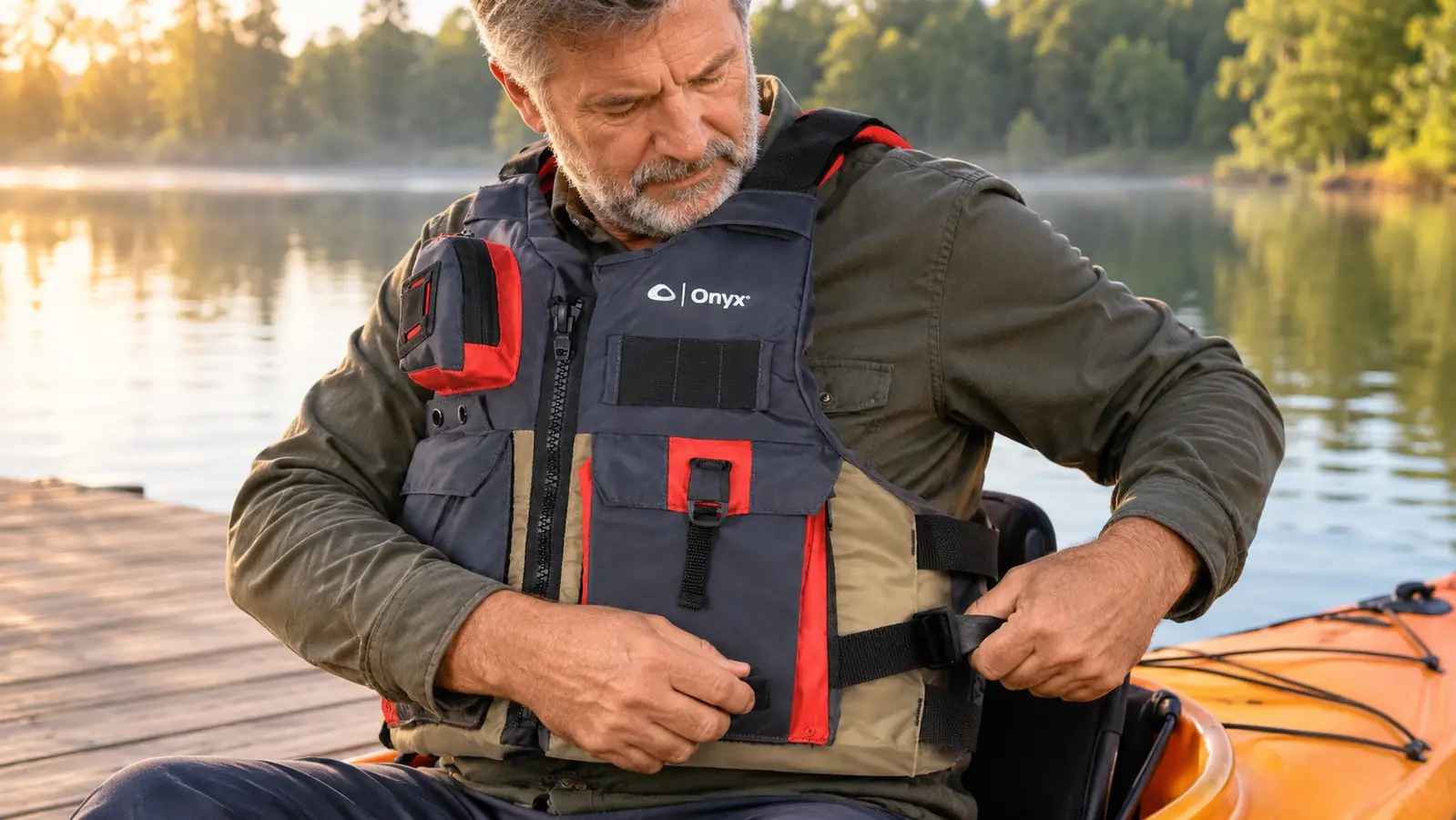
The Onyx kayak fishing life jacket is the one I use as my working example here, mostly because it was designed around the exact problems a sit-on-top angler runs into: a seat back that pushes a vest forward, pockets you cannot reach once your knees are up, and a cut that turns a ten-minute paddle into a ten-minute adjustment session. I am not going to tell you the Onyx is the only vest worth owning. I am going to walk you through what I check now, in the order I check it, and let you apply it to whatever is on the rack in front of you.
Stop fighting your vest on the water
The Onyx kayak fishing life jacket is cut high in the back so it sits with a kayak seat instead of against it. Adjustable straps, zippered pockets, and a 1.4-pound build. If your current vest spends more time around your ears than on your shoulders, start here.
Amazon Check Today's Price on Amazon →Five Checks, In the Order I Do Them
Step 1: Read the Label and Pick Your Real Size
Turn the vest over and find the label sewn inside the back. It tells you that the vest is a Coast Guard approved personal flotation device and what chest range and weight it was built to cover. Read that label in the store, standing under the fluorescent lights, not in your driveway at six in the morning when you are already late for the ramp. I have watched a grown man paddle out in a vest two sizes off because he grabbed the one on top of the pile. It stayed on him. It would not have done him much good if he had gone in.
Sizing is where most people get it wrong, and it is not their fault. A life jacket should be snug enough that it does not move independently of your body. The Onyx is listed in a size called oversize, which sounds generous and can be a trap if you are narrow through the shoulders. Try it on over the layers you actually paddle in. For me that means a long-sleeve sun shirt in July and a fleece pullover in April, and the vest fits differently in both. A vest that fits over a t-shirt and pinches over a fleece is a vest you will stop wearing in April.
Here is the test I use. Zip it, buckle it, then have somebody stand behind you and lift up on the shoulders of the vest. If it slides up past your chin, it is too loose, no matter what the tag says. Then raise your arms straight over your head. If the vest climbs up around your ears, it will do the same thing every time you take a paddle stroke, and you will be fighting it all morning.
Step 2: Match the Back of the Vest to the Back of Your Seat
A sit-on-top kayak has a seat with a back, and that back is the enemy of most life jackets. The foam in a standard vest runs from your shoulders to your waist, and when you lean against the seat the foam has nowhere to go but up. By the second hour the vest is under your chin and you are paddle-stroking with your shoulders around your ears.
The fix is a high-back cut. The Onyx is built that way, with the foam stopping higher up and a mesh panel across the lower back and shoulders. That mesh is not decoration. It is the difference between a vest that sits against the seat and a vest that gets pushed up by it. Sit in your own kayak in the driveway before you commit to anything. Five minutes of leaning back in the actual seat will tell you more than any product photo on a screen.
Shoulder room matters too. The Onyx uses neoprene padding at the shoulders, which sounds like a small detail until you have taken three hundred strokes in a vest with stiff webbing cutting across the top of your arm. My shoulders ache after a long paddle as it is. I do not need a vest helping them along.
Step 3: Put the Pockets Where Your Hands Already Go
Pockets sound like a nice extra until you try to use one while seated in a kayak with your knees up. Anything on the front of the vest below chest height is effectively in another county once you are in fishing position. Look at where the pockets sit and whether you can reach them with your elbows tucked in at your sides, because that is how you will be sitting when you want them.
The Onyx has multiple pockets and tool holders, including zippered pockets and D-ring attachments. I keep a line clipper on a short leash on a D-ring, a lip gripper in one pocket, and a sunscreen stick in the other. In April the fleece lining in those pockets is the reason I can still feel my fingers after an hour on the water. Small thing. Big deal on a cold morning.
One warning. A vest loaded down with pliers, a phone, and half a tackle box is a vest that fits differently than it did in the store. Keep the heavy items off the vest or you will spend the day re-adjusting straps that were fine when you left the ramp. Check anything hard against your back before you lean into the seat, too. A pair of pliers under your shoulder blade will ruin a good morning faster than a cold front.
Step 4: Set the Straps Sitting Down, Then Test Them Standing Up
Set the straps while you are sitting down, in the kayak, with the vest zipped. The Onyx closes with a zipper and buckles, and the order matters. Zip first, then snug the adjustable straps, starting at the waist and working your way up. If you set them standing in the driveway and then sit down in the boat, everything shifts and you start the day already out of adjustment.
Then test the range of motion you actually use. Take twenty imaginary paddle strokes. Lean forward like you are reaching for a fish at the side of the boat. Twist to look behind you, which you will do every single time you hear a boat motor. If the vest digs into your neck or rides up during any of that, loosen one strap and try again. Most discomfort in a life jacket is a strap problem, not a vest problem, and it takes about ninety seconds to fix.
The last test is the one nobody wants to do. On a warm day, at the ramp at Herrington Lake, wade out to waist deep and let the vest float you. Then try to get back in the kayak. The Onyx weighs 1.4 pounds, so it is not going to fight you, but you still want to know what your body does when the water is cold and your hands are shaking. My husband Earl stood on the dock and watched me do it the first time. He said it looked like a turtle trying to climb a log. He was not wrong, and I was still glad I had practiced.
Step 5: Decide What You Will Trade for Comfort
Every vest is a set of tradeoffs, and the Onyx has its own. The outer shell is 400 denier nylon, which is tough enough to survive being dragged across the bed of a pickup and snagged on rod holders. It also holds water longer than a mesh vest does. On a humid Kentucky afternoon in August, that vest is going to be damp when you take it off, and it will not dry overnight in a closed garage. Hang it, do not wad it up in the hull.
It also carries a one year manufacturer warranty, which is a normal length for this kind of gear and worth knowing before you buy. If a buckle fails in the first season, that is a warranty conversation. If it fails in year three, it is a shopping conversation. Buy from somewhere with a return policy you trust, because fit is the one thing nobody can guess for you.
What it is not is an inflatable. A belt pack is cooler and less bulky, and some anglers swear by them. They also require you to maintain them, and they do nothing for you until they deploy. I want the flotation on my body, not in a pouch, and I want it working the second I hit the water without me doing anything about it. If you are weighing those two paths against each other, that is a fair comparison and a different argument.
What Else Helps
The vest is the center of the system, not the whole system. A paddle leash means you are not swimming after your paddle. A dry bag with a change of clothes lives in the hull of my kayak from April through October. I carry water even on cool mornings, because the sun on open water is stronger than it feels from the bank, and I have come home dehydrated more than once learning that lesson.
Tell somebody where you are going and when you expect to be back. Earl and I have a standing rule about it, and it has never once been inconvenient. If you paddle with a dog, get the dog a vest too. Biscuit rides along on calm days and wears one, and he is not thrilled about it, but he is also not built for swimming forty yards in open water.
And practice the boring stuff. Getting back in the boat. Kicking with the current instead of against it. Floating on your back and letting the vest do the work so you can catch your breath. None of it is fun. All of it is the reason a bad ten minutes stays a bad ten minutes instead of turning into something worse.
A vest that rides up around your ears is not safety equipment you will keep wearing. It is something you peel off at the first sandbar and leave in the truck.
The vest I keep in the truck, not on the sandbar
High-back cut that works with a kayak seat, adjustable straps, zippered pockets and tool holders, 1.4 pounds, one year manufacturer warranty. If you fish from a sit-on-top, this one was built with you in mind.
Amazon Check Today's Price on Amazon →